Showing posts with label Bubbles. Show all posts

Tuesday, May 22, 2012

Hoare's Bank, a Family Business Since 1672

This article in Barron's Penta features what must be one of the world's oldest family-owned banks, C. Hoare & Co.
…the tiny bank is still 100% owned and run by the Hoare family, with the 11th generation of family managers consisting of seven Hoare cousins sitting on the partners' board, each "enjoying" unlimited personal liability, which means they are personally on the hook, right down to their cufflinks. Samuel Pepys, Jane Austen, and Lord Byron once kept their guineas at the bank; in more recent decades, it's been the likes of Agatha Christie and, according to the British media, the current Chancellor of the Exchequer, George Osborne.
Online, Hoare & Co. just published Through the Years, Tales from the Hoare's Bank Archive. Fascinating! A letter written by a women who saw the Statue of Liberty in Paris … the probate inventory of an Elizabethan gentleman's estate … an 1800 income-tax return. And this stock certificate from the time of the South Sea Bubble. (Please, no wisecracks relating to Facebook's IPO!)

Thursday, March 19, 2009

Popular Delusions and Perpetual Madness

This morning visited the Gutenberg Project to seek out the truest book about people and money ever written, Charles Mackay's "Popular Delusions and the Madness of Crowds." The Project is trying out a new format, EPUB. The beta version seems to work pretty well with Adobe Digital Editions, though copying text is iffy. "Popular Delusions" is said to remind us that human nature and human greed never change. That's not necessarily so. Investor foolishness may actually be on the increase. Consider the following, from Mackay's description of all the little stock bubbles that popped up in London's Exchange Alley at the time of the South Sea Bubble:
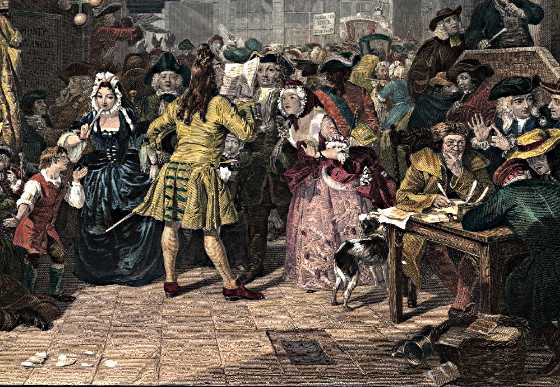
But the most absurd and preposterous of all, and which showed, more completely than any other, the utter madness of the people, was one, started by an unknown adventurer, entitled "company for carrying on an undertaking of great advantage, but nobody to know what it is." Were not the fact stated by scores of credible witnesses, it would be impossible to believe that any person could have been duped by such a project. The man of genius who essayed this bold and successful inroad upon public credulity, merely stated in his prospectus that the required capital was half a million, in five thousand shares of 100 pounds each, deposit 2 pounds per share. Each subscriber, paying his deposit, would be entitled to 100 pounds per annum per share. How this immense profit was to be obtained, he did not condescend to inform them at that time, but promised, that in a month full particulars should be duly announced, and a call made for the remaining 98 pounds of the subscription. Next morning, at nine o'clock, this great man opened an office in Cornhill. Crowds of people beset his door, and when he shut up at three o'clock, he found that no less than one thousand shares had been subscribed for, and the deposits paid. He was thus, in five hours, the winner of 2,000 pounds. He was philosopher enough to be contented with his venture, and set off the same evening for the Continent. He was never heard of again.
Writing in 1841, Mackay assumed his readers would recognize that investing in "blind pools," as such ventures came to be known on Wall Street, was the height of folly. Today? Blind pools known as hedge funds attract presumably sophisticated investors, pension funds and endowments. In recent years they sold particularly well as Madoff funds. "In the present state of civilization," Mackay wrote, "society has often shown itself very prone to run a career of folly…. Melancholy as all these delusions were in their ultimate results, their history is most amusing." Excuse us if we don't laugh, Mr. Mackay. We're too deep in melancholy.

Saturday, October 11, 2008

Sex, Bulls and Naked Shorts

In Swept Up by Insanity of Markets, Joe Nocera surveys students of financial behavior. They pretty much agree that the markets are governed not by science, nor even art, but by emotion.

James Grant puts it this way:
People keep on stepping on the same rakes because money, like romance, is only partly an intellectual experience. Money, like sex, brings out some thought — but also much heavy breathing and little stored knowledge. In finance, the process is cyclical. Some people learn from their ancestors, but mostly they repeat the same mistakes. Thus it has always been and thus it will always be.

Sunday, July 20, 2008

When Investors Throw Caution to the Winds

From Object Lesson in the Yale Alumni Magazine:
A financial bubble bursts, and stock markets around the world are in free fall. Investor exuberance, greed, and folly are widely blamed. How could we all have been so foolish?

The year is not 2000, but 1720. Soaring prices for newly issued stock shares in France, England, and Holland had made speculators of everyone. The streets in Paris, London, and Amsterdam had buzzed with rumors of the Mississippi Company, the South Sea Company, and other unusual new financial firms set up to issue paper money, fund government debts, and write insurance. Spiraling asset prices made heroes of financial engineers. John Law, a former gambler turned French finance minister, quickly became the world's richest man. But when stock prices plunged Law fled the country, taking with him only what he could carry.

John Law is the culprit in the cartoon shown here, drawn by an anonymous contemporary and printed in an extraordinary volume called Het Groote Tafereel der Dwaasheid (often translated as The Great Mirror of Folly). The crash of 1720 was quickly memorialized by artists and writers. By the end of the year, Het Groote Tafereel appeared in Dutch bookshops -- an anonymous multimedia extravaganza, filled with dozens of allegorical prints, plays, and poems about the crash, as well as financial documents about the Dutch Provinces' own bubble companies.

For more on wild and crazy investors and their bubbles, see this Baker Library presentation.

Monday, July 07, 2008

Oil Bubble?

Investors, including pension funds and Wall Street speculators, have sharply increased their commodity allocations since 2003, from $13 billion to $260 billion, The Washington Post reports.

"The increase in commodity prices has been so sharp that some pension managers are worried about a possible crash…. 'It's hard to know which commodities are in a bubble and which aren't,' said Bob Schultze, director of the Virginia Retirement System."

Tuesday, May 23, 2006

An instructive guide to stock market bubbles

The Baker Library of the Harvard Business School offers a resource-rich web site, as I discovered when The Wall Street Journal announced that historical examples from its "Pepper...and Salt" cartoons were on view.

The Baker Library's other offerings include an extensive online exhibit relating to stock market bubbles, illustrating that The South Sea Bubble and the Dot Com Bubble were sisters under the skin. Here's a sample from the exhibit, showing early 18th-century stock jobbers, as traders then were known. (Yes, women of the day pawned their pearls and rushed to buy stocks!)