Showing posts with label corporate fiduciaries. Show all posts

Thursday, December 13, 2018

Guardian Columnist Disses Northern Ad

Today's admeisters stress pinpoint accuracy: Deliver your sales pitch for gold-plated garlic presses only to people who think gold-plated garlic presses are totally cool.

Aspirational advertising spreads a wider net. Generations have learned what to buy when they get rich by leafing through the pages of The New Yorker. (You're unlikely to purchase a Rolex or a Bentley someday if you've never heard of them.)

If Thomas Ricks had recognized the value of aspirational advertising, his Guardian column might have been less grumpy. Northern Trust's "Greater" message draws particular ire:
[T}he full page ad that set me off on this tear came on page 10, when a relatively young man – his bearded thirty-ish face illuminated as he stares off to the side – is shown behind the capitalized headline “GREATER IS ELEVATING THE FAMILY NAME INTO AN ICON.” The text below, from a trust company, explains that, OK, you have your “business ownership and personal wealth”, but now you have to move up to the next step, “build something that lasts”. Not only is being comfortable no longer the goal, being wealthy is no longer enough.
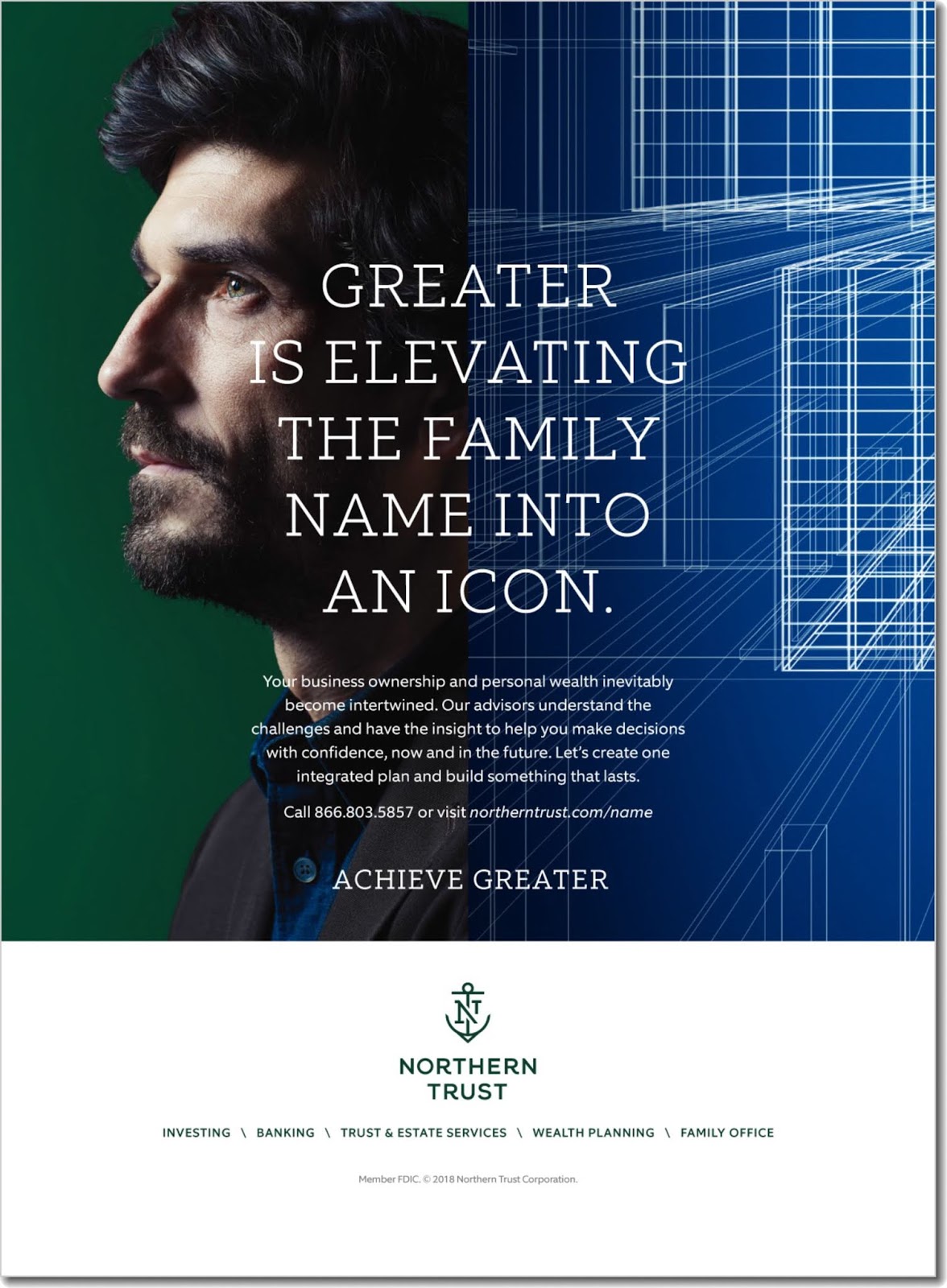
Admittedly, Northern's message encourages greed and egotism:
"How do you feel now that you're taking $50 million out of the company?"  
"I feel great." 
"So why are you moping around like a dog who lost his bone?"
"I want to feel greater."
But greed, Michael Douglas reminded us in "Wall Street," is good. And although audiences were supposed to scorn that sentiment, the film reportedly inspired a good number of young people to seek a Wall Street career.

Wednesday, March 28, 2018

Name a Corporate Trustee – But How Big?

The New York Times' latest Wealth Section includes a welcome column on living trusts (if you ignore the sidebar claiming that revocable trusts must file annual tax returns) as well as a plug for naming a corporate trustee in order to avoid family dissension.

The plug comes with a caution from attorney William D. Zabel: Don't name a local bank.

Why does Zabel think trustors should go big bank? He feels hometown banks, attorneys and accountants are tempted to favor some family members over others. The Times offers as example a situation where an out-of-state son-in-law and his wife have spent years battling "the locals" and her hometown siblings.

Small town trust departments aren't always ideal, but the services of megabanks also have bitter critics. On balance, isn't a capable hometown bank a reasonable choice for nonbillionaires?

Sunday, September 13, 2015

Best Wealth Management Commercial, U.S. Open

Before Federer and Djokovic finish their match, let's declare BNY/Mellon the clear winner for "Best Wealth Management Commercial" during ESPN's TV coverage of the US Open tennis.

BNY/Mellon's "Perlman" reinforces the theme of its print ads: unlike most banks, we actually manage our clients' investments. In the commercial, the violin soloist at a Perlman performance turns out to be the ungifted Rhea, not Itzhak. 

For years and years, we heard that banks were dweebs who ought to outsource the job of choosing investments. The outsources, of course, were no better than the banks. It's fun to see BNY/Mellon strike back.

Wednesday, September 10, 2014

It's Not Easy Being Fiduciary

The NY Times reports on the plight of two Deutsche Bank private bankers who were forced out because they balked at pushing DB products – notably, a fund of funds. (Funds of funds answer the perceived demand for investment products that carry even higher annual expenses than regular hedge funds.)

According to this petition to the Supreme Court of the State of New York – we don't have DB's side of the story – the two found "staying fiduciary" was a losing battle.

As big banks try to grow bigger, sales tends to overwhelm service. One result: a marketing opportunity for smaller, fiduciary-minded institutions. 

Thursday, March 27, 2014

Can You Spot a Trust Company?

As they liked to say back in the age of print, you can't judge a book by its cover.

Optima Bank and Trust, despite its name, offers no trustee or investment services.

Glenmede, despite its ad logo, is of course a trust company.

Takeaway: Use "trust" in your name if you wish your personal banking services to sound upscale. Eschew "trust" if you want to be seen as a forward-looking wealth manager.

Hey, we don't make the marketing rules. We just report them.

Sunday, December 29, 2013

The Street of Trust Companies

Once upon a time, the trust companies you passed on the street were monumental edifices, faced with granite and marble. By contrast, the trust companies on this street are little more than mail drops.


South Phillips Avenue, Sioux Falls, South Dakota
What do you suppose they'll be saying about the recent rash of Forever Trusts a century from now?

Monday, December 09, 2013

A Classic Investment Ad From 1935

Don't try to make investing your second career, turn your portfolio over to the pros. That's the message Fiduciary Trust delivered in this 1935 ad.

That's the message we were still recycling for Merrill Anderson clients many decades later. Not until digital data-crunching revealed that the average investment pro produced only average results did we have to fall back on "asset allocation."

By 1935 it must have seemed safe to advertise again. After  the market disaster of 1929-32, the DJIA recovered nicely in 1933, remained fairly stable in '34, and soared almost 40% in 1935. Alas, a new, er, "recession" sent the Dow plunging almost 33% in 1937.

 Do you suppose Fiduciary was still running ads in 1938?

Wednesday, July 31, 2013

The Trust Industry’s Trillions

Some say the trust industry isn't what it used to be. (Ask an ancient trust officer about the days when the American Bankers Association had a whole division devoted to trust services.) Yet the need for fiduciary organizations has never been greater. From distracted young scholars to high-tech philanthropists to elderly invalids, millions of Americans need investment service and financial guidance they can rely upon. Also, as noted here recently, businesses need a trustworthy, relatively economical source of retirement-plan administration.

If we didn't have a trust industry, we'd have to invent one.

Happily, the industry hasn't exactly withered away. At last count trust institutions administered $2.2 trillion.

Tuesday, May 28, 2013

Wealth Mismanagement in Texas?

Not long after Invesco announced the sale of Atlantic Trust Wealth Management to CIBC, the head of  Atlantic Trust's Austin, Texas, office was found dead.

Now, The Wall Street Journal reports, "investors have come forward to say they lent him in total millions of dollars, according to people familiar with the matter. At least some of that money appears to have gone missing, the people said."

Thursday, May 23, 2013

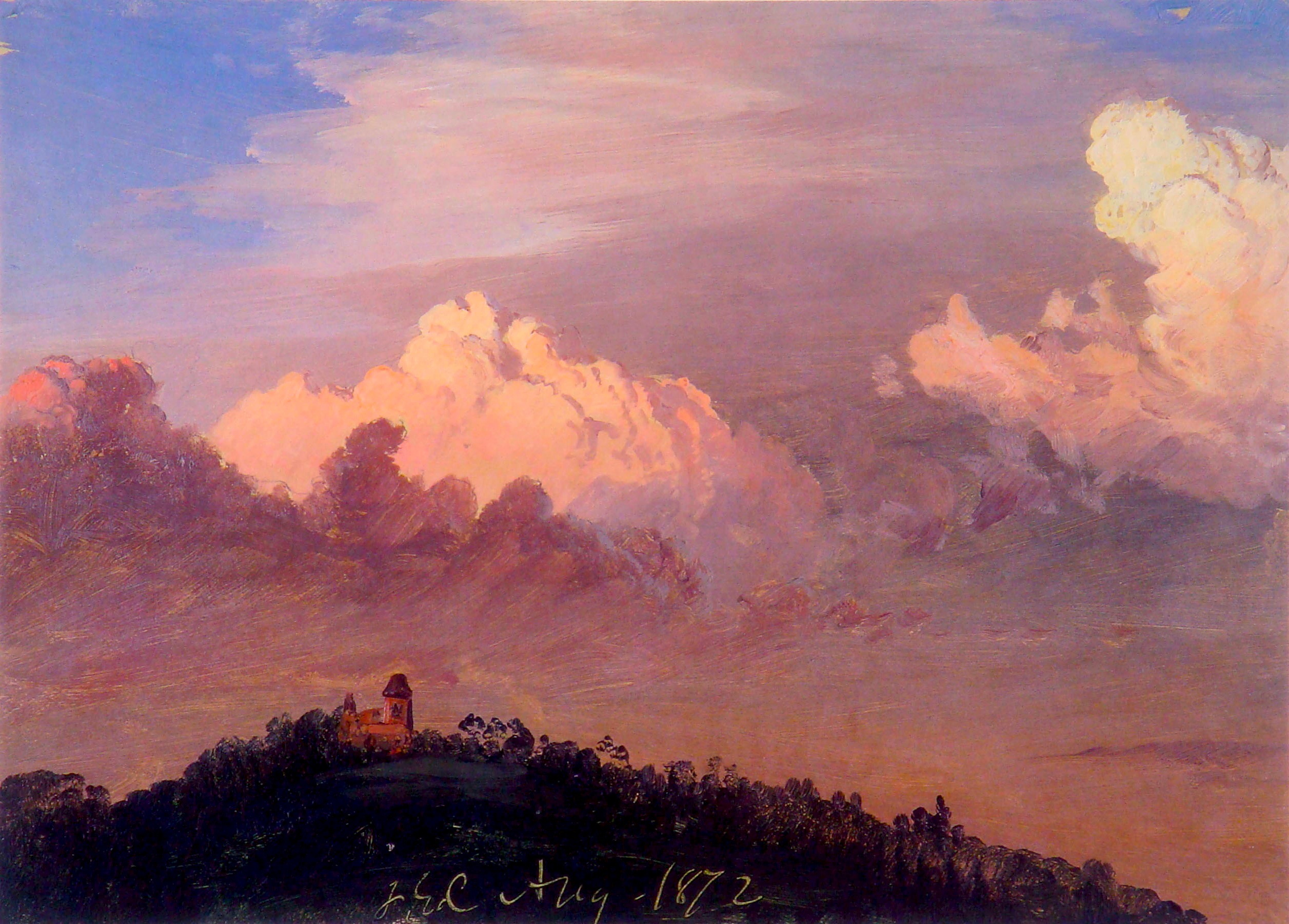
The Trust Company That Saved Olana

When Don Draper, Roger Sterling and the other Mad Men leafed through the April 27, 1968 issue of The New Yorker, surely they stopped at this lavish two-page spread from Bankers Trust.


The trust company had held Olana, home of famed artist Frederick Church, in an estate long enough for preservationists to save it. The self-congratulatory copy was possibly overdone. Just imagine the news items had the decision gone the other way:

"Only months before preservationists could raise money to save Frederick Church's Persian-styled home on the Hudson, Bankers Trust ordered the contents sold and the mansion razed." Would have been bad PR, to say the least.

Today Olana survives but Bankers Trust does not. After misadventures with derivatives, the trust company was acquired by Deutsche Bank in 1998.

Clouds over Olana, by Frederic Edwin Church, 1872

Saturday, May 18, 2013

The 3% Solution – a Tough Sell

In his weekly Wealth Matters column, Paul Sullivan looks at Evercore Wealth Management. Founded by escapees from US Trust after Bank of America swallowed the nation's oldest trust company, Evercore asks the wealthy to focus on net investment results. That is, net returns after fees, taxes and inflation.

Admirable idea, but a tough sell. Even Sullivan has his doubts:
[W]hat I would have liked to see was a pre-fee return along with the returns before taxes and inflation.
Evercore's web site is cleaner than most. Also worth emulating, their uncluttered, plain-spoken newsletter.

Thursday, October 11, 2012

A “Grossly Negligent and Reckless” Trustee

Jamie Dimon did not enjoy today's New York Times.

On the front page JPMorgan's CEO was greeted with a story on emerging criminal prosecutions, focused on traders associated with Morgan's infamous London Whale and his $6-billion trading loss.

The business section was just as depressing: JPMorgan Told to Pay $18 Million to a Trust.

The trust case concerns an oil heiress with lots of Exxon Mobil stock and the trustee's use of a complex investment product, designed to cash in on appreciated shares without triggering tax on capital gain.
Judge Linda G. Morrissey of the Tulsa County District Court in Oklahoma said that the bank had breached a series of fiduciary duties in its handling of the trust of Carolyn S. Burford, an oil heiress who died in 1996. The court also ordered JPMorgan to pay punitive damages, to be set at a later date, along with the trust’s legal fees.
Judge Morrissey concluded that JPMorgan had breached its fiduciary duty in 2000 when it sold what are known as variable prepaid forward contracts to the trust, a complex fee-rich product that the judge determined was unsuitable for the trust.
* * *
The judge found that JPMorgan, which ended up with the account after a series of bank mergers, had not properly explained the product to its client and had failed to disclose that the bank was benefiting from the transaction. The bank also breached its duty when it invested the proceeds of the contracts in its own investment products, which the judge said “amounted to double dipping” that was unreasonable.

Jamie Dimon is widely admired in the financial world, and rightly so. Yet he has to be wondering whether it's possible to build a financial institution that's too big to fail without creating one that's too big to manage.

Tuesday, September 25, 2012

Private Banks For Name Droppers

Exclusivity. Social status. Along with quality and "overall client experience," those are the criteria Luxury Institute uses to rank the year's top private bank brands. This year's winner, determined by a survey of investors with at least $5 million: Brown Brothers Harriman, followed by Boston Private Bank. Neuberger Berman Private Asset Management and Bessemer Trust.

A year ago different names possessed the snob appeal: Atlantic Trust, Glen Mede Trust and Rockefeller Wealth Management.

(When I was very young, my father used to stop by the Rockefeller office to drop off a bookbinding job or pick up a check. The notion that a family had an office impressed me immensely. In those days the place must have been truly exclusive  – you probably had to marry into it.)

These days, the exclusivity of Rockefeller, Bessemer and other former family offices resides in the eye of the  beholder. Marketingwise, a little snob appeal probably can't hurt. Or could perceived exclusivity impede growth?

Despite their prestige, fiduciary-style wealth managers aren't exactly cornering the high-net-worth market."Morgan Stanley, Merrill Lynch and Wells Fargo are the top three primary wealth managers to the wealthy," Luxury Institute noted last year. More than one third of the multimillionaires surveyed said a full-service broker was their primary adviser.

Wednesday, August 15, 2012

When the Going Gets Tough, Investors Need Fiduciaries


Two icons of the investment world have looked ahead, and what they see isn't pretty.

Bill Gross, the bond king, says the cult of equities is dying. Jeremy Siegel and others point out that Gross confuses stock appreciation with stock returns. Even so, Gross makes his case: subpar returns appear likely for several years.

John Bogle, the Vanguard founder, terms this the worst time for investors he's ever seen. The outlook for stocks is poor, and “the outlook for bonds over the next decade is really terrible.”


That's not even the bad news. In Bogle's view, the whole financial-services system is broken. “A culture of short-term speculation has run rampant,” he writes in his latest book, “superseding the culture of long-term investment that was dominant earlier in the post-World War II era.”

Bogle's proposed remedies, as summarized by The New York Times:

He advocates taxes to discourage short-term speculation. He wants limits on leverage, transparency for financial derivatives, stricter punishments for financial crimes and, perhaps most urgently, a unified fiduciary standard for all money managers: “A fiduciary standard means, basically, put the interests of the client first. No excuses. Period.”

Agreed. In a perfect world all investors, even "the little guy," would receive the same kind of unbiased guidance offered by the best corporate trustees and advisory firms.

In the real world, it's a tall order.

A clipping from "The Clash of Cultures"

Thursday, July 26, 2012

What's Past Is . . . Prologue?

Enough of the Mad Men era. Let's move on to the advertising archives of 1982.
You know about the Great Bull Market that began thirty years ago. 1982, what a great time to invest!

Now turn your Hindsight Device  to "Off."

in 1982 the stock market had been declared dead and a recession had begun. To survive hard times, U.S. Trust expanded its banking operations. The strategy may have helped in the short run, but the future belonged to megabanks. Even The Bank of New York, a moderately-sized commercial bank founded by Alexander Hamilton, ended up merging with Mellon Bank. U.S. Trust became a wealth-management arm of Bank of America.

The greatest megabank was created by Sandy Weill. In 1998 Weill merged Travellers, which owned Salomon Smith Barney, with Citibank to form Citigroup. At that time Citigroup ranked as the largest financial services company in the world.

Citigroup barely survived the Great Recession. Now retired, Sandy Weill astonished the financial world this week by admitting megabanks were a mistake. We probably ought to bring back the Glass-Steagall era, Weill told CNBC, once again separating investment banks from commercial banks that hold federally-insured deposits. Wow!

Monday, April 09, 2012

These Trust Officers Are The Cat's Meow

Georgia Lee Dvorak died last December,. Her will instructs her executor to put to death any of her cats who survive her. Bad news for Boots, who did.

Happily, the executor is a bank, The trust officers "got a Cook County probate court to set aside that part of the 1988 document because they found a shelter to take the 11-year-old cat."


Fifth Third has got to be one of the best-named banks in the country. Not surprising that it has cool trust officers.

Beware of Dark Pools

Investors need the kind of help a fiduciary provides because it's a jungle out there. The Wall Street Journal (subscription) examines the hazards created by high-frequency traders who lurk in Dark Pools. 
Less than half of securities now trade on exchanges with readily available price information, market analysts say. Many investors remain unaware of the strategies technologically savvy firms use to gain a trading edge, and even large investment firms often can have little assurance someone isn't gaming their orders.

Wednesday, January 25, 2012

Ameriprise, an Eager Trustee

Ameriprise wants new trust business. And existing trust business, too. "If you have an existing trust," says this Ameriprise video, "consider the advantages of moving it to Ameriprise Financial."

Should other banks and trust companies be doing more to generate successor-trustee business?

Monday, September 12, 2011

Mitt Romney's Parable of The Faithless Fiduciary

Marc Thiessen in The Washington Post:
Heated exchanges notwithstanding, the fact is that Romney and Perry both agree that Social Security is being run as a criminal enterprise. In his book, “No Apology,” Romney writes: “Suppose two grandparents created a trust fund, appointed a bank as trustee, and instructed the bank to invest the proceeds of the trust fund so as to provide for their grandchildren’s education.” (Yes, he really chose a “trust fund” as an example.) “Suppose further that the bank used the proceeds for its own purposes, so that when the grandchildren turned eighteen, there was no money for them to go to college. What would happen to the bankers responsible for misusing the money? They would go to jail.

Wednesday, July 13, 2011

In Praise of the Corporate Executor

From Canada's Financial Post: Choosing an executor is more than an honour.
Corporate executors can help the family cope with complex decisions and details reducing the potential for conflict. They could help reduce the liability that an executor may face for wrong decision, and provide access to a dedicated team of professionals for the efficient settlement of the estate, maximizing value for the beneficiaries – which in the end, is what you want most, isn’t it?