Showing posts with label numeracy. Show all posts

Tuesday, July 26, 2016

Financial Literacy 101

Young Americans typically lack numeracy and come up short on financial literacy. Parental advice gets no respect. Could the answer be third-party guidance?

A math major we know recently took a new personal finance class offered by her college. She rated it Excellent and passed along slides outlining the course.

It covers about what you would expect, with added emphasis on on topics – education loans, subsidized health insurance – of special concern to new grads. Students are introduced to basic accounting (income statement, balance sheet, net worth), banking, retirement plans, credit cards (use as charge cards only), taxes, insurance and goal setting.

Because most new grads will start out poor and in debt, the course encourages inconspicuous consumption, as advocated by Mr. Money Moustache and – new to me – the Frugalwoods.

Investing receives substantial coverage. Students are encouraged to keep it cheap and simple:  Avoid brokers. Buy mutual funds, not stocks. Buy no-load funds, preferably index funds, from the fund company. Choose funds with an expense ratio of no more than .35%.

As investors, most new grads will have little to work with. The course encourages them to look on the bright side:

"If you were to take only one thing away from this class it would be to understand the time value of money.
 
"Compound interest is a very powerful concept. It is the single greatest advantage that young people have over old people."

Friday, May 09, 2014

Mark Zuckerberg: a Billion Here, a Billion There…

Last year, CNBC's Robert Frank reports, Mark Zuckerberg paid an estimated $1 billion in taxes.

Photo: Wikimedia Commons
Facebook's CEO also made last year's biggest charitable donation, giving the Silicon Valley Community Foundation shares worth about $1 billion.

If $1 billion is starting to sound like a routine sum, remember the John Allen Paulos comparison:

A million seconds is less than twelve days.

A billion seconds is almost thirty-two years.

Monday, February 09, 2009

“$1 Trillion” Revisited

Via The Numbers Guy at The Wall Street Journal comes this quote from Senator Mitch McConnell:

“if you started the day Jesus Christ was born and spent $1 million every day since then, you still wouldn’t have spent $1 trillion.”

Tuesday, February 03, 2009

How to Tell a Trillion From a Billion

That thought exercise suggested by John Allen Paulos keeps running through my head. How long does it take a million seconds to pass by? Less than 12 days. A billion seconds? Almost 32 years.

Even larger quantities of seconds really boggle the mind. Take 50 billion, the notional total of the dollars lost in Madoff's self-confessed Ponzi scheme.

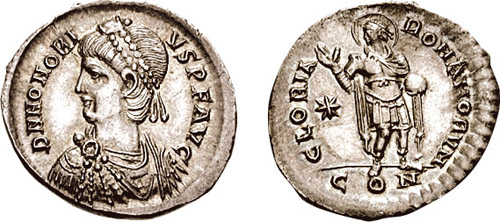
How long is 50 billion seconds? About 1,585.5 years. Backtrack though that much human history and you're in 423, the year Roman Emporer Honorius died. Honorius was the first to reign over only the Western Roman Empire, and that was disintergrating fast. The Visigoths sacked Rome in 410.

Honorius depicted on a silver coin

Now consider one trillion seconds. (The stimulus package is around $900 billion and counting, so consider we must.) If one billion seconds amount to 31.7 years, one trillion amount to 31.7 millennia. Go back 31,700 years and you find yourself in the Stone Age. You're probably a few centuries too late to meet an actual Neanderthal. So head for what is now the south of France and ask an early Homo Sapiens about local art exhibits. With luck, he'll direct you to the Chauvet Cave, containing remarkable drawings of horses and other animals. This scene shows lions hunting bison.

Chauvet Cave: Lions Hunting

Wonder what would have happened if the Neanderthals had remained in the World Survival League. They appeared to have sizable brains. Would they have steered clear of synthetic CDOs?

Tuesday, January 27, 2009

How to Tell a Billion From a Million

John Lanchester, in his review of "Lords of Finance" in The New Yorker:
Try the following thought experiment, suggested by the mathematician John Allen Paulos, in his book “Innumeracy”: Without doing the calculation, guess how long a million seconds is. Now try to guess the same for a billion seconds. Ready? A million seconds is less than twelve days; a billion is almost thirty-two years.