Goodbye, Spry Codgers. So Long, Feisty Crones says the New Old Age Blog at NYTimes.com. The allowable vocabulary for referring to the oldest Americans has shrunk considerably. Insults such as "codger" or "crone" were never politically correct, of course. But now, according to the International Longevity Center, we should no longer say "senior citizen" (because there are no "junior citizens") or "golden years."
Even the obviously harmless word "elderly" is now off limits. You can use the word for groups ("a home for the elderly" is ok, if barely) but not for individuals ("an elderly woman" is now per se demeaning).
Who makes these rules?
Whose feelings are we trying to spare? Why?
Wednesday, February 11, 2009


Tuesday, February 10, 2009
Cloud on the homebuyer's tax credit
Tax Analysts ($) is reporting that the $15,000 tax credit for home buyers included in the stimulus package is in jeopardy. The tax "cost" was originally projected at $18.5 billion, but upon closer examination it has been rescored at $35 billion. No word on what new assumptions led to the revision (end of the recession, perhaps?).
$35 billion is just too darn much for American homeowners to be granted, so some sort of restrictions will be required to "lower the cost." We could also lower the cost by going back to the original assumptions, but that doesn't fit someone's agenda.
Not that I'm expecting to make use of the credit, or even know anyone who is. But I've heard, and I'd like a source on this, that for $800 billion we could actually pay off completely some 95% of all the home mortgages in America. Why isn't that the right way to go?
$35 billion is just too darn much for American homeowners to be granted, so some sort of restrictions will be required to "lower the cost." We could also lower the cost by going back to the original assumptions, but that doesn't fit someone's agenda.
Not that I'm expecting to make use of the credit, or even know anyone who is. But I've heard, and I'd like a source on this, that for $800 billion we could actually pay off completely some 95% of all the home mortgages in America. Why isn't that the right way to go?
Trusts and Assault Weapons
 Odd Combination? Not really. On his Florida Estate Planning Lawyer Blog, David M. Goldman calls attention to the Assault Weapons Trust.
Photo via Wikimedia Commons
Charitable Lead Trusts Offer Bargain "Hurdle Rate"
Charitable lead trusts get a plug in The Wall Street Journal. See Giving Smarter While Helping Your Estate.

Monday, February 09, 2009
Why the Rich Avoid Eye Contact
Researchers at Berkeley find that the rich don't like eye contact. Why so snooty? Robert Frank in The Wealth Report offers a plausible explanation. The rich "always feel like targets."
So if you walk into a crowded room of wealthy people, most will avoid your gaze and look vacantly into the middle distance to avoid getting cornered by salesman, gold diggers, aspiring “friends” and other hangers on. ***
But if they know you, the wealthy can be just as locked in and engaged–perhaps more so–than the every day Joe. To me, it is more a function of familiarity than income.
“$1 Trillion” Revisited
Via The Numbers Guy at The Wall Street Journal comes this quote from Senator Mitch McConnell:
“if you started the day Jesus Christ was born and spent $1 million every day since then, you still wouldn’t have spent $1 trillion.”
“if you started the day Jesus Christ was born and spent $1 million every day since then, you still wouldn’t have spent $1 trillion.”
Optimist bias
The New York Times promises to explainWhy Analysts Keep Telling Investors to Buy but in fact only documents the fact that buy recommendations always outnumber sell suggestions, even as the market is collapsing. Some of their examples are usefully shocking.
The question not posed: With that rotten track record, why should anyone ever believe investment analysts again?
The question not posed: With that rotten track record, why should anyone ever believe investment analysts again?
Whither the Estate Tax?
Only believers in the Tooth Fairy expect the federal estate tax to vanish as scheduled next year. What will happen? Three theories circulate:
Stay the same. As noted with approval on Freakonomics, President Obama is thought to still favor continuing the tax at this year's level: 45% of everything over $3.5 million.
Lower exemption. Some (many?) estate planners have warned clients that a populist backlash against "the greedy rich" could spur Congress to lower the $3.5-million exemption.
Higher exemption. At the 3% withdrawal rate favored by Tiger 21 members and other cautious wealth holders, a $3.5 million inheritance would give an heir less than $115,000 a year to live on. Even twice that amount won't allow you to live rich these days. See You Try to Live on 500K .
Stay the same. As noted with approval on Freakonomics, President Obama is thought to still favor continuing the tax at this year's level: 45% of everything over $3.5 million.
Lower exemption. Some (many?) estate planners have warned clients that a populist backlash against "the greedy rich" could spur Congress to lower the $3.5-million exemption.
Higher exemption. At the 3% withdrawal rate favored by Tiger 21 members and other cautious wealth holders, a $3.5 million inheritance would give an heir less than $115,000 a year to live on. Even twice that amount won't allow you to live rich these days. See You Try to Live on 500K .
Saturday, February 07, 2009
Silver Lining for the Silver Spoon Set?
Paused to admire Hawthorn's web site the other day. Hawthorn, PNC's financial service center for the rich, even offers a reading list. Several of the recommended books deal with the wealth- management preoccupation of a few years ago: How could ultra-high-net-worth families and advisers arm heirs with the values and coping skills they would need to navigate "the dark side of wealth?"
How long ago that seems! The financial economy has collapsed, and the falling stock market has made off with much of the family wealth that Madoff himself did not.
Could that be a lucky break for heirs?
For the next decade of so, anyway, many heirs no longer face the trauma associated with "Too Rich For Their Own Good." Fate has demoted them to a healthier, happier category: "Rich Enough to Do Anything; Not Rich Enough to Do Nothing."
Maybe every cloud does have a silver lining.
management preoccupation of a few years ago: How could ultra-high-net-worth families and advisers arm heirs with the values and coping skills they would need to navigate "the dark side of wealth?"How long ago that seems! The financial economy has collapsed, and the falling stock market has made off with much of the family wealth that Madoff himself did not.
Could that be a lucky break for heirs?
For the next decade of so, anyway, many heirs no longer face the trauma associated with "Too Rich For Their Own Good." Fate has demoted them to a healthier, happier category: "Rich Enough to Do Anything; Not Rich Enough to Do Nothing."
Maybe every cloud does have a silver lining.
Friday, February 06, 2009
Tigers Singed, Slightly
 Michael W. Sonnenfeldt, founder of Tiger 21, also chairs an investment company, Muus. The Muss Independence Fund, a fund of funds, attracted investments from some Tiger 21 members, according to Robert Frank's Wealth Report. About 7% of the fund, which closed down last year, was invested with Madoff.
Apparently Tiger 21 members also invested with Madoff on their own. Sonnenfeldt tells Frank that none went whole hog.
Note the comments to the Wealth Report post. Cap Gemini seems to expect the world millionaire count for 2008 to be about the same as the previous year. Frank is understandably dubious.
Thursday, February 05, 2009
Real Bankers Still Exist!
 A sidebar in my American Banker email highlights the publication's 2008 Best in Banking, The report features BofA's Ken Lewis, named Banker of the Year last December. Must have seemed a good idea at the time. Since then Mr. Lewis and others have learned hard lessons.
Things are going better, we hope, for those selected community bankers of the year. I especially admired UMB CEO Mariner Kemper, the sixth member of the family to run that bank since a Kemper founded it almost a century ago. Mr. Kemper's banking strategy must have seemed strange to megabanks, but it appears to be working for UMB: "…lend to borrowers we have met … understand the loans we are making, and [don't] make them through intermediaries."
Marketing sidelight: Lately it's been fashionable to imagine banks as composed of sub-brands: AnyBank Credit Cards, AnyBank Mortgage, AnyBank Brokerage, Anybank Trust, etc. It becomes easy to imagine that a slip-up at one sub-brand matters not to the others. Wrong! In the public's mind, what happens in any part of the bank shapes the reputation of the whole.
That's true when there are slip-ups, and it's true when a bank gets good PR. If you were looking for a Midwest trust department, wouldn't you figure that UMB's is likely to invest prudently, just because its CEO is so prudent about lending?
P.S. Mr. Kemper is one example of a banker who probably deserves more than $500,000 a year!
Pay cap fallout
Apparently no one thought about what effect the salary cap would have on New York City and State tax revenue, according to wcbstv.com. It will not be good. The idea that the cap will drain away talent and slow the recovery from the recession for this firms is also floated in the article.
Charlie Foxtrot asks when the pay cap will apply to athletes, who perform in taxpayer-subsidized stadia? What about actors and actresses who are paid millions even when movies flop?
Charlie Foxtrot asks when the pay cap will apply to athletes, who perform in taxpayer-subsidized stadia? What about actors and actresses who are paid millions even when movies flop?
Wednesday, February 04, 2009
The devil is in the details
This is not unexpected: Obama Calls for ‘Common Sense’ on Executive Pay - NYTimes.com. However, I'm not certain that they've fully thought this through.
Earlier I thought that the $500k cap would apply to top executives only (top 5, I thought it was), but the Times is reporting that no one at Citibank or Bank of America can be paid more than $500,000 unless the excess is paid in restricted stock (query: would that be currently taxable?). Even guys (and gals) who have been working strictly on commission. In other words, all the most talented people have to start looking for other jobs unless they can take a pay cut, but the less talented won't have to sacrifice. To each, according to his needs.
This is the another manifestation of the Ward Three mentality that David Brooks wrote about yesterday. That was one of his best columns in months.
Not clear to me that this is a winning formula. My father worked with a Smith Barney broker, with whom he was well satisfied, but that guy has already jumped ship. He must have seen the handwriting on the wall.
Earlier I thought that the $500k cap would apply to top executives only (top 5, I thought it was), but the Times is reporting that no one at Citibank or Bank of America can be paid more than $500,000 unless the excess is paid in restricted stock (query: would that be currently taxable?). Even guys (and gals) who have been working strictly on commission. In other words, all the most talented people have to start looking for other jobs unless they can take a pay cut, but the less talented won't have to sacrifice. To each, according to his needs.
This is the another manifestation of the Ward Three mentality that David Brooks wrote about yesterday. That was one of his best columns in months.
Not clear to me that this is a winning formula. My father worked with a Smith Barney broker, with whom he was well satisfied, but that guy has already jumped ship. He must have seen the handwriting on the wall.
Taxes Never Add Up
In the preceding post, Jim Gust's suspicion of the $11 billion "tax cost" of the proposed new deductions for car buyers seemed justified. I tried a few extremely off-the-cuff calculations:
One thing for sure. To Jim Gust's charge of Congressional hypocrisy you can add an indictment for outrageous, ever-worsening complexity. Read Howard Gleckman's column at Tax Vox and weep:
Say 10 million cars are sold this year (we're fantasizing, O.K.?) at an average price of $25,000. Total sales: $250 billion.Any resemblance to reality in the above is strictly coincidental. Still, maybe the $11-billion estimate isn't as far off as we thought.
Of that, say $200 billion is financed at 8%. Total interest paid for year: $16 billion.
At an average income tax rate of 20%, $16 billion in interest deductions would cost the Treasury $3.2 billion.
Now suppose all 10 million cars are subject to sales tax averaging 8%. (8% of $250 billion = $20 billion.) At an average interest rate of 20%, $20 billion in sales-tax deductions would cost the Treasury another $4 billion.
$4 billion + $3.2 billion = $7.2 billion.
Suppose we raise the assumed average income-tax rate to 25%. That would bring the "tax cost" for 2009 alone to $9 billion.
One thing for sure. To Jim Gust's charge of Congressional hypocrisy you can add an indictment for outrageous, ever-worsening complexity. Read Howard Gleckman's column at Tax Vox and weep:
The University of Michigan’s Joel Slemrod, estimates that it costs individuals $85 billion-a-year in time and money to prepare their taxes. Businesses spend another $40 billion. This is nuts.
I don't think this adds up
The Senate has decided to make the interest on certain auto loans tax deductible—now that's a blast from the past! According to Tax Analysts ($) the provision would be coupled a new deduction for state sales or excise taxes on new car purchases. The write-up makes it clear that the interest deduction will be "above the line," but is silent on the sales tax treatment, which I think is much more important. The tax break applies to this year only (and for some reason reaches back to purchases after November 12, 2008.)
What really caught my eye was the "tax cost" of the provisions: $11 billion. That seems awfully high to me, given today's low interest rates. I'd love to see their methodology sometime.
I haven't blogged about H.R. 1, the American Recovery and Reinvestment Act of 2009, because the tax provisions are surprisingly weak. A huge percentage of the "tax cut" is just another one-year patch to the AMT. I wonder that someone doesn't call politicians out on the hypocrisy of declaring every year that maintaining the status quo for one more year is a $70 billion middle class tax cut.
What really caught my eye was the "tax cost" of the provisions: $11 billion. That seems awfully high to me, given today's low interest rates. I'd love to see their methodology sometime.
I haven't blogged about H.R. 1, the American Recovery and Reinvestment Act of 2009, because the tax provisions are surprisingly weak. A huge percentage of the "tax cut" is just another one-year patch to the AMT. I wonder that someone doesn't call politicians out on the hypocrisy of declaring every year that maintaining the status quo for one more year is a $70 billion middle class tax cut.
Tuesday, February 03, 2009
How to Tell a Trillion From a Billion
That thought exercise suggested by John Allen Paulos keeps running through my head. How long does it take a million seconds to pass by? Less than 12 days. A billion seconds? Almost 32 years.
Even larger quantities of seconds really boggle the mind. Take 50 billion, the notional total of the dollars lost in Madoff's self-confessed Ponzi scheme.
How long is 50 billion seconds? About 1,585.5 years. Backtrack though that much human history and you're in 423, the year Roman Emporer Honorius died. Honorius was the first to reign over only the Western Roman Empire, and that was disintergrating fast. The Visigoths sacked Rome in 410.

Now consider one trillion seconds. (The stimulus package is around $900 billion and counting, so consider we must.) If one billion seconds amount to 31.7 years, one trillion amount to 31.7 millennia. Go back 31,700 years and you find yourself in the Stone Age. You're probably a few centuries too late to meet an actual Neanderthal. So head for what is now the south of France and ask an early Homo Sapiens about local art exhibits. With luck, he'll direct you to the Chauvet Cave, containing remarkable drawings of horses and other animals. This scene shows lions hunting bison.

Wonder what would have happened if the Neanderthals had remained in the World Survival League. They appeared to have sizable brains. Would they have steered clear of synthetic CDOs?
Even larger quantities of seconds really boggle the mind. Take 50 billion, the notional total of the dollars lost in Madoff's self-confessed Ponzi scheme.
How long is 50 billion seconds? About 1,585.5 years. Backtrack though that much human history and you're in 423, the year Roman Emporer Honorius died. Honorius was the first to reign over only the Western Roman Empire, and that was disintergrating fast. The Visigoths sacked Rome in 410.
Honorius depicted on a silver coin
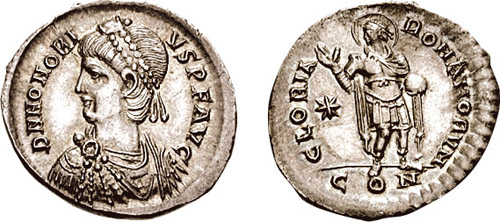
Now consider one trillion seconds. (The stimulus package is around $900 billion and counting, so consider we must.) If one billion seconds amount to 31.7 years, one trillion amount to 31.7 millennia. Go back 31,700 years and you find yourself in the Stone Age. You're probably a few centuries too late to meet an actual Neanderthal. So head for what is now the south of France and ask an early Homo Sapiens about local art exhibits. With luck, he'll direct you to the Chauvet Cave, containing remarkable drawings of horses and other animals. This scene shows lions hunting bison.
Chauvet Cave: Lions Hunting

Wonder what would have happened if the Neanderthals had remained in the World Survival League. They appeared to have sizable brains. Would they have steered clear of synthetic CDOs?
Monday, February 02, 2009
NFL Coaches “Too Conservative.” Investors, Too?
 Remember the Steelers' opening drive? It ended with Roethlisberger diving into the end zone for an apparent touchdown. When video replay showed Roethlisberger's knee had hit the ground too soon, the Steelers were left with fourth down and one on the one. And the coach sent in the field-goal unit.
"By Zeus," I thought, "that's wrong!"
As described in The New York Times, Zeus is a computer program that analyzes coaching decisions, seeking to determine which ones create the highest Game Winning Chances, or GWCs. Zeus says coaches tend to be too conservative for the team's good in certain situations, such as fourth and one:
Coaches routinely take the points by virtue of a field goal when a long drive stalls on fourth-and-short in the opponent’s red zone. This misguided decision is responsible for a disproportionate amount of squandered G.W.C. each season.With one minute to go last evening, the Steelers were trailing by three. The early decision to go for three instead of trying for seven looked disastrous. If Holmes hadn't grabbed a pass in the end zone with 42 seconds to play….
• • •
Hammered by financial meltdowns and a Great Recession, will investors play it even more conservatively than NFL coaches in the decade to come? Will they go for the almost sure 3 points (bonds) instead of trying for 7 (stocks)?If so, will they still manage to win financial independence before falling into retirement?
Sunday, February 01, 2009
Six Degrees of Madoff
 Bernie Madoff had an amazing network of money-gatherers. That's evident just looking at my old stamping grounds of Fairfield County, CT.
The other day Tom Gerrity mentioned in an email that the late Rene-Thierry Magon de la Villehuchet's membership in the Milford Yacht Club apparently led to a number of local investors losing wealth to Madoff.
Walter Noel's Fairfield Greenwich Group was one of the more prominent Madoff feeders, but it had plenty of company. Fairfield County's namesake town suffered losses in an employee pension fund through a feeder fund offered by MAXAM Capital Management LLC of Darien. (Now Maxam is suing auditors who supposedly vetted Madoff.) The town of Fairfield would like to haul Madoff to Connecticut and arrest him for fraud.
Former Merrill Lynch CEO's Daniel Tully and David Komansky reportedly got Madoffed through a fund run by former Merrill brokerage chief John "Launny" Steffens. J. Ezra Merkin, who ran three feeder funds, was Steffens' partner. Tully and Komansky are among the founders of Fieldpoint Private Bank in Greenwich. Fieldpoint's distinctive marketing pitch is, "members only."
The moral of the story? That could take years to sort out. What's already clear is how time and networking worked to Madoff's advantage. The longer Madoff operated, the larger his network of feeders, subfeeders and dupes, the more "authentic" he seemed to become.
Many investors are likely to be taking David Swensen's warning seriously: If you can't pick a good hedge fund manager, you sure can't pick a funds of hedge funds manager.
Thursday, January 29, 2009
Trust Me, Invest in TARP
Some investors are really dumb. Others, as Gordon B. Grigg, a "financial planner" of Nashville, discovered, seem still to be striving to ascend to that level. I'm sure Mr. Grigg enjoyed taking their money.
Want Inflation Now?
Comments on the the utility of inflation as a solution to our overleveraged economy. It amounts to advocacy of slow expropriate of wealth from the lenders. But we are likely to see more this.
Wednesday, January 28, 2009
Maybe things aren't so bad?
Despite the financial market chaos, the Economix Blog at the New York Times reports that 2008: A Banner Year? Real GDP in the U.S. reached $14 trillion last year, or $46,000 per American, the highest in the nation's history.
As surprising as that factoid is, I am most surprised that I read it in the NY Times. I may have to grudgingly agree with JLM that the Times is improving its business reporting.
As surprising as that factoid is, I am most surprised that I read it in the NY Times. I may have to grudgingly agree with JLM that the Times is improving its business reporting.
Tuesday, January 27, 2009
Estate Planning or Intestacy?
See Estate Planning: What You Need to Know for an efficient summary, plus the link to a cool site where you can find out which relatives would get how much, depending on which state you live in, should you fail to leave a will.
The article includes this plug for trusts:
The article includes this plug for trusts:
[T]rusts are no longer the province of the very rich. They have morphed over the years into useful and straightforward vehicles to protect assets in life from creditors and lawsuits and to pass them to heirs on your own terms.
How to Tell a Billion From a Million
John Lanchester, in his review of "Lords of Finance" in The New Yorker:
Try the following thought experiment, suggested by the mathematician John Allen Paulos, in his book “Innumeracy”: Without doing the calculation, guess how long a million seconds is. Now try to guess the same for a billion seconds. Ready? A million seconds is less than twelve days; a billion is almost thirty-two years.
Monday, January 26, 2009
Revenge of the Trust Fund Teenagers
The Deal tipped me off to this story in the Palm Beach Post. Take that, Bernie!
Dead More Generous Than The Living
Seven out of the ten largest gifts to charity last year came from estates, Robert Frank notes in The Wealth Report. The largest came from the estate of "Trouble's" best friend, Leona Helmsley.
Needed: Research Risk Ratings
 As watchers of the Australian Open tennis know, January 26 is Australia Day. (At this writing, it's already January 27th down under; the celebrants are presumably back at work.) Seemed like a good time to visit the Aussie version of Yahoo finance, from whence comes this column by stockbroker Marcus Padley, calling for a new sort of risk ratings:
CEOs don't understand their own companies, so how can an analyst with limited time and selective exposure to the company do any better.
The last year has taught us that we will never know everything about some companies let alone be able to predict their futures. It has also made it clear that we have been making a heck of a lot of more assumptions and taking a heck of a lot more risk in the investment game than we knew.
We complain that the broker research has served us badly, especially in the last year, but as unimaginable disasters unfold it is becoming clear why. Because researchers have no chance. Large complex companies don't even know what they're doing so no manner of "in depth" research is ever going to be better than a best guess. The inadequacy of research is excusable because it is understandable and inevitable. What has cost us is our assumption that some of it is more credible than it is.
What we need is a Research Risk Rating (RRR) for each stock. An investment bank for instance would have a "High" RRR. It is almost impossible to know what they are doing.
Photo via Wikimedia Commons
A British view of the recession.
There's no new motor to drive the economy | Matthew Parris - Times Online. Key observations:
This recession is not a failure of market economics. It is a reassertion of market economics after a decade in which we paid ourselves more than we were producing, and funded it precariously and temporarily by complicated credit instruments that it took a while for the market to rumble. Now a prosperity that always baffled ordinary citizens has collapsed. The collapse of confidence is not irrational; it's the correction to a long run of irrational confidence. All that stuff about the emerging Asian giants wasn't just phrasemaking for party conference speeches. It was true. We're falling behind. We face a mountain of debt: the difference between the life we are able to sustain and the life we were enjoying.
Thursday, January 22, 2009
When Wall Street Really Was The Street
 Figuratively speaking, mighty Wall Street is disappearing. Today Merrill Lynch moved another step closer to the history books with the resignation of its ex-CEO from BofA. A year ago, NYSE Euronext's acquisition of The American Stock Exchange removed another segment of Wall Street history – a reminder of the days when much of The Street's business was conducted…in the street.
Until 1953, the American Exchange was known as the Curb Exchange, and that's what most Wall Streeters continued to call it. To learn why, drop by the current exhibit at the Museum of American Finance. Or check out their slide show.
The kerbstone brokers didn't move indoors until 1921. This photo from the Library of Congress was probably taken shortly before the move.

"What If Your Bank Collapses?"
Talk about signs of the times! This Wall Street Journal Q&A examines What if Uncle Sam Takes Over Your Bank?
The picture painted isn't rosy. For instance:
The picture painted isn't rosy. For instance:
How will private-banking and brokerage-account customers be affected?For a preview of what could lie ahead, The New York Times suggests, we should keep an eye on financial developments in the U.K.
That depends on whether the government takes a short- or long-term view. If it intends to be a long-term owner, then it will probably sell off the brokerage, investment-banking and other auxiliary operations as nonessential to the core banking business. If, however, the government sees its step as a short-term fix to shore up the system temporarily, then it may hang on to such operations.
What other products and services might be affected?
If the government takes over a bank, management will be under even more pressure to cut costs. Expect more branch closings and poorer customer service. "Think of the bank as the DMV of the future, run by government employees who have little upward mobility," says [Dave Kaytes, managing director at Novantas].
Wednesday, January 21, 2009
Good Time to Trim Estates
Tough Times Are Good Times to Trim Estates, The Wall Street Journal points out.
[S]harply lower prices, combined with rock-bottom interest rates, make this an unusually attractive time for many people to transfer wealth to the next generation.Wealth-holders considering GRATs may want to get a move on. Reform is in the air. In the current Estate Planning Studies, Louis A. Mezzullo writes: "Future legislation…could require that the minimum value of the remainder interest in a GRAT must be at least 10% of the fair market value of the transferred assets."
Among the tax-smart strategies advisers are recommending are low-interest loans to other family members and "grantor-retained annuity trusts," or GRATs -- which are designed to transfer assets to family members while minimizing gift and estate taxes. These and other interest-rate sensitive techniques are likely to look even more attractive next month, thanks to even lower rates.
Tuesday, January 20, 2009

Monday, January 19, 2009
Is it better to not plan?
Consumer Reports surveyed 19,000 subscribers ages 55 to 75 about their retirement finances. Their findings are not pretty.
However, pre-retirees who had done more planning reported worse losses, on average, than those who hadn’t planned. Retirement planning strategies encourage investors to diversify beyond safe vehicles such as bonds and CDs. Respondents who had planned were less conservative, in general than those who didn’t. Before the meltdown, this strategy was much more beneficial according to Consumer Reports’ 2007 Retirement Survey. But it proved punishing during the unusually severe market downturn of recent months.What's more, those who used financial planners did no better than those who managed on their own.
Saturday, January 17, 2009
How to disguise a Ponzi scheme
According to the New York Times, exploring the roots of the Madoff mess, it helps if you don't keep records.
Frank Avellino allegedly was running a Ponzi scheme of his own, and was caught in 1992. He had been guaranteeing returns of 13.5% to 20.0%. When asked how this was possible, he replied that the money was managed by Madoff, and if their was any shortfall his firm was obligated to make it up.
His firm was ordered liquidated, money returned to investors, and an audit was required. Price Waterhouse had some trouble doing the audit, due to the absence of ordinary financial records. Responded Avellino:
Frank Avellino allegedly was running a Ponzi scheme of his own, and was caught in 1992. He had been guaranteeing returns of 13.5% to 20.0%. When asked how this was possible, he replied that the money was managed by Madoff, and if their was any shortfall his firm was obligated to make it up.
His firm was ordered liquidated, money returned to investors, and an audit was required. Price Waterhouse had some trouble doing the audit, due to the absence of ordinary financial records. Responded Avellino:
My experience has taught me to not commit any figures to scrutiny when, as in this case, it can be construed as ‘bible’ and subject to criticism. In this present instance, quite severely. I explained how the profit and loss can be computed from the records you now hold in your possession that Bernard L. Madoff and I supplied.Despite this gross irregularity, the investigation essentially petered out and a settlement was reached. Avellino went back to funneling money to Madoff, according the Times. Interesting conincidence: Avellino's lawyer in 1992 was Ira Sorkin, Madoff's lawyer today.
Friday, January 16, 2009
Madoff's Feeding Chain
While "feeders" were funneling money to Bernard Madoff, others – including a golf caddie – were feeding the feeders. Business Week reports on the Layers and Layers of Players.
For background on funds of funds and an introduction to Arpad Busson, one of field's pioneers, see this Bloomberg story.
For background on funds of funds and an introduction to Arpad Busson, one of field's pioneers, see this Bloomberg story.
Subscribe to:
Posts (Atom)

 Posts
Posts


