A giant insurance company decides to go into a new form of "insurance" that requires no reserves of capital, gets burned, then contracts with several hundred employees to pay them retention bonuses if they will stick around to clean up the mess.
Who could have guessed that this chain of events would boost the local economy in and around Fairfield County, Connecticut? More demand for bodyguards…security services…alarm systems!
Yet that is the likely result, judging from this New York Times story. Death threats and vicious condemnation by locals are being rained upon the hapless AIG threesome we previously mentioned, as well as others. If the names of recipients of bonus bounty at Merrill Lynch are publicized, the Times notes, they too may need to up their security spending.
A financial headline this morning indicated that a certain firm was revamping its platforms, hoping to resume full production of financial products, this time in a more "transparent" manner. If the populist backlash against derivatives and those who loved them continues, is it really going to be that simple?
Friday, March 20, 2009


Followup on the Sun-IBM merger
Here's some interesting background from AppleInsider related to the Sun-IBM merger talks and the effect they could have on Apple. I did not realize that before Steve Jobs sold the NextStep operating system to Apple, where it would become the foundation of OS X, he had already sold it once to IBM for $10 million and later to Sun for $11 million. That is some salesmanship.
The article concludes that the merger could be beneficial to Apple:
The article concludes that the merger could be beneficial to Apple:
A merger of IBM and Sun would result in an even tighter relationship with Apple, and could even create a market for licensing Mac OS X Server on enterprise hardware and supporting that software using a services team that Apple lacks the resources to quickly assemble from scratch.
Thursday, March 19, 2009
Sometimes $43 Million Isn't Enough
The post-nup gives her $43 million, but the divorcing wife of United Technologies chairman George David figures she needs more than $53,000 a week to get by.
Don't we all.
Don't we all.
Whoops! Not Just "London Loonies"
Commenting on a previous post, I termed the bonus babies at AIG's Financial Products Division "London loonies." Incorrect, or at least incomplete, according to The Stamford Advocate:
[Three Connecticut residents] were identified by the New York Post as recipients of the highly criticized bonuses.
***
The three Connecticut men work for AIG's Financial Products division in Wilton. That group entangled its parent company in a massive web of credit default swaps -- a kind of insurance policy covering debt -- that put AIG on the hook for billions of dollars when mortgage securities and other investments went bad.
***
Finding supporters of the titans of AIG Financial Products' division is hard. Finding anybody Wednesday to talk about [the three] in their neighborhoods proved impossible.
No one answered the door at any of their homes, well-appointed, large colonials with clapboard exteriors and manicured lawns.
Can Investment Management Be Overpriced?

That's the question, more or less, in the case of Jones v. Harris Associates. As investment managers – aka "advisers" – to certain mutual funds, Harris charged individual investors a higher percentage than it charged institutions such as pension funds.
Did Harris have a fiduciary duty to treat individual investors fairly? A federal appeals court didn't think so. Now the Supreme Court will explore the question.
Popular Delusions and Perpetual Madness
This morning visited the Gutenberg Project to seek out the truest book about people and money ever written, Charles Mackay's "Popular Delusions and the Madness of Crowds." The Project is trying out a new format, EPUB. The beta version seems to work pretty well with Adobe Digital Editions, though copying text is iffy.
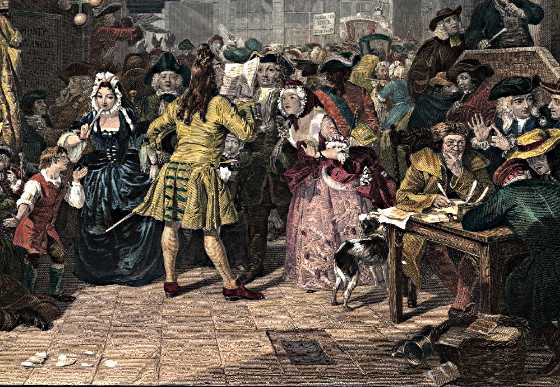 "Popular Delusions" is said to remind us that human nature and human greed never change. That's not necessarily so. Investor foolishness may actually be on the increase. Consider the following, from Mackay's description of all the little stock bubbles that popped up in London's Exchange Alley at the time of the South Sea Bubble:
 "Popular Delusions" is said to remind us that human nature and human greed never change. That's not necessarily so. Investor foolishness may actually be on the increase. Consider the following, from Mackay's description of all the little stock bubbles that popped up in London's Exchange Alley at the time of the South Sea Bubble:
 But the most absurd and preposterous of all, and which showed, more completely than any other, the utter madness of the people, was one, started by an unknown adventurer, entitled "company for carrying on an undertaking of great advantage, but nobody to know what it is." Were not the fact stated by scores of credible witnesses, it would be impossible to believe that any person could have been duped by such a project. The man of genius who essayed this bold and successful inroad upon public credulity, merely stated in his prospectus that the required capital was half a million, in five thousand shares of 100 pounds each, deposit 2 pounds per share. Each subscriber, paying his deposit, would be entitled to 100 pounds per annum per share. How this immense profit was to be obtained, he did not condescend to inform them at that time, but promised, that in a month full particulars should be duly announced, and a call made for the remaining 98 pounds of the subscription. Next morning, at nine o'clock, this great man opened an office in Cornhill. Crowds of people beset his door, and when he shut up at three o'clock, he found that no less than one thousand shares had been subscribed for, and the deposits paid. He was thus, in five hours, the winner of 2,000 pounds. He was philosopher enough to be contented with his venture, and set off the same evening for the Continent. He was never heard of again.Writing in 1841, Mackay assumed his readers would recognize that investing in "blind pools," as such ventures came to be known on Wall Street, was the height of folly. Today? Blind pools known as hedge funds attract presumably sophisticated investors, pension funds and endowments. In recent years they sold particularly well as Madoff funds. "In the present state of civilization," Mackay wrote, "society has often shown itself very prone to run a career of folly…. Melancholy as all these delusions were in their ultimate results, their history is most amusing." Excuse us if we don't laugh, Mr. Mackay. We're too deep in melancholy.
Wednesday, March 18, 2009
Sun for sale?
Remember when Sun Microsystems was going to buy Apple computer? That was before Steve Jobs returned to Apple and discovered the immense power of the lower case i (iMac, iPod, iTunes, iPhoto, iEtc.) . That 1996 deal fell apart, if I remember correctly, because Sun didn't think Apple was worth the price management and shareholders were asking.
How quickly fortunes turn. I.B.M. Said to Be in Talks to Buy Sun for $7 Billion reports the New York Times.
How quickly fortunes turn. I.B.M. Said to Be in Talks to Buy Sun for $7 Billion reports the New York Times.
Another Madoff question
There are lots of unanswered tax questions, according to the Tax Notes writeup on reactions to Rev. Proc. 2009-20 and Rev. Rul. 2009-09,the Madoff/ponzi scheme relief rulings announced yesterday. Here's one I should have thought of earlier:
Taxpayer made a gift to child of a $2 million interest in the Madoff fund. Taxapayer used up his unified credit to avoid gift tax, but did file a gift tax return. Does he get his unified credit back now? Does it depend upon how long ago he made the gift?
Taxpayer made a gift to child of a $2 million interest in the Madoff fund. Taxapayer used up his unified credit to avoid gift tax, but did file a gift tax return. Does he get his unified credit back now? Does it depend upon how long ago he made the gift?
Historic moment?
NYTimes.com has published a letter from reader Paulette Altmaier.. These portions resonated with me:
Are the AIG bonuses a tipping point? They certainly make the government look hapless at the moment. What about the fact that AIG has really just been a conduit for billion-dollar payments to foreign banks and Goldman Sachs?
"President Obama may not realize it yet, but his Katrina moment has arrived.Altmaier goes on to identify herself as an Obama voter, ands calls for deeds, not words.
"This is a defining moment for his presidency, and how he responds will determine the trajectory of his term. He needs to deal with the excesses within the financial industry with the same toughness and conviction that President Ronald Reagan brought to bear during the air traffic controllers’ strike. To date, he is sorely wanting."
Are the AIG bonuses a tipping point? They certainly make the government look hapless at the moment. What about the fact that AIG has really just been a conduit for billion-dollar payments to foreign banks and Goldman Sachs?
Tuesday, March 17, 2009
Market Bottom?
If Warren Buffett can't always predict stock market moves, we shouldn't try. Still, hope springs eternal. Contrarians have to love Equities dead as long-term asset.
U.S. advertising down 2.6% in 2008
says Nielsen :: Media Business. That's less that I expected. More:
However, history suggests that those who advertise through tough economic times are more likely to survive them.
Ad spending in b-to-b magazines fell 9.7%. Ad expenditures in other print categories were hit hard, too, with steep declines at national magazines (-7.6%), national newspapers (-9.6%), local newspapers (-10.2%) and local Sunday supplements (-11.0%).Even Internet display advertising fell 6.4%. Cable TV ads were up, the only bright spot.
However, history suggests that those who advertise through tough economic times are more likely to survive them.
IRS Takes Pity on Madoff Victims
 Some Madoff victims may be able to deduct most of their losses and carry unused deductions back as far as five years or forward as far as twenty years, according to this NY Times dispatch:
Under the plan, which has been reviewed by the Congressional offices, the I.R.S. will allow investors who are not suing Mr. Madoff to claim a theft-loss deduction equal to 95 percent of their investments, minus any withdrawals, reinvested gains and payouts from the Securities Investor Protection Corporation, the government-chartered fund set up to help protect investors of failed brokerage firms.
Investors who are suing Mr. Madoff, and who thus may have some prospect of recovery, can claim a deduction equal to 75 percent of their investments.
The I.R.S. is also relaxing the rules on how far back the losses can be carried. Current theft loss rules typically allow loss to be carried back 2 years and forward 20 years, but under the plan, the I.R.S. will allow losses to be carried back 5 years as well as forward 20 years.
Monday, March 16, 2009
A Swindler With Class
Paul Greenwood is alleged to have defrauded investors of a half-billion dollars. Lunch money, by Madoff standards. But keeping up appearances counts for something. Greenwood showed up in court wearing a bow tie.
Who says traditional values are dead?
Who says traditional values are dead?
Sunday, March 15, 2009
Be an Enthusiastic Investor!
 From a Yale Alumni Magazine interview with David Swensen, Yale's star endowment manager:
One of the great ironies is that if you had talked to the average investor 18 months ago, he or she would have thought it was a pretty good idea to buy stocks. In recent months, the same investors despair about their portfolio and are fearful about putting money into the equity market.
That's 180 degrees wrong. They should have been cautious 18 months ago, when prices were much higher than they are now. They should be enthusiastic today.
Undelivered Billions: Is Some Yours?
From The Wall Street Journal:
[N]early $33 billion in unclaimed property [sits] in state governments' coffers.
These are sums that businesses were required to turn over to the states after no activity or contact with the owner after a period of a year or more.
Items can include dividend or payroll checks that haven't been cashed, refunds, trust distributions, unredeemed money orders, insurance payments or refunds, annuities, certificates of deposit, customer overpayments and the contents of safe-deposit boxes.
Saturday, March 14, 2009
Some state tax revenues crashed last quarter
So saysTaxProf Blog reporting on a study by the Nelson Rockefeller Institute of Government. Curiously, New York was not among the top ten losers, but Connecticut came in number 9, down 8.5%, and New Hampshire, down 11.6%, was number 7.
Friday, March 13, 2009
Is Warren Buffett Crazy?
Jim Gust likes Warren Buffett's solution to the banking crisis. He can take heart from he New Yorker's James Surowiecki, who explains why maybe Buffett isn't crazy.
Thursday, March 12, 2009
Remember the SEC prosecution of Martha Stewart?

Five years ago Martha Stewart was released from prison, having been convicted of lying to a federal officer and obstructing an agency proceeding. Her theoretical offense was that by selling shares of ImClone in 1981 based upon inside information, she avoided a stock loss of about $45,ooo. Stewart made the classic mistake of failing to "lawyer up," as they say on TV, and her statements were used against her.
Do you think that the SEC spent its time wisely in going after Martha with such enthusiasm? Because I've been thinking that maybe we would have better served if the SEC had paid more attention at the time to Bernie Madoff.
According to press reports, Madoff did not make a single trade for his clients after 1996. How could an SEC audit not notice that?
There going to be reformation of the regulation of the financial services industry, but the Stewart case suggests that regulators often get their priorities wrong.

What Jamie Dimon Fears
The Washington Post's David Ignatius tells why Jamie Dimon's hopes for a quick end to the financial crisis, mentioned below, seem doomed.
Wednesday, March 11, 2009
Millionaires Endangered, Too
As noted below, some billionaires became mere millionaires last year. But the mere millionaires were vanishing, too. According to the Spectrem Group, millionaire households in the U.S. declined from 9.2 million in 2007 to 6.7 million in 2008.
Another Endangered Species?
 Last year, Forbes estimates, the world had 1,125 billionaires. Now it has 793. Donations to our "Save the Billionaires Fund" should be sent directly to Jim Gust.
Same War, Different Century
 Guessing from the costumes, the drama promoted in this old ad dealt with the Panic of 1907. That's when J.P. Morgan tamed the trust companies.
We don't have J.P. to help us this time. But the current head of his bank, Jamie Dimon, today said we could get past our crisis this year, provided Democrats and Republicans cooperate and act without endless argument and delays. (Don't you wish that wasn't a sucker's bet?)
Thanks to CNBC, you can view Dimon's well-received talk at the Chamber of Commerce Summit here.
Warren Buffett's solution to the banking crisis
From Buffett's CNBC interview, as reported by Holman Jenkins in WSJ.com:
Now comes Warren Buffett, a big investor in Wells Fargo, M&T Bank and several other banks, who, during his marathon appearance on CNBC Monday, clearly called for suspension of mark-to-market accounting for regulatory capital purposes.Read the whole piece—it's an even more hopeful sign that the one below.
[snip]
Mr. Buffett obviously understands where we are today, though it seems to elude many of those kibitzing about "nationalization," "letting banks fail" and other lagging notions. Since last year, our banking system no longer rests on capital, but on government guarantees. With those sweeping guarantees in place to protect their depositors and bondholders, banks now are able to earn princely spreads above their cost of funds, however questionable their balance sheets.
Banks will "build equity at a very rapid rate with the spreads that exist now," Mr. Buffett said. With the possible exception of Citigroup, he added, "the banking system largely will cure itself."
One hopeful sign
Some Banks, Citing Strings, Want to Return Aid says the New York Times today. In the beginning, taking TARP money was seen as a badge of honor, proof that the government would not let an institution fail. Now having TARP money is seen for what it is, a sign of weakness and an open invitation for government and media micromanagement. Just ask Northern Trust.
Surprisingly, sentiment is growing to stop bleeding the stronger banks in order to help the weaker ones:
Surprisingly, sentiment is growing to stop bleeding the stronger banks in order to help the weaker ones:
Although this looks like a better policy, the Administration argues that it can't be applied to the biggest banks today. Which suggests that part of the long-term remedy could be to cap the size of banks, so that none are too big to fail.At the height of the savings and loan crisis in the 1980s and 1990s, Congress and regulators adopted new rules known as “prompt corrective action” that required the government to quickly close weak financial institutions if they could not raise money to absorb mounting losses.
The rules were a response to a consensus that keeping weak institutions open longer, under an earlier practice known as forbearance, damaged healthy banks competing with the government-subsidized ones and ultimately destabilized the banking system. By shutting weakened institutions before their losses grew, prompt corrective action was also seen as less costly to taxpayers and the deposit insurance fund.
The Next Stock Market Boom
 Maybe it's a bit closer than we thought. Your humble, obedient blogger has been reading (actually, listening to) The Snowball, Alice Schroeder's biography of Warren Buffet.
Schroeder introduces Warren as he and his family travel to Sun Valley in 1999 for the annual retreat hosted by Herbert Allen. Warren delivers the closing presentation. Speaking at the height of the dot.com-tech bubble, he warns the gathering of tycoons and masters of the universe that stocks are dangerously overvalued. To illustrate what could happen, he points out that the Dow was at about 874 at one point in September, 1964 and seventeen years later, in 1981,was again around 874. Was everybody ready for another 17 years of stocks going nowhere?
At the time, that thought was a real downer. Now, not so bad. Seventeen years from 1999 is 2016. Some followers of saros cycles believe the next stock market boom won't start until 2018. If Warren was right, the good times may start to roll sooner!
Tuesday, March 10, 2009
Shakespeare Revealed?
 An authentic portrait of Shakespeare, painted around 1610, may have been discovered.
Or, maybe not.
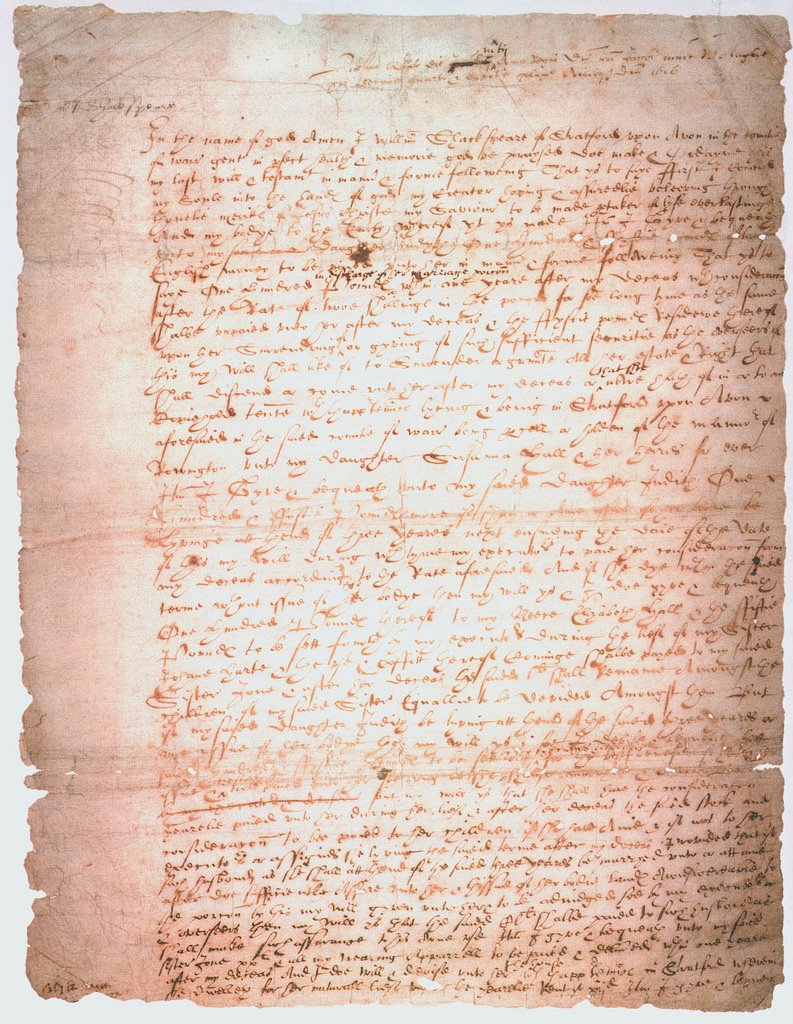
The chap at right does look awfully healthy for a Shakespeare who, only six years later, seemed barely strong enough to sign his will:

Read the Yale Alumni Magazine's story on Shakespeare's will here.
Below is a photo of the first page of the will that accompanied the print version of the article.
Monday, March 09, 2009
Know Anyone Who “Invested” With Sir Allen?
 Via FT's Alphaville we learn that the FBI seeks individuals who placed wealth in CDs or other products offered by Sir Allen Stanford:
The Houston Division of the Federal Bureau of Investigation (FBI) is seeking information from individuals who have invested in the Stanford Financial Group (SFG) or its affiliated companies-Stanford Capital Management, the Stanford Group Company, the Stanford International Bank, the Stanford Trust Company, or the Bank of Antigua. To facilitate information gathering, the FBI has established a dedicated investor email address Stanford.group@ic.fbi.gov, and an informational telephone line (713) 693-5699.Sir Allen's clients have probably lost money. Over 1,000 of Sir Allen's employees have already lost their jobs.
Friday, March 06, 2009
Remember Doorly, “the Poor Man's Madoff”?
John Doorly reportedly looted the trusts of more than 100 descendants of the Ayer family. Now he's on trial, facing perhaps 20 years in prison. He also may have to part with $20 million and his time-share at the Ritz-Carlton Golf Club and Spa in Florida.
Any trust officer whose wealthiest client asks why he shouldn't set up his own family office should tell him about Doorly.
Googling the Ayer family takes you back to a New England that has largely vanished. The obit of Frederick Ayer, who died in 1914 at age 95, is here.
Frederick Ayer II (a grandson?) lived not quite as long. His 1998 obituary begins thusly:
"Go to work, support causes you believe in, and feel free to be eccentric." That's how New England once raised its trust fund babies. How did we end up with today's version?
Any trust officer whose wealthiest client asks why he shouldn't set up his own family office should tell him about Doorly.
Googling the Ayer family takes you back to a New England that has largely vanished. The obit of Frederick Ayer, who died in 1914 at age 95, is here.
Frederick Ayer II (a grandson?) lived not quite as long. His 1998 obituary begins thusly:
Frederick Ayer II, heir to a family fortune generated by woolen mills and sarsaparilla, got the message from his father when he was a boy: He was urged to make something of himself and not merely live off his inheritance, so something would be left for future generations.A research physicist, Ayer II helped fund the sexual research of Masters and Johnson, along with research on UFOs, DNA and cancer. He collected orchids and compiled a grammar of the Balinese language.
"Go to work, support causes you believe in, and feel free to be eccentric." That's how New England once raised its trust fund babies. How did we end up with today's version?
Wednesday, March 04, 2009
Why Lawyers Love "Last Wills"?
Brooke Astor was age 105 when she died in 2007. Her son, accused of fraud, is in his 80s. His trial finally may start later this month. Or maybe not.
Good Night, Poor Harvard?
 Commitments to private equity and real estate ("the investments that keep on taking") may require Harvard to fork over $1.5 billion a year for three years, the Deal Professor guesstimates.
 "Private equity was historically viewed as the savior to higher education," writes the prof, "but it now may mean its trouble."
Which "alternative investments," if any, will survive the Great Recession?
Can a President Move the Market?
"What you're now seeing is profit and earning ratios are starting to get to the point where buying stocks is a potentially good deal if you've got a long-term perspective on it."
Yesterday's remarks by the Market-Timer-in-Chief were all over the news last evening and this a.m. Will investors now hiding in T-bills consider buying equities as a result of the President's advice?
Before you answer, better take a look at our prescient post from August, 2007. Remember that unexpected commotion in the White House rose garden?
“I believe that markets ultimately look at the fundamentals of any economy,” Mr. Bush said at that time. “And the fundamentals of our economy are strong."

Yesterday's remarks by the Market-Timer-in-Chief were all over the news last evening and this a.m. Will investors now hiding in T-bills consider buying equities as a result of the President's advice?
Before you answer, better take a look at our prescient post from August, 2007. Remember that unexpected commotion in the White House rose garden?
“I believe that markets ultimately look at the fundamentals of any economy,” Mr. Bush said at that time. “And the fundamentals of our economy are strong."

Tuesday, March 03, 2009
Stocks: the Long View
"By yearend," Warren Buffet writes in his Chairman's Report 2008, "investors of all stripes were bloodied and confused, much as if they were small birds that had strayed into a badminton game."
Two months later, investors feel more like a tennis ball that was just served at 130 mph by Andy Murray and returned by Rafa Nadal. "Ouch!" "Ouch!"
To distract clients from the bruises of the day, investment advisers can draw upon the long-term perspectives found in the Credit Suisse Global Investment Returns Yearbook 2009. One of the contributors is professor Elroy Dimson, previously mentioned here. A sample:

Two months later, investors feel more like a tennis ball that was just served at 130 mph by Andy Murray and returned by Rafa Nadal. "Ouch!" "Ouch!"
To distract clients from the bruises of the day, investment advisers can draw upon the long-term perspectives found in the Credit Suisse Global Investment Returns Yearbook 2009. One of the contributors is professor Elroy Dimson, previously mentioned here. A sample:

Monday, March 02, 2009
Tax Hike Targets Red Staters?
Income millionaires nationwide would be hit by the rate hikes in President Obama's proposed budget. Families at the $200,000-$400,000 level may escape if they live on the East or West Coasts, strongholds of Obama-leaning liberals. Many Red Staters with comparable incomes but lower expenses could see their taxes go up.
The New York Times explains: Many of the Californians and East Coasters have already left the regular income-tax system. They pay AMT, the Alternative Minimum Tax. And they'll still be paying it if the regular rates rise as proposed. The Times offers this example:

Could the proposed hike in capital gains tax, to 20%, also be rendered moot for many taxpayers because of the AMT? From personal experience, I wouldn't be surprised.
The New York Times explains: Many of the Californians and East Coasters have already left the regular income-tax system. They pay AMT, the Alternative Minimum Tax. And they'll still be paying it if the regular rates rise as proposed. The Times offers this example:

Could the proposed hike in capital gains tax, to 20%, also be rendered moot for many taxpayers because of the AMT? From personal experience, I wouldn't be surprised.
Sunday, March 01, 2009
Confessions of a Conflicted Money Guru
Investing is a thankless subject to write about during the Great Recession. Joel Lovell ponders the problem in the Washington Post.
Subscribe to:
Posts (Atom)

 Posts
Posts


