Calpers is have second thoughts, per The Wall Street Journal.
Individuals can inject politics into their investment strategy freely, but those responsible for public pensions need to put rate of return first.
Monday, June 17, 2019


Friday, June 14, 2019
Thousands and Thousands of Apps for Investors
 |
| Number of Android and Apple apps in 2018 that mentioned investing in their descriptions. |
Helping fuel the proliferation of investing apps, the WSJ observes, is the rise of socially-conscious investing.
Does the investment business really need thousands and thousands of apps? Maybe not. But as Mae West once said, "Too much of a good thing can be wonderful."
•
Bankrate's recent list of 5 best investing apps contains one oddity: an app intended not for actual investing but for game playing. Millennials may not take phone calls, but they're ever ready to socialize online.
Thursday, May 30, 2019
Johnny Hallyday’s Domicile? See Instagram!
 |
| Hallyday in 1965 photo©ErlingMandelmann.ch |
national icon, right up there with Edith Piaf.
Hallyday died in 2017, leaving two wills, one of which was probated in Los Angeles, where he and his fourth wife had taken up residence in 2007. The will leaves everything to his widow, who has their two adopted children in her care. The will leaves nothing to Hallyday's two older children from previous marriages.
In France, where a form of forced heirship still rules, the older children would not be disinherited. So they went to court in France, seeking to show that Hallyday had still been domiciled in France, not LA.
The French court has now agreed to take up the case, convinced in part by photos Hallyday had posted on his Instagram account from 2012 to 2017. They indicate that he spent more than 150 days in France during both 2015 and 2016. In 2017 he was in France for eight months before his death.
In the age of not only Photoshop but AI, the use of digital photographs as evidence seems destined to become increasingly iffy. No other type of fake news is easier to create.
Wednesday, May 29, 2019
Climate Change: Europe Flooded with Tourists
 |
| Photo: Rick Steves Blog |
Travel agents (remember them?) used to tell us to visit Europe in spring or fall, to avoid the crowds of summer. This spring you would have arrived in London, Paris or Rome only to find your access to tourist attractions already blocked by long lines.
Got clients preparing to join the crowds? Do them a favor by sharing the tips offered by travel writer Cameron Hewitt.
More Americans than ever seem to be getting passports and venturing abroad. Newly affluent tourists from China, India and Russia add to the crush. If the world economy is headed downhill as many investors fear, it appears to be starting from an impressive high.
Wednesday, May 22, 2019
Senators Seek Penalties on Brokers Who Inherit
"I'd like your opinion about an inheritance question," a woman told the Ethicist at Investment News. Her aunt had died, leaving a will that named the aunt's financial adviser and his attorney friend as co-executors. The will left 25 percent of her estate to the questioner's father. Another 25 percent was left to the aunt's close friend. The rest went to the financial adviser.
Kosher? No, ruled the Ethicist. The financial adviser should not have assumed the role of executor. As for his inheritance (close to half a million, apparently) "if the financial adviser is wise, he will step down immediately and disclaim any rights to his former client's assets."
Now, another case of questionable inheritance reported by Gretchen Morgenson in The Wall Street Journal has prompted a bipartisan foursome of U.S. Senators to write Finra urging closer regulation. Advisers accepting such gifts “should forfeit the bequests, pay large fines and/or be unable to serve as financial professionals in the future.”
Kosher? No, ruled the Ethicist. The financial adviser should not have assumed the role of executor. As for his inheritance (close to half a million, apparently) "if the financial adviser is wise, he will step down immediately and disclaim any rights to his former client's assets."
Now, another case of questionable inheritance reported by Gretchen Morgenson in The Wall Street Journal has prompted a bipartisan foursome of U.S. Senators to write Finra urging closer regulation. Advisers accepting such gifts “should forfeit the bequests, pay large fines and/or be unable to serve as financial professionals in the future.”
Wednesday, May 15, 2019
1969 Trust Ads Featured Two Historic Generations
Half a century ago, Chemical Bank was running ads for trust and investment services that portrayed men and sometimes women of means.
This example features a member of the Greatest Generation – the men who came home from war and prospered in the quarter century that followed. His $830,000 wasn't chicken feed – it's equivalent to almost $6 million today.

Chemical's ads series became familiar enough to inspire this playful variation – a Trust Fund Baby from the soon-to-be-notorious Baby Boom generation.

This example features a member of the Greatest Generation – the men who came home from war and prospered in the quarter century that followed. His $830,000 wasn't chicken feed – it's equivalent to almost $6 million today.

Chemical's ads series became familiar enough to inspire this playful variation – a Trust Fund Baby from the soon-to-be-notorious Baby Boom generation.

Monday, May 13, 2019
A Private Bank by Any Other Name . . .
Family office services…plus loans to wealthy clients who need quick cash to meet a capital call or buy a villa…plus investment selection and supervision.
The functions of a private bank? Yes. but in this case the tasks are performed by the team Lyon Polk has assembled at Morgan Stanley. They manage over $15 billion.
Banks, trust companies, wirehouses and advisory firms all seek to offer comprehensive services to the wealthy. And it's getting hard to tell them apart.
The functions of a private bank? Yes. but in this case the tasks are performed by the team Lyon Polk has assembled at Morgan Stanley. They manage over $15 billion.
Banks, trust companies, wirehouses and advisory firms all seek to offer comprehensive services to the wealthy. And it's getting hard to tell them apart.
Tuesday, May 07, 2019
Have a will
Nice article in Bloomberg about a millionaire who did not have a will, nor did he have immediate family. An heir-finding company eventually located nieces and nephews. Lots of colorful detail in the article, I won't spoil the punchline.
Sunday, May 05, 2019
Can the IRS be Saved?
Paragraph we never expected to read in the newspaper:
Still, this op-ed by two Politico reporters reminds us that the IRS is an endangered bureaucracy, underfunded and understaffed. Notably lacking: hundreds of highly-trained auditors needed to go toe-to-toe with aggressive tax planners.
Will the IRS receive the many billions needed to restore the agency to fighting trim? Probably not, unless the president is tired of being the only high-income celebrity under constant audit.
One 2020 candidate already has a bold proposal to resuscitate the I.R.S. It’s a plan to pump tens of billions into the agency, enough to fund a second army of agents. That candidate’s name is Donald Trump.In political folklore Republicans are known for disliking federal taxes and fiercely disliking paying taxes, so the future of the president's budget proposal is anyone's guess.
Still, this op-ed by two Politico reporters reminds us that the IRS is an endangered bureaucracy, underfunded and understaffed. Notably lacking: hundreds of highly-trained auditors needed to go toe-to-toe with aggressive tax planners.
Will the IRS receive the many billions needed to restore the agency to fighting trim? Probably not, unless the president is tired of being the only high-income celebrity under constant audit.
Wednesday, April 24, 2019
Few Millionaires are Rich These Days
When Bernie Sanders released his tax returns, he triggered taunts about being a millionaire – a rich socialist! Bernie did achieve richness temporarily: for two years his success as an author made him a income millionaire. Presumably his net worth is also well over a million. But unlike demi-billionaires, ordinary millionaires don't live rich.
Median U.S. household income is a bit over $60,000. As Thomas Heath points out in The Washington Post, a retiree with $1 million probably can't reach that income level. Even retirees with two or three million shouldn't expect to live large.
These days living rich probably requires at least $20 or $30 million. According to Spectrem, almost 12 million U.S. households have at least one million in investable assets, but only about 170,000 have more than $25 million.
Median U.S. household income is a bit over $60,000. As Thomas Heath points out in The Washington Post, a retiree with $1 million probably can't reach that income level. Even retirees with two or three million shouldn't expect to live large.
These days living rich probably requires at least $20 or $30 million. According to Spectrem, almost 12 million U.S. households have at least one million in investable assets, but only about 170,000 have more than $25 million.
Sunday, March 31, 2019
Private Equity, Intriguing and…Complicated
Private equity is a passion investment with a difference, observes Paul Sullivan in the NY Times. Unlike art, cars or collectibles, "it is a financial investment, not a tangible asset. You can’t hang it on your wall, park it in your garage or serve it with dinner. But it has a cachet from the past successes of other investors, and the high barrier to entry creates an air of intrigue."
That air of intrigue covers a wide field – vaster than some investors may realize. The Washington Post's David Ignatius has been studying the murder of his friend and colleague Jamal Khashoggi. He finds that some members of the Saudi hit team that killed Khashoggi may have been trained, under U.S. government auspices, by companies owned by affiliates of a major private equity firm. He also notes that an Israeli-founded company noted for its phone-hacking capabilities is now a British private equity holding.
The appeal of private equity, writes Sullivan, is "the promise of exclusive deals, outsize returns and enviable cocktail parties." Some deals, however, may not be appropriate cocktail party conversation.
That air of intrigue covers a wide field – vaster than some investors may realize. The Washington Post's David Ignatius has been studying the murder of his friend and colleague Jamal Khashoggi. He finds that some members of the Saudi hit team that killed Khashoggi may have been trained, under U.S. government auspices, by companies owned by affiliates of a major private equity firm. He also notes that an Israeli-founded company noted for its phone-hacking capabilities is now a British private equity holding.
The appeal of private equity, writes Sullivan, is "the promise of exclusive deals, outsize returns and enviable cocktail parties." Some deals, however, may not be appropriate cocktail party conversation.
Tuesday, March 26, 2019
Two Ways to Wear a Suit Like a CEO
As annual reports for 2018 appear, notice the crumbling of the business dress code. White shirt and tie is giving way to tieless blue shirt.
Pfizer's CEO photo shows him in suit and tie. Ditto for Bank of America's CEO. But AT&T's CEO photo shows that he has joined the tieless, unbuttoned blue-shirt rebellion. So has Citi's.
CEOs of troubled companies, however, need to look as somber and serious as possible. Leaders of GE and Wells Fargo still wear ties.
JPMorgan Chase's report isn't online yet, but Jamie Dimon presumably will appear with tieless blue shirt as he did a year ago.
For traditionalists, worse is yet to come. The disappearing tie, the WSJ suggests, will be followed by the disappearing business suit. Already, shoppers at the Joseph A. Banks store in NYC have to sidle past displays of khakis and jeans and head upstairs in order to find suits.
West Coast techies are to blame, of course. Judging from photo evidence, the only time Apple's Tim Cook wears a suit is when he visits the White House.
The crumbling dress code leaves wealth managers with a serious challenge, Which fashion look will impress the client – Armani or Lululemon?
Pfizer's CEO photo shows him in suit and tie. Ditto for Bank of America's CEO. But AT&T's CEO photo shows that he has joined the tieless, unbuttoned blue-shirt rebellion. So has Citi's.
 |
| AT&T's CEO |
CEOs of troubled companies, however, need to look as somber and serious as possible. Leaders of GE and Wells Fargo still wear ties.
JPMorgan Chase's report isn't online yet, but Jamie Dimon presumably will appear with tieless blue shirt as he did a year ago.
For traditionalists, worse is yet to come. The disappearing tie, the WSJ suggests, will be followed by the disappearing business suit. Already, shoppers at the Joseph A. Banks store in NYC have to sidle past displays of khakis and jeans and head upstairs in order to find suits.
West Coast techies are to blame, of course. Judging from photo evidence, the only time Apple's Tim Cook wears a suit is when he visits the White House.
The crumbling dress code leaves wealth managers with a serious challenge, Which fashion look will impress the client – Armani or Lululemon?
Sunday, March 24, 2019
Where‘s Your Teddy Bear Domiciled?
High net worth folks with several homes often strive to avoid being counted as a resident of a high-tax state. Traditionally, that's meant keeping careful count of how many days are spent in said state, and there are apps for that. But as Paul Sullivan reports in his Wealth Matters column, states such as New York and California have become more sophisticated in their efforts to tax the rich.
Days spent in state represent only one of five tests New York applies. "The state also looks at the size and cost of the New York home compared with those in other states, a person’s business and family ties to the state, and a category that looks at where 'near and dear' items are kept."
That last category is popularly known as the teddy bear test.
The new federal income tax cap on SALT deductions has further motivated the rich to flee their domiciles in high tax states. It has also motivated the high-tax states to fight back. In addition to checking for stuffed animals, New York may examine cell phone records and Facebook posts.
From a revenue standpoint the stakes are high. New York gets 46 percent of its income tax take from the top one percent of taxpayers.
Even top one percent New Yorkers who establish domicile elsewhere could be snared by a new proposed revenue raiser: a pied-à-terre tax on second homes worth over $5 million.
 |
|
teddy bears, is now domiciled
in New York, at the Public Library.
|
That last category is popularly known as the teddy bear test.
The new federal income tax cap on SALT deductions has further motivated the rich to flee their domiciles in high tax states. It has also motivated the high-tax states to fight back. In addition to checking for stuffed animals, New York may examine cell phone records and Facebook posts.
From a revenue standpoint the stakes are high. New York gets 46 percent of its income tax take from the top one percent of taxpayers.
Even top one percent New Yorkers who establish domicile elsewhere could be snared by a new proposed revenue raiser: a pied-à-terre tax on second homes worth over $5 million.
Saturday, March 16, 2019
The Pioneer Who Discovered Growth Stocks
Long before Jack Bogle, the father of index funds, there was T. Rowe Price, the father of growth investing. He and Bogle are probably the only two investment managers to popularize an entire theory of investing.
Born March 16, 1898, T. Rowe Price was a chemist by training but a stock picker at heart. While working at a brokerage he decided he wanted to sell advice, not stocks. In 1937 he opened his own investment counseling firm, a bold move in those times. Fee-based investment counsel was rare. The seeds of war were sprouting in Asia and in Europe. In the U.S. four years of painful recovery from the Great Depression had relapsed into a new recession.
Somehow, Price survived and prospered, propelled by his belief that he could outperform the market by selecting stocks whose earnings were growing faster than inflation and faster than the general economy.
After World War II ended, high wartime income tax rates lived on. Price's clients wanted to ease their tax burden by moving money into accounts for their children. (In those days Daddy's Little Taxpayers were entitled to their own low tax brackets.) To facilitate small accounts Price started a mutual fund, the T. Rowe Price Growth Stock Fund.
 Brokers working on commission didn't sell the Growth Stock Fund. Investors had to buy shares: Send for a prospectus. Fill out the accompanying new-account form. Return it with a check to Price in Maryland. Nevertheless, the fund's performance led to phenomenal success. In the 1970's, when Jack Bogle decided to make his index fund no load, Price's accomplishment must have bolstered his belief that his index fund could flourish without the help of a commissioned sales force.
 |
| T. Rowe Price |
Somehow, Price survived and prospered, propelled by his belief that he could outperform the market by selecting stocks whose earnings were growing faster than inflation and faster than the general economy.
After World War II ended, high wartime income tax rates lived on. Price's clients wanted to ease their tax burden by moving money into accounts for their children. (In those days Daddy's Little Taxpayers were entitled to their own low tax brackets.) To facilitate small accounts Price started a mutual fund, the T. Rowe Price Growth Stock Fund.
 Brokers working on commission didn't sell the Growth Stock Fund. Investors had to buy shares: Send for a prospectus. Fill out the accompanying new-account form. Return it with a check to Price in Maryland. Nevertheless, the fund's performance led to phenomenal success. In the 1970's, when Jack Bogle decided to make his index fund no load, Price's accomplishment must have bolstered his belief that his index fund could flourish without the help of a commissioned sales force.
•
Jack Bogle was a successful author and a beloved commentator on personal investing. If T. Rowe Price did TV interviews or authored op-eds, I must have missed them. He is said to have disliked public speaking. Thirty-six years after his death, his public image may be getting an overdue boost. Wiley is publishing a bio, T. Rowe Price, the Man, the Company and the Investment Philosophy.
Thursday, March 14, 2019
Wednesday, March 13, 2019
Seeing Helps Investors Believe
MarketWatch offers two graphics that investment advisers may want to add to their educational materials.
This one shows how often and how vigorously stock returns go up and down.

A second graphic (a lively GIF) shows the likelihood of stock investors making money over various time periods. Investors holding for 20 years can't lose – at least they never have. But remember, that perfect success rate assumes all dividends are reinvested.
This one shows how often and how vigorously stock returns go up and down.

A second graphic (a lively GIF) shows the likelihood of stock investors making money over various time periods. Investors holding for 20 years can't lose – at least they never have. But remember, that perfect success rate assumes all dividends are reinvested.
Saturday, March 02, 2019
Are Both Hawaiian War Gods Worth Millions?
Unlike regular investments – stocks, ETFs, bonds – alternative investments such as art can be difficult to value. Perhaps that's why they're alternative investments.
Current illustration: doubts about the value of a wooden statue bought at a Christie's auction by billionaire Marc Benioff for about $7.5 million and donated to a Hawaiian museum.
Is Benioff's purchase, at left, the equal of the similar statue in the British Museum at right? Or is it "the sort of thing you see in a tiki bar"?

Current illustration: doubts about the value of a wooden statue bought at a Christie's auction by billionaire Marc Benioff for about $7.5 million and donated to a Hawaiian museum.
Is Benioff's purchase, at left, the equal of the similar statue in the British Museum at right? Or is it "the sort of thing you see in a tiki bar"?

Tuesday, February 12, 2019
Will Your Robo Adviser Plan Your Estate?
 |
| Illustration: Sydney Morning Herald |
According to Steve Lockshin of Adviceperiod in this Barron's interview, human estate planners should start feeling nervous:
We are beginning to work on automation for estate planning—the one area that advisors love to insist cannot be automated. We are using our access to data to build out the algorithms to automate estate-planning recommendations and then create the appropriate legal documents. It’s all rules-based, and when it comes to most lawyers, it’s an antiquated industry.
Tuesday, February 05, 2019
Should Retirement Savers Slow Down?
Most Americans aren't building adequate retirement nest eggs. Investment providers usually urge them to save more. So how do you explain this T. Rowe Price mailing?

Why on earth would a mutual fund firm want enthusiastic retirement savers to slow down – to trot rather than gallop as they add to their investments?
Turns out it doesn't. "Rein in" is seldom taken literally in an age when few of us ride or drive a horse to work. The phrase has become a figure of speech. If you're a nervous wreck, you're urged to rein in your emotions. If you're deep in debt, you're advised to rein in your credit card usage.
As figures of speech age, their meaning sometimes goes astray. What T. Rowe Price really wants, according to the next page of the mailer, is for retirement investors to consolidate their accounts.
Maybe their headline should have been E Pluribus Unum.
Our advice to retirement savers? Give yourself free rein.

Why on earth would a mutual fund firm want enthusiastic retirement savers to slow down – to trot rather than gallop as they add to their investments?
Turns out it doesn't. "Rein in" is seldom taken literally in an age when few of us ride or drive a horse to work. The phrase has become a figure of speech. If you're a nervous wreck, you're urged to rein in your emotions. If you're deep in debt, you're advised to rein in your credit card usage.
As figures of speech age, their meaning sometimes goes astray. What T. Rowe Price really wants, according to the next page of the mailer, is for retirement investors to consolidate their accounts.
Maybe their headline should have been E Pluribus Unum.
Our advice to retirement savers? Give yourself free rein.
Saturday, February 02, 2019
Imagine a Thundering Herd of Fiduciaries

But these days the dividing line between brokers and RIAs is not so clear. Some wear both hats, and more and more "brokers" now work for fees, not commissions. In reality, duQuesnay asserts, "the investing public uses the words broker/advisor/adviser interchangeably. They do not know the difference…."
Maybe the public is on to something. David DeVoe, a San Francisco investment banker, notes the rising competition that wirehouses like Merrill Lynch and Morgan Stanley face from large RIA organizations and offers a provocative thought:
What if one of the wirehouses decided to become a full-blown RIA, to embrace fiduciary and independence? I think that could be a fascinating development.If it happens, will females be well represented in the crew?
The wirehouses have done a pretty good job over the years of mimicking the independent model in many regards, but they’ve done it slowly. I’ve said this before: It takes a long time to turn a battleship, but once it does turn, you have a lot of artillery pointed at you.
Tuesday, January 22, 2019
Crypto Bungling, Crypto Greed, Crypto Fear
CNN's article on how a crypto exchange mistakenly doled out $5 million in Bitcoin carried this sidebar.

Choose one: Get rich quick? Get really, really poor?

Choose one: Get rich quick? Get really, really poor?
Wednesday, January 16, 2019
John Bogle (1929-2019)
“In investing, you get what you don’t pay for. Costs matter. So intelligent investors will use low-cost index funds to build a diversified portfolio of stocks and bonds, and they will stay the course. "
Heckerling
The last time I attended the Heckerling Institute on Estate Planning was the final year it was held in Miami. More than a decade ago, I believe.
It's great, really great. More than 3,400 attendees, a new record. Even so, the Orlando convention center is so huge it doesn't feel crowded. I need to attend more than once every 10 years. I ran into Merrill Anderson's former client and good friend, Dave Folz.
I note with interest an increase in nontax subjects being discussed. Guardianships, for example. Choosing the right trustee, which is what caused me to send in my registration. Things that are important, but that I suspect will be hard to charge a suitable fee for, given the time it takes.
Selling estate planning was easier when the tax savings of a simple plan was 100 times larger than the fee being charged.
Also noted, an increasing push toward choosing corporate trustees. Use of trusts has exploded in recent years, according to several of the lecturers.
It's great, really great. More than 3,400 attendees, a new record. Even so, the Orlando convention center is so huge it doesn't feel crowded. I need to attend more than once every 10 years. I ran into Merrill Anderson's former client and good friend, Dave Folz.
I note with interest an increase in nontax subjects being discussed. Guardianships, for example. Choosing the right trustee, which is what caused me to send in my registration. Things that are important, but that I suspect will be hard to charge a suitable fee for, given the time it takes.
Selling estate planning was easier when the tax savings of a simple plan was 100 times larger than the fee being charged.
Also noted, an increasing push toward choosing corporate trustees. Use of trusts has exploded in recent years, according to several of the lecturers.
Monday, January 14, 2019
How Tax Refunds Drive the Economy
Unhappy taxpayers may not be the only victims of the winter of tax discontent. Last year the new tax
 law made folks feel flush – and automobile sales, a key driver of the U.S. economy, exceeded expectations. This year millions of Americans are expected to receive lower refunds or, worse, owe more to the IRS.
"Without that seasonal bounce," Axios warns, "2019 auto sales may be lower, making a recession more likely."

"Without that seasonal bounce," Axios warns, "2019 auto sales may be lower, making a recession more likely."
Sunday, January 06, 2019
A Winter of Tax Discontent?

One reason: the new tax law created a much larger standard deduction – $12,00 for singles, $24,000 for married couples. Though some taxpayers will benefit, others accustomed to itemizing their deductions may feel shortchanged. A couple whose state and local taxes, mortgage interest and donations add up to, say, $22,000 will find that their accustomed deductions are worthless.
According to estimates cited by the WSJ, the number of returns claiming the mortgage-interest deduction for 2018 will drop to 16 million from almost 40 million. Returns claiming deductions for charitable contributions also are expected to drop by more than 50%.
Tax withholding could be another sore spot. The withholding tables for 2018 may result in some taxpayers receiving smaller refunds or owing more at tax time.
And, smaller or not, taxpayers' refunds will be delayed if the partial government shutdown persists.
Friday, January 04, 2019
A novel way to beat the estate tax
According to this report, a couple owned a department store together in France. When the wife died in 1934, the husband should have paid a death tax of 38% on her half of the business. To avoid that tax, he reported instead that his daughter died, and the daughter then assumed the identity of the wife. Bingo, no death tax.
How did this story come to light? The daughter had a very long life. So long that she became famous for it, apparently living for 122 years and 164 days. Subsequent investigation turned up the possible fraud, the daughter may actually have died at age 100.
The woman was Jeanne Calment, a name that JLM may remember. She was the one who sold her apartment for a life annuity at age 90, only to outlive the buyer. Talk about buyer's remorse! His estate had to keep paying the annuity, so the final price for apartment was double its initial value, according to Wikipedia.
Not everyone is buying the story that a daughter could adopt the identity of her mother in a small town and everyone in town would either not notice or keep the secret. The evidence for fraud is thin—inconsistent passport descriptions, stories that don't match known facts, and the observation that in her 100s she seemed about 20 years younger.
I'd like the story to be true.
How did this story come to light? The daughter had a very long life. So long that she became famous for it, apparently living for 122 years and 164 days. Subsequent investigation turned up the possible fraud, the daughter may actually have died at age 100.
The woman was Jeanne Calment, a name that JLM may remember. She was the one who sold her apartment for a life annuity at age 90, only to outlive the buyer. Talk about buyer's remorse! His estate had to keep paying the annuity, so the final price for apartment was double its initial value, according to Wikipedia.
Not everyone is buying the story that a daughter could adopt the identity of her mother in a small town and everyone in town would either not notice or keep the secret. The evidence for fraud is thin—inconsistent passport descriptions, stories that don't match known facts, and the observation that in her 100s she seemed about 20 years younger.
I'd like the story to be true.
Tuesday, January 01, 2019
The Trump Market’s Still Up (a Little)
 |
| $100 invested in stocks when President Trump took office would have been worth $110 when the market closed out 2018. |
Sunday, December 30, 2018
Alas, Poor Bitcoin

Today the price of Bitcoin — $19,783 last December — is $3,810. Litecoin was $366 a coin; it’s now $30. Ethereum was $1,400 in January; today it’s $130.Blockchain, the technology developed to help manage Bitcoin, offers vast potential "to transform financial systems," Bowles writes. Inevitably, cockamamie blockchain ventures boiled up.
***The computing power needed to “mine” a Bitcoin or other cryptocurrency is now sometimes costing more than that coin is worth.
Even the word itself worked wonders. "When Long Island Iced Tea Company changed its name to Long Blockchain Company, its stock went up 500 percent in a day."
Friday, December 28, 2018
Thursday, December 13, 2018
Guardian Columnist Disses Northern Ad
Today's admeisters stress pinpoint accuracy: Deliver your sales pitch for gold-plated garlic presses only to people who think gold-plated garlic presses are totally cool.
Aspirational advertising spreads a wider net. Generations have learned what to buy when they get rich by leafing through the pages of The New Yorker. (You're unlikely to purchase a Rolex or a Bentley someday if you've never heard of them.)
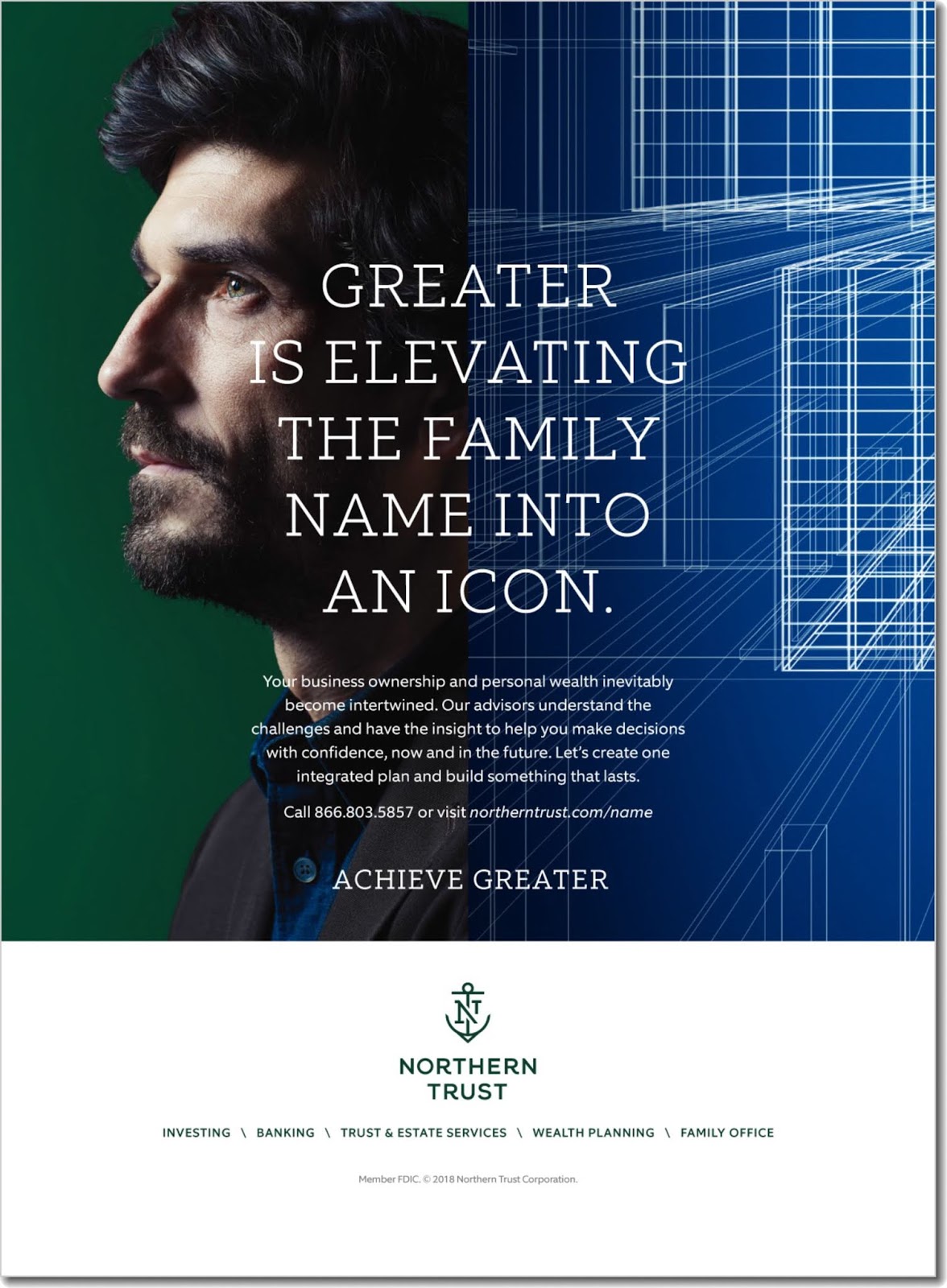
If Thomas Ricks had recognized the value of aspirational advertising, his Guardian column might have been less grumpy. Northern Trust's "Greater" message draws particular ire:
 Admittedly, Northern's message encourages greed and egotism:
Aspirational advertising spreads a wider net. Generations have learned what to buy when they get rich by leafing through the pages of The New Yorker. (You're unlikely to purchase a Rolex or a Bentley someday if you've never heard of them.)
If Thomas Ricks had recognized the value of aspirational advertising, his Guardian column might have been less grumpy. Northern Trust's "Greater" message draws particular ire:
[T}he full page ad that set me off on this tear came on page 10, when a relatively young man – his bearded thirty-ish face illuminated as he stares off to the side – is shown behind the capitalized headline “GREATER IS ELEVATING THE FAMILY NAME INTO AN ICON.” The text below, from a trust company, explains that, OK, you have your “business ownership and personal wealth”, but now you have to move up to the next step, “build something that lasts”. Not only is being comfortable no longer the goal, being wealthy is no longer enough.
"How do you feel now that you're taking $50 million out of the company?"
"I feel great."
"So why are you moping around like a dog who lost his bone?"
"I want to feel greater."But greed, Michael Douglas reminded us in "Wall Street," is good. And although audiences were supposed to scorn that sentiment, the film reportedly inspired a good number of young people to seek a Wall Street career.
Saturday, December 08, 2018
The Simon abundance index
There has been a followup on the famous bet between Julian Simon and Paul Ehrlich on whether the costs of resources go down over time. Ehrlich ("The Population Bomb) thought that Reverend Malthus was right, and we were on the brink of mass starvation. The fact that he was entirely wrong has not had any impact on his dire opinions.
Simon and Ehrlich bet on five materials on a ten-year span. In this followup, 50 items are tracked from 1980 to 2017. Bottom line, as population grows, access to resources grows. Simon continues to win.
Now I have to figure out how to put this new learning into ITN.
Simon and Ehrlich bet on five materials on a ten-year span. In this followup, 50 items are tracked from 1980 to 2017. Bottom line, as population grows, access to resources grows. Simon continues to win.
Now I have to figure out how to put this new learning into ITN.
Sunday, December 02, 2018
The High Price of Nice Dinners, Continued
 |
| Robert Neubecker's illustration for "We Went to a Steak Dinner Annuity Pitch." |
Almost a decade ago, in “Protecting Older Investors: 2009 Free Lunch Seminar Report,” AARP said 63 percent of the people it had surveyed had received an invitation like the one my aunt found in her mailbox. Among that group, 57 percent had received five or more within the previous three years. The organization figured that 5.9 million people ages 55 or over had attended at least one seminar.
AARP’s protective instincts were warranted. Two years earlier, the Securities and Exchange Commission, the North American Securities Administrators Association and the Financial Industry Regulatory Authority sent examiners to 110 free-meal seminars. They found that 57 percent of the time, the salespeople used materials that “may have been misleading or exaggerated or included seemingly unwarranted claims.”
I genuinely hoped not to encounter any such thing Tuesday night. But I did.To avoid elder abuse, annuity sales efforts are said to target people no older than 70. But oldsters certainly get dinner invitations. My mother has received several this year. Had she not died in the 1990s, she now would be well over 100.
Sunday, November 25, 2018
As Investors, Women Outperform Men
A Warwick Business School study, covering investment returns over three years, found that the U.K.'s women investors do better than the men.
Analysis of 2,800 investors found that not only did the female investors outperform the FTSE 100 over the last three years but they also outshone their male counterparts.

While annual returns on investments for men were on average a marginal 0.14 per cent above the performance of the FTSE 100, annual returns on the investment portfolios held by women were 1.94 per cent above it. This means returns for women investing outperformed men by 1.8 per cent.The women did better than the men because they avoided speculative stocks, traded less frequently and were more willing to sell their losers. They were less likely to confuse investing with playing the lottery, more likely to keep calm and carry on.
Friday, November 16, 2018
The “Sewer Rat” and the Misplaced Wil
From the UK, the tale of how a "cavalier and reckless" heir hunter — a company that traces people who may not realize they’re in line for part of a deceased relative’s estate — came perilously close to denying a retired film editor the home his aunt left him in her will.
Wednesday, November 14, 2018
Time to Retire “Retirement”?
In financial marketing circles you don't hear much about personal investing. It's "retirement investing." Personal financial planning? It's mostly "retirement planning."
Out in the real world, that's a problem. Many, perhaps most working people aren't actually retiring. Some can't afford to retire; others prefer not to. The vast majority of "retirees" working part time say it's by choice, not necessity.
The meaning of "retirement" gets even murkier as young people aspire to retire early. Movements such as FIRE urge them to spend almost nothing, save and invest almost everything.
Alas, spending almost nothing is not a meaningful life plan. Suze Orman interrupted her own retirement to assert that somebody retiring at 40 would need $5 million to live on. Maybe $10 million. She later recanted, after learning that the potential "retirees" realized they would have to keep working for a living. They simply wanted to stop "working for The Man" and start doing something they enjoyed or found fulfilling.
"Retirement," whatever it means, is not a useful financial goal. The goal should be financial independence. Canadian writer Jonathan Chevreau calls it findependence.
Former Marines should love this approach. "Semper FI, guys. Semper FI."
The meaning of "retirement" gets even murkier as young people aspire to retire early. Movements such as FIRE urge them to spend almost nothing, save and invest almost everything.
Alas, spending almost nothing is not a meaningful life plan. Suze Orman interrupted her own retirement to assert that somebody retiring at 40 would need $5 million to live on. Maybe $10 million. She later recanted, after learning that the potential "retirees" realized they would have to keep working for a living. They simply wanted to stop "working for The Man" and start doing something they enjoyed or found fulfilling.
"Retirement," whatever it means, is not a useful financial goal. The goal should be financial independence. Canadian writer Jonathan Chevreau calls it findependence.
[W]hen you’re financially independent, you work because you want to, not because you have to. “Findependence is necessary for retirement,” he says. “You can be findependent and not retired, but you can’t be retired without being findependent.”The FIRE movement (Financial Independence, Retire Early) should become simply the FI movement. Calculators could help Millennials check their FI progress like they check their FICA scores.
Former Marines should love this approach. "Semper FI, guys. Semper FI."
Subscribe to:
Posts (Atom)

 Posts
Posts


