Showing posts with label women. Show all posts

Sunday, November 25, 2018

As Investors, Women Outperform Men

A Warwick Business School study, covering investment returns over three years, found that the U.K.'s women investors do better than the men.
Analysis of 2,800 investors found that not only did the female investors outperform the FTSE 100 over the last three years but they also outshone their male counterparts.
While annual returns on investments for men were on average a marginal 0.14 per cent above the performance of the FTSE 100, annual returns on the investment portfolios held by women were 1.94 per cent above it. This means returns for women investing outperformed men by 1.8 per cent.
The women did better than the men because they avoided speculative stocks, traded less frequently and were more willing to sell their losers. They were less likely to confuse investing with playing the lottery, more likely to keep calm and carry on.

Monday, September 03, 2018

Why Stocks Are Like Women

This ad ran in The New Yorker 60 years ago, a time when Wall Street men regarded women as a breed apart.

"Stocks are somewhat like women," Merrill Lynch's copywriter asserts. Like stocks, all women are not alike. "For instance, some women move in schools, like fish; others are strictly independent. Some women are busy as waltzing mice; others are languid and lackadaisical. Some are fickle; others are faithful. They come in all shapes, sizes, and temperaments . . . to suit the shapes, sizes and temperaments of men."

The good news: Male copywriters don't write this sort of stuff any more.

The bad news: Wall Street still views women as a breed apart. Women in the financial industry get promoted more slowly and rise to senior positions more rarely, a CNBC-Linkedin survey finds.

Wednesday, August 30, 2017

Fifty Years Ago, Married Women Got a Charge Card

Those "Her reaction is Chemical" ads we showed you "might have a place in Ms. magazine's hall of shame," Jim Gust suggests. Actually, the idea of a woman hiring her own investment adviser probably raised a few eyebrows among old-school males.

Here's a better candidate for the Ms. hall of shame. This 1967 Carte Blanche ad assures the traveling man with a wife back home he'll be glad "to have someone with influence looking after her while they're away."


But remember the context of the times. Married women were routinely denied credit because it was assumed they had no income. Carte Blanche comes to the rescue by offering them a card of their own, though surely backed by their husbands' credit – and it's pink!

Monday, August 28, 2017

The Little Woman and the Tire Guy

 Kathleen Thomas heads a successful advisory firm that holds our securities for us. Heightwise, you might describe Kathleen as a little woman. (And you might be surprised to learn she's run in seven Boston Marathons.) While on vacation recently, she took a damaged tire to be repaired, and the tire guy . . . well, read her story for yourself.

Tire guys prey on men, too, but the complaints I've heard have come from women.

And it's not just tire guys, of course. Male financial advisers have been known to condescend to "the little woman." Perhaps that's one reason Kathleen and her mostly female staff are doing well.

Saturday, August 26, 2017

Men, Women and Investing in 1967

How do men and women differ? As a Google engineer discovered recently, that topic may be too hot to handle. Yet financial marketers have long believed in the need for sex-specific messages.

Here are examples from Chemical Bank's ads fifty years ago. 

The ad agency's perception: Men care about process: an investment adviser who works hard. 


Women care about results: investment peace of mind.

Tuesday, May 26, 2015

Rise of the Woman Investor

When my bride opens Martha Stewart Living, she expects the first ad to feature bedclothes or kitchen appliances. In the June issue, surprise! Instead of an ad for deluxe domestic items, a two-page spread from US Trust.

Presumably the socially responsible investment service is for her, the art financing for him. (No, Martha, US Trust definitely will not advocate insider trading.)

Even in the Mad Men era, women were beginning to catch the attention of investment managers. Here are two examples from Chase Manhattan. The first is from 1963. The second, more mod, dates from 1966.


Thursday, July 24, 2014

From Ladies of Leisure to Women CEO’s

Sallie Krawcheck, in partnership with Pax World Management, is launching a fund to invest in enterprises with a better-than-average proportion of women in key positions.

What a difference half a century makes. Ladies of leisure like the ones depicted in these 1964 ads certainly didn't expect their daughters or granddaughters to be CEOs of major companies.


Thursday, July 17, 2014

What Do Women Want?

"I never met a SRI investor who wasn't a woman," said a broker quoted somewhere recently. An exaggeration, of course.

More generally, the question of how women approach investing remains perplexing, especially to men. We know that women, on average, tend to be more conservative than male investors. And because they don't believe they know it all, women investors tend to be more successful.

M. J. Dunleavey, remembered on this blog from her years with The New York Times, tries to offer clues to what women want in her WSJ column. For instance, women like to ask questions of their investment advisers, but they also feel under time constraints. Lots of questions but no time for answers?

Wall Street will continue to wrestle with the question of how to relate to women. Funny thing, though – none of the women trust officers, brokers and investment advisers I've met over the years ever felt it necessary to ask me what men want.

Sunday, June 15, 2014

1964: The Ladies Who Invest


Of all the ads The Merrill Anderson Company created for U.S. Trust, this message from half a century ago probably was the most off beat.

Does the headline strike you as sexist or condescending? Remember that Betty Friedan's The Feminine Mystique had appeared only a year earlier, in 1963.

U.S. Trust was entitled to boast about advertising to women back in 1864. At that time married women in New York State had been allowed to own and control property for less than 20 years. (More on the evolution of laws granting property rights to female U.S. citizens here.) Most likely, women during The Civil War were compelled to take on more responsibility for family wealth.
For all his copywriting skills, the founder of The Merrill Anderson Co. was not noted for his sense of humor. Wish I knew whose idea it was to sneak the dozing businessman into the illustration. 

Wednesday, February 26, 2014

Are Women Investors More Timid?

Via Felix Salmon come these charts. Woman appear more risk averse when they're young. But women and men accept essentially the same risk level once they reach age 50 or build a net worth of $1 million or more.

Sunday, June 30, 2013

The Almost Liberated Woman, Cont'd.

Following up on a recent post, here are two ads that illustrate the changes wrought in the 1960s.

From 1963, a Chase nest egg ad features a well-dressed woman watering her plants. (Shouldn't she have had staff for that?)


Half a decade later, in 1968, Peck and Peck shows us a woman more interested in growth stocks than growing plants. (Welcome to the Go-Go Years!)

Sunday, June 16, 2013

1968: The Almost Liberated Woman

Bet the imaginary heiress in this 1968 Chemical Bank ad could have spiced up the plot of Mad Men. Her $300,000 was equivalent to a couple of million today.

Women were getting more attention in financial advertising in the 'Sixties, though they weren't quite liberated. (Yale College admitted its first women students, rightly described as superwomen, in 1969.) In Chemical's view, men were unlikely to spring for more than a custody account. Women would need an investment manager. You can see the contrast in the two ads shown here.

Sunday, July 15, 2012

Evolution of the Woman Investor

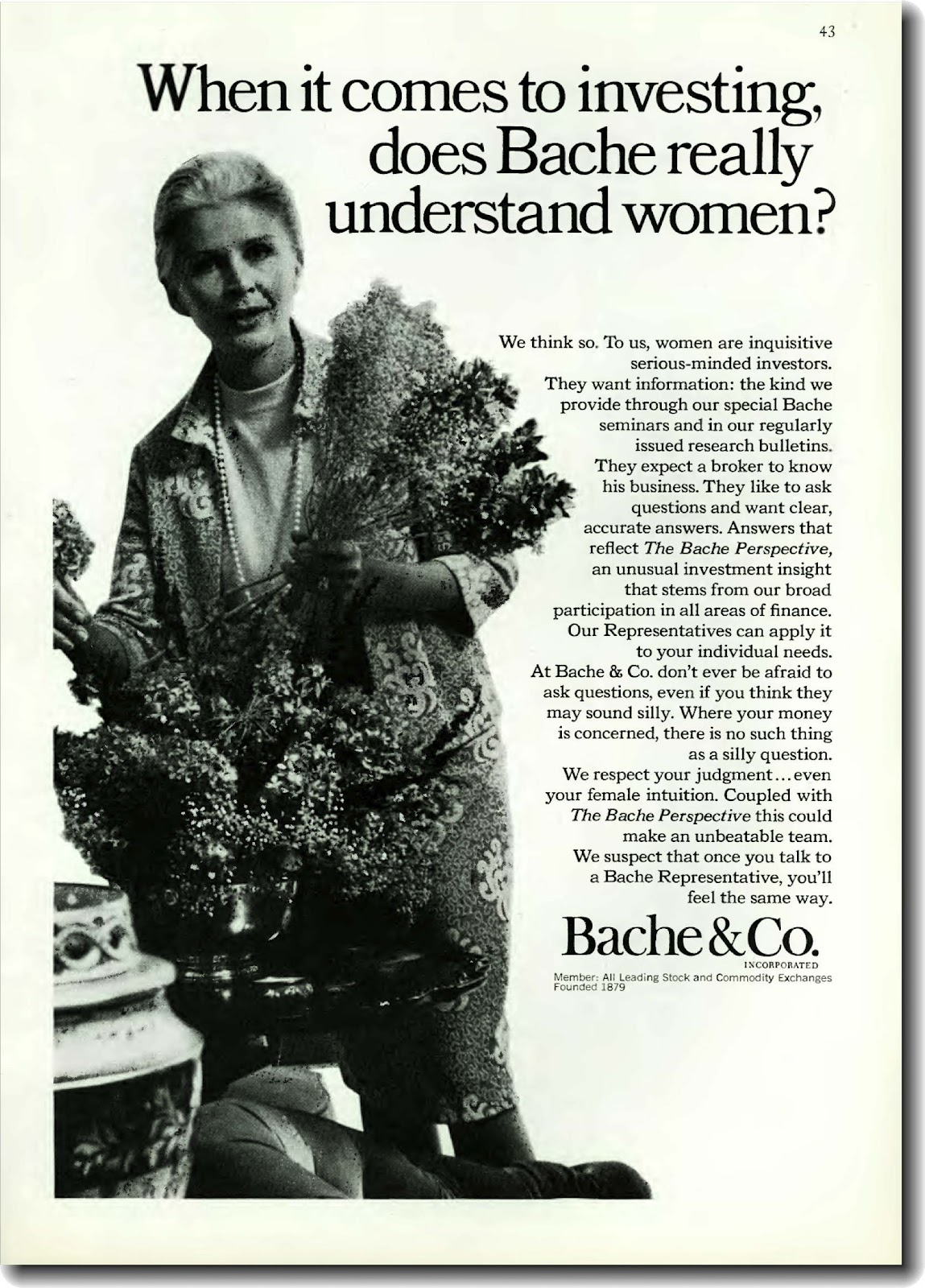
Bache & Co. ad from 1966:


Give the copywriter credit for taking the woman investor seriously. Take points off for the "women's intuition" jibe.

These days, women investors have become role models. See Warren Buffett invests like a girl
The look of that Bache ad is 1950's stodgy by the Mad Men standards of 1966. Compare my favorite 1966 Schweppes ad, where the distinguished Commander Whitehead, president of Schweppes USA, hits the beach.

Wednesday, July 11, 2012

Think Generations, Not Gender

On his latest radio show Ric Edelman remarked that women are taking greater responsibility for family investments. A generation ago, many wives managed daily family finances while their husbands toyed with the brokerage account. Today, much investing is done through 401(k)s and other retirement plans. Increasingly, it seems, the wife who monitors the family bank accounts keeps an eye on the family  retirement accounts as well.

Nevertheless, male wealth managers continue to wonder: What do women really want? Schwab seeks to provide guidance with a survey of "high net worth women," but note the quotes. Average investable assets for the women surveyed was only $1.3 million, making it unlikely that most qualified as high net worth. Half had no investment account. Four in ten had no credit card of their own.

For a meatier survey, see US Trust's 2012 Insights on Wealth and Worth. The study probes wealth-related attitudes by generation – pre-boomer, boomer and under 50. Boomers, it turns out, have relatively less interest in keeping wealth in the family. Under-50's are more likely to turn to private banks or trust companies for investment guidance.

Friday, July 06, 2012

Could Women Have Saved Lehman Brothers?

Picture a group of top-notch trust officers. Estimate how much they make in a year.  Compare your estimate with the annual fortunes – typically between $10 million and $20 million – received by the top 50 employees of Lehman Brothers before it collapsed. (The top 50 were subordinate to Lehman's corporate officers, whose presumably higher earnings went on public record.)

"The one thing which is most startling about this list," Felix Salmon observes, "is the number of women on it: exactly zero. One can’t help but suspect that the all-male culture at the upper reaches of Lehman was a corrosive and damaging thing, which in some way helped lead to the bank’s demise."

Woman are thought to be more prudent investors, on average, than men. Would a healthy infusion of female managing directors help Wall Street manage its greed?

If so, help may be on the way. Watch for alumnae of Westover School.

Friday, January 06, 2012

"I Am Woman, Watch Me Retire"

"It's underappreciated how much better one large cohort of aging boomers should do financially during the traditional retirement years," writes Chris Farrell in BloombergBusinessweek: "The college-educated stalwarts of the feminist movement."

These professional women have been slightly better than men at taking advantage of 401(k) plans, he notes. And they don't have to hurry into retirement. 
The vanguard generation of the women’s movement is well-suited to work long into the traditional retirement years. Baby boomers are healthier and better educated than earlier generations. Survey after survey shows that they don’t think of themselves as old and they’re well-positioned to earn a paycheck.
They're well-suited to investing, too,  Farrell contends. "A University of Michigan Retirement Research Center study found that men trade 56 percent more than their female counterparts in 401(k) plans, and the more men traded, the worse they did." 


Many of these women should be prospects for investment services of fiduciary quality.