Tuesday, August 21, 2012

Should “Bankable Personas” Survive as Estate Assets?

Bill Cosby reportedly nudged Massachusetts to consider a statute that preserves a deceased celebrity's identity as an estate asset for 70 years. Already passed by the Massachusetts Senate, the legislation will become law if approved by the House. Massachusetts then would  become the 16th state to establish the right of publicity as an inheritable asset.

Leon Neyfakh surveys the pros and cons of preserving a celebrity's identity in this Boston Globe article.
Mad Men era note: Before Bill Cosby became a familiar father figure on sitcoms, he gained television stardom on I Spy. In that show Robert Culp and Cosby played CIA types, traipsing around the world under cover as a tennis player and his trainer/manager. A few NBC affiliates were so shocked by a black leading man they refused to run the show. For at least the first two of its three seasons on NBC – a big-deal network back then – I Spy was pretty cool.

Sunday, August 19, 2012

Was That Sam Israel Laughing?

The case of Sam Israel and the ponzi scheme he called Bayou just keeps getting weirder:  Goldman, Still Playing In Bayou's Mud.

Thursday, August 16, 2012

SmartMoney: Hail and Farewell

The September issue of SmartMoney will be its last, on paper. Times are tough for magazines. As Rupert Murdoch takes The Wall Street Journal mainstream to compete with The New York Times, he may feel less need for a personal-finance publication.

SmartMoney hopes to continue online. Generally, web sites seem sorry substitutes for print publications.  Magazines on the iPad look more promising. A touch screen allows readers of, say, The Economist to leaf through articles and skip or return to ad pages much as print readers do. But judging from SmartMoney's announcement, the publication is destined to be little more than a web site.

SmartMoney launched in 1992. Seems like only yesterday to some of us. In reality it was a world without smart phones. Wall Street was a place where ordinary folks thought twice before going to the expense of buying stocks. At Schwab in 1991, SmartMoney recalls, the average price of a trade was about $76. And that was a bargain compared with "full-service" commissions.

Haven't read SmartMoney much since my working days. At its best the content had a bit of an edge. One of the last examples, perhaps, is this column from Brett Arends. Though Mitt Romney may have paid at least 13 percent in federal income tax for the last ten years, as he announced today, he probably paid more for investment management.

Tying Strings on Trusts

"…of sound mind, good moral character and temperate financial habits."

Do you qualify? How do you define those "temperate financial habits?" No more than three credit cards? No home-equity loan? No junk bonds? Evidently the folks at Northern Trust understood the requirement well enough to decide on a distribution to a trust beneficiary. See Getting Heirs to Do Your Bidding.

Laura Sanders' survey of string-tying reminds us that modern testators and trustors really have to watch their language. For instance, must a beneficiary's "spouse" be of a particular gender? Do "descendants" include a child conceived with frozen sperm?

Wednesday, August 15, 2012

When the Going Gets Tough, Investors Need Fiduciaries


Two icons of the investment world have looked ahead, and what they see isn't pretty.

Bill Gross, the bond king, says the cult of equities is dying. Jeremy Siegel and others point out that Gross confuses stock appreciation with stock returns. Even so, Gross makes his case: subpar returns appear likely for several years.

John Bogle, the Vanguard founder, terms this the worst time for investors he's ever seen. The outlook for stocks is poor, and “the outlook for bonds over the next decade is really terrible.”


That's not even the bad news. In Bogle's view, the whole financial-services system is broken. “A culture of short-term speculation has run rampant,” he writes in his latest book, “superseding the culture of long-term investment that was dominant earlier in the post-World War II era.”

Bogle's proposed remedies, as summarized by The New York Times:

He advocates taxes to discourage short-term speculation. He wants limits on leverage, transparency for financial derivatives, stricter punishments for financial crimes and, perhaps most urgently, a unified fiduciary standard for all money managers: “A fiduciary standard means, basically, put the interests of the client first. No excuses. Period.”

Agreed. In a perfect world all investors, even "the little guy," would receive the same kind of unbiased guidance offered by the best corporate trustees and advisory firms.

In the real world, it's a tall order.

A clipping from "The Clash of Cultures"

Friday, August 10, 2012

How to Pay Off the National Debt

Wealth managers and their clients can stop worrying about the fiscal cliff. Allan Sloan has a Modest Proposal that will erase not only federal deficits but the entire National Debt.

As real life moves beyond parody, columnists like Sloan face a daunting challenge. How do you make fiction sound stranger than fact? The Washington Post apparently feared we'd take Sloan's idea seriously. Hence the warning, "Budgetary satire."

Hollywood screenwriters also have it tough. How on earth do you satirize Congressional politics? Reviewing "The Campaign."the new comedy with Will Ferrell and Zach Galifianakis, New York Times film critic A. O. Scott concludes that you probably can't:
[T]here may be comfort in the thought that the American people would never elect clowns like these to any office. But then a glance at some of the clowns we do elect, perhaps especially to our national legislature, might lead you in the opposite direction. Really, the movie could not possibly go far enough unless the screenwriters (Chris Henchy and Shawn Harwell) had abandoned all invention and transcribed the script directly from C-Span. 
As for Wall Street, just imagine a screenwriter pitching his over-the-top financial farce: "This brokerage firm installs new trading software, see? It runs amok and costs them a fortune. All because they can't find the 'off' switch!"

Doesn't Sloan's scheme to take  the Fed public sound more plausible?

Monday, August 06, 2012

If you see a cliff, which way do you run?

We're running toward the fiscal cliff.  The Democrats have already announced a plan to let all the Bush tax cuts expire, so they can start fresh in the spring.  The sequester is on the way, and firms will soon be sending out legally required pink slips.

Businesses are running away from the cliff.

They have more at risk, after all.

Tuesday, July 31, 2012

The Upside of High Income Tax Rates

Basically, an income tax can be designed in a couple of ways.

1. Low rates, perhaps a flat tax, levied on a wide tax base. Few if any deductions. (Why should Uncle  Sam try to control the way you spend, invest or donate your income?) Most proponents of federal-income-tax reform lean toward this model. Realists try not to laugh.

2. High rates, made bearable by plentiful deductions. The wicked tax rates of half a century ago did not apply to interest payments, medical expenses, state and local tax payments, any purchase of goods or services that could conceivably be called a business expense, etc., etc.

The current revenue code, beloved by no one, could be termed a rag-tag compromise – "moderate" income-tax rates paired with limited deductions that sometimes phase out or vanish, depending on the level or nature of a taxpayer's income.

If a simple, low-rate, federal income tax is politically impossible, should we go back to high rates? In his Sunday New York Times op-ed, Yale economist Robert Shiller runs the idea up the flagpole.

During World War II, Shiller points out, the top income tax rate soared to 94 percent. Rates remained high after the war but did not seriously hamper the post-war boom. And people seemed to get along better back then. (Little Orphan Annie liked Daddy Warbucks). High tax rates and an ample charitable deduction eased class envy and promoted generosity, in Shiller's view.

Think we could recreate the spirit of the 1948-1963 era? In those kind and generous times, Republicans were happy to vote for a massive national infrastructure project – the interstate highway system.

The good old days
Shiller's theme, promoting philanthropy through taxation, reminded me of "Art and Taxes," an article by Jerome Rubin in the December, 1966 issue of Horizon. A sister publication of American Heritage, Horizon was hard-bound, lavishly illustrated and covered the wold of culture.

High tax rates paired with a charitable deduction don't merely encourage generosity, the article points out. They make generosity profitable. "Such titans as Morgan, Altman and Frick could afford to be generous to the nation's museums. With a proper regard for the Collector of Internal Revenue, today's wealth cannot afford not to be."

Rubin offers an example:

Thursday, July 26, 2012

What's Past Is . . . Prologue?

Enough of the Mad Men era. Let's move on to the advertising archives of 1982.
You know about the Great Bull Market that began thirty years ago. 1982, what a great time to invest!

Now turn your Hindsight Device  to "Off."

in 1982 the stock market had been declared dead and a recession had begun. To survive hard times, U.S. Trust expanded its banking operations. The strategy may have helped in the short run, but the future belonged to megabanks. Even The Bank of New York, a moderately-sized commercial bank founded by Alexander Hamilton, ended up merging with Mellon Bank. U.S. Trust became a wealth-management arm of Bank of America.

The greatest megabank was created by Sandy Weill. In 1998 Weill merged Travellers, which owned Salomon Smith Barney, with Citibank to form Citigroup. At that time Citigroup ranked as the largest financial services company in the world.

Citigroup barely survived the Great Recession. Now retired, Sandy Weill astonished the financial world this week by admitting megabanks were a mistake. We probably ought to bring back the Glass-Steagall era, Weill told CNBC, once again separating investment banks from commercial banks that hold federally-insured deposits. Wow!

Thursday, July 19, 2012

One Picture is Worth . . .

Great illustration on the cover of Bloomberg Businessweek.


The cover story is one that wealth managers and their clients will be chatting about: Does more economic pain produce quicker gain?

Wednesday, July 18, 2012

Presidential Tax Returns

H/T to Glenn Kessler, The Fact Checker at The Washington Post, for calling attention to the treasure trove of presidential income-tax returns at the Tax History Project. Browse returns as far back as FDR.

Roosevelt, 1913, Assistant Secretary of the Navy
The Roosevelt archive goes all the way back to 1913. With his first return FDR enclosed a letter from The Bank Of California, noting the  deductibility of a state tax paid by the bank on behalf of its shareholders.

Tuesday, July 17, 2012

An IPO Shakes the Money Tree

Gaining private banking and wealth management relationships with the very rich, even the young very rich, is a challenge. Once in a while, though, fate lends a hand. Morgan Stanley's misfortunes in taking Facebook public, Felix Salmon suggests, turned out to be First Republic's good luck.

Photo: Noah Berger/Bloomberg
Mark Zuckerberg's newly refinanced residence is an Old Money (1903) home.

Sunday, July 15, 2012

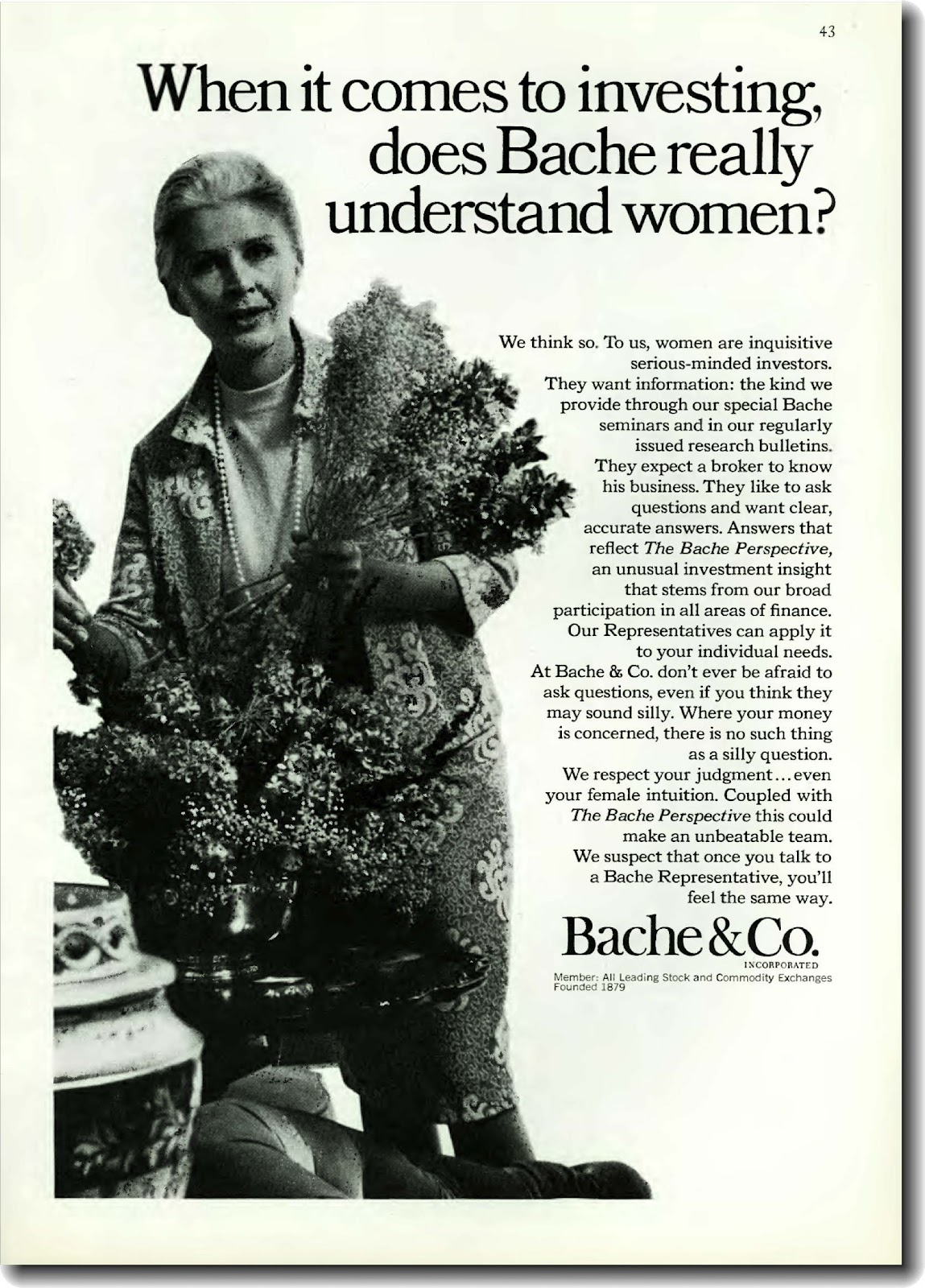
Evolution of the Woman Investor

Bache & Co. ad from 1966:


Give the copywriter credit for taking the woman investor seriously. Take points off for the "women's intuition" jibe.

These days, women investors have become role models. See Warren Buffett invests like a girl
The look of that Bache ad is 1950's stodgy by the Mad Men standards of 1966. Compare my favorite 1966 Schweppes ad, where the distinguished Commander Whitehead, president of Schweppes USA, hits the beach.

Brother, Can You Spare $10 Million?

Bloomberg seems worried: Rich Passing Up $10 million Opportunity to Gift Tax-Free. According to one survey of CPAs, fewer than 10 percent of people with $10 million or more have used any of their federal gift tax exemption or plan to do so.

As the Bloomberg report indicates, the generous gift-tax exemption now available can be helpful to owners of exceptionally valuable family businesses. Otherwise, the aversion to massive gifting is understandable. Folks with $20 million or $30 million could see their net worth plummet if the Great Global Deleveraging ends badly; they don't feel they have a lot of wealth to spare. As Bloomberg notes, those with $100 million or more are likelier candidates for gifting.

Billionaires are the best bet. My State, New Hampshire, is among those seeking to attract their trust business. Glad to learn that one NH trust company has picked up six billionaire clients in the last couple of years.

Last year Mary Rowland reported on New Hampshire trusts, as well as family-office developments,  in Keeping Family Trust.

Friday, July 13, 2012

How to beat the stock market!

It's a truism that if you miss the five best days of the year in the stock market, you'll get mediocre returns.  We write about this regularly. Because one can't know when the five best days are, one needs to stay invested all the time. It's a great anti-timing argument.

But what if you knew with some confidence when the best days would be?

According to a staff report at the New York Federal Reserve Bank, most of increase in the S&P 500 since 1994 has occurred on the days just before the announcements of the Federal Open Market Committee!  Taking out the three day window before the announcements leaves the index essentially flat for the past 17 years (the data ends in 2011).

Interestingly, the nature of the FOMC announcement didn't matter.

I haven't finished reading the paper for their attempted explanation of the phenomenon, but the topic will be in the next issue of our Investment and Trust Newsletter.

Thursday, July 12, 2012

Gunpowder … Inheritance … Shots Fired


An elderly woman. Two children with whom she was not close. A nephew who steps in to help his aunt in her final years. Her revised will, leaving him a third of her $12 million. A drive-by shooting with apparently murderous intent.

As if we needed reminding, inheritance can be an explosive subject.

Update: July 12: a more detailed account of the feud.

Wednesday, July 11, 2012

Think Generations, Not Gender

On his latest radio show Ric Edelman remarked that women are taking greater responsibility for family investments. A generation ago, many wives managed daily family finances while their husbands toyed with the brokerage account. Today, much investing is done through 401(k)s and other retirement plans. Increasingly, it seems, the wife who monitors the family bank accounts keeps an eye on the family  retirement accounts as well.

Nevertheless, male wealth managers continue to wonder: What do women really want? Schwab seeks to provide guidance with a survey of "high net worth women," but note the quotes. Average investable assets for the women surveyed was only $1.3 million, making it unlikely that most qualified as high net worth. Half had no investment account. Four in ten had no credit card of their own.

For a meatier survey, see US Trust's 2012 Insights on Wealth and Worth. The study probes wealth-related attitudes by generation – pre-boomer, boomer and under 50. Boomers, it turns out, have relatively less interest in keeping wealth in the family. Under-50's are more likely to turn to private banks or trust companies for investment guidance.

Saturday, July 07, 2012

“My Trust Fund”

Ever heard of a yacht named "My Brokerage Account"? Not likely. See Fred Schwed's Where Are the Customers' Yachts?

Now check out the name of the superyacht berthed at Wentworth marina, just a few miles from this blog's Northern office:


"My Trust Fund"was purchased by a couple (Canadian, you think?) at last fall's Monaco yacht show. You can admire her photo gallery here.


Friday, July 06, 2012

Could Women Have Saved Lehman Brothers?

Picture a group of top-notch trust officers. Estimate how much they make in a year.  Compare your estimate with the annual fortunes – typically between $10 million and $20 million – received by the top 50 employees of Lehman Brothers before it collapsed. (The top 50 were subordinate to Lehman's corporate officers, whose presumably higher earnings went on public record.)

"The one thing which is most startling about this list," Felix Salmon observes, "is the number of women on it: exactly zero. One can’t help but suspect that the all-male culture at the upper reaches of Lehman was a corrosive and damaging thing, which in some way helped lead to the bank’s demise."

Woman are thought to be more prudent investors, on average, than men. Would a healthy infusion of female managing directors help Wall Street manage its greed?

If so, help may be on the way. Watch for alumnae of Westover School.

Tuesday, July 03, 2012

Wealth management pays off!

To the tune of $118 billion, says the American Banker.

Time for some more wealth management newsletters?

Tuesday, June 26, 2012

Does Your Hedge Fund Manager Have Time to Talk?

A medium-security facility at Butner
Prompted by an upcoming book on Connecticut's notorious Ponzi artist, Joe Nocera of the NY Times went to the Butner Federal Correctional Complex in North Carolina to talk with the subject, Sam Israel III.

The manager of the mostly mythical Bayou funds said hedge fund investors should  investigate before they invest:
Seek as much transparency as possible. If they do not understand exactly how a manager is making money, do not invest. If there is a secret process that cannot be explained, run. Go see the organization yourself, talk to the employees. The manager cannot see everyone or he could not be making money; if he has all the time in the world for you, that is a flag.
Good advice, but unlikely to stop investors for stumbling into the next Bayou. Sam Israel's approach, short-term trading of stocks, sounded simple enough. Who knew his accountant was as fictitious as his returns?

Top SSRN downloads

When Professor Gerry Beyer writes an Estate Planning Study for us, we provide a PDF for him to post to the SSRN Journal of Wills, Trusts and Estates Law.  We're pleased to see that, according to his blog, his April Study is the second-most downloaded paper for the current period.  I expect that if people are willing to go to the trouble to download it, those who receive it free from our clients will be willing to read it.

Saturday, June 23, 2012

Jonathan Blattmachr's Mindboggling Trusts

Will more people with eight-or-nine-figure net worths (a somewhat limited market) set up trusts that take advantage of this year's extraordinarily generous federal gift tax and GST exemptions?

Jonathan Blattmachr, the noted tax-planning guru, is not letting the opportunity go to waste. According to Paul Sullivan in The New York Times, Blattmachr has created what could prove to be an estate-planning masterpiece.
[Blattmachr] has structured trusts with his wife, Betsy, that are so complex they boggle the mind. They enable the Blattmachrs to take advantage of the current exemptions and gift money today to reduce future estate taxes. But he has structured the trusts, which each hold about $4 million, in such a way that they have a built-in safety valve if something goes wrong: they can get the money back.
Could the IRS consider the trusts a shell game and deny the Blattmachrs' tax savings? Time may tell.

Wednesday, June 20, 2012

The Top 400 Taxpayers Club

Bruce Bartlett's post at Economix looks at income inequality over the years. For members of the Top 400 Taxpayers Club, there's good news and bad news.

Good news. The effective tax rate paid by club members, which had risen to about 30% in 1995, was only about 20% in 2009.

Bad news. For about three out of four members, their club membership expired after one year and was never renewed.

Tuesday, June 19, 2012

The Mystery of Joe Paterno's Will

Like many 21st-century wills, that of the late Penn State football coach Joe Paterno is uninformative. He had a living trust, so his will simply disposes of tangible personal property and sweeps any remaining assets into the trust.

Because the terms of living trusts usually remain private, we may never know much about Paterno's estate plan.

The mystery: Why did the Paterno family nevertheless seek to keep the will secret?

Wednesday, June 13, 2012

Women of the 1960’s: It was Complicated

Mad Men ended its season last Sunday. We'll have to wait for season six to find out how Joan, Megan and Peggy cope with their careers and romances (relationships hadn't been invented yet).

 Meanwhile, this comparison will help illustrate the complexity of women's roles in the 1960's.


"The little woman." What did The Women Who Lunch do for the rest of the afternoon? Apparently they played bridge. Even when this Merrill Anderson ad for US Trust appeared in 1966, the image seemed dated and Merrill's copy condescending:
The man who introduces his wife to the Trust company – to observe and take part in his talks with them – is filling the role of a devoted and far-seeing husband.
But remember, in those days many a high-net-worth man was married to a woman who didn't know how to write a check. Often the men liked it that way. "You want my wife to talk with you? What if she learns my net worth? Good grief! Next thing, you'll be wanting to tell her my income."

Mad women. In the 1960's women found little welcome in many areas of business, especially banking and Wall Street. Advertising was something of an exception, and had been for decades.

In London in the 1920's, Dorothy Sayers worked for an ad agency. (So did the hero of her mysteries, Lord Peter Wimsey, in "Murder Must Advertise.") In New York, circa 1930, another Dorothy worked for Edwin Bird Wilson. So did young Merrill Anderson. They married, and in 1934 Merrill and Dorothy Anderson launched The Merrill Anderson Company.

In the 1960's, the really big news on Madison Avenue was a woman. Mary Wells Lawrence. Read her story and you'll appreciate the challenge faced by Mad Men creator Matthew Weiner: you can't make this stuff up.

How the Great Recession Dented Family Finances

You've heard about the Great Recession, right? So no surprise when the Fed's new Survey of Consumer Finances revealed (BREAKING NEWS!) that the fall in prices of real estate and corporate shares caused Americans' wealth to decline.

This decline, The Wall Street Journal points out, further dampens Boomers' hopes of retiring in comfort on the inheritances they receive from their parents. Those hopes were overblown anyway. Only the notorious Top One Percent of families ever had enough wealth – at least a few million – to leave their children significant nest eggs.

The new Fed survey offers plenty of tidbits for those with time to browse. Households in the East are significantly richer than those in the South or Midwest. Americans now have 38.1% of their financial assets in retirement plans. Only about 1% report having trusts or managed investment accounts. That sounds low. Can we try for 2%?

Sunday, June 10, 2012

Death of an Inheritance Tax

Tennessee is ending its taxation of gifts and inheritances, and the governor figures Tennessee will come out ahead. 

Tennessee's action leaves our sponsor's home base, Connecticut, as the only state that continues to tax gifts.

Saturday, June 09, 2012

The Birth of Inherited Wealth?

Along with farming and architecture (think Stonehenge) inheritance may have developed way back in the Neolithic – the New Stone Age. So suggests this research reported by The Guardian.

Inheritance taxes came a little later.

Two Neolithic figures

Sunday, June 03, 2012

When Jaguars Were Like Hedge Funds

Last week Sterling Cooper Draper Pryce, the Mad Men agency, won the Jaguar account. Back then, Jaguar's cars behaved a bit like the hedge funds of our time. At their best, the E-Type roadster, Jags were like a stellar fund that generates a 23% annual return. Otherwise, Jaguars were like the average hedge fund – upscale image despite decidedly mediocre performance.  (One of my college roommates prospered quickly, acquired a Jaguar sedan, and promptly regretted it. The temperamental beast seldom took him far.) 

1961
At Bonham's June 3 Greenwich Concours action, this fully restored 1964 Jaguar E Type roadster just sold for $128,00. Will hedge funds will remain as popular three or four decades from now?


Queen Elizabeth celebrated her Diamond Jubilee today, so it's appropriate to recall British autos. But let the record show that America also produced notable roadsters. This ad is from 1966.


Investing in art

Interesting piece in the NYTimes on why the art market seems to be doing so much better than the rest of the economy. Best bit:
Sergey Skaterschikov, who publishes an influential art-investment report, says that no painting bought for $30 million or more has ever been resold at a profit.

Friday, June 01, 2012

Estate Planning Isn’t Just Estate Tax Planning

What kind of federal estate tax will we have next year? Year after that? Nobody knows. Meantime, Estate Planning.com, a site produced by WealthCounsel, reminds us that estate planning isn't just about taxes. Good to see that the featured article, recently, was Understanding the Significance of Trusts. You'll find other articles of interest as well.

Tuesday, May 29, 2012

Public Pensions and the 8% Myth

City and State governments and  the unions representing their employees pretty much agree: on average, pension fund investments ought to earn close to 8 percent a year. The reality? Returns are closer to 5 percent – even lower for pension funds that go for broke with hedge funds, private equity or real estate.

Why don't plan sponsors set realistic investment targets? Because hard-pressed taxpayers then would be required to contribute more money to the plans. Why don't employee unions insist on realism? Because they fear benefits would be cut to avoid a taxpayer rebellion.

We bring up this impasse for two reasons. First, it's an excuse to quote New York City's mayor:
The actuary [for the city's five pension funds] is supposedly going to lower the assumed reinvestment rate from an absolutely hysterical, laughable 8 percent to a totally indefensible 7 or 7.5 percent. If I can give you one piece of financial advice: If somebody offers you a guaranteed 7 percent on your money for the rest of your life, you take it and just make sure the guy’s name is not Madoff.
Second, now and then every investor needs a reminder that wanting a stated rate of return bears no relation whatsoever to getting that rate of return. "If wishes were horses," as my mother used to tell me, "beggars would ride."

Jackie O's Charitable Lead Trust

Merrill Anderson's trust marketing publications covered Jackie O's charitable lead trust in some detail when the news of it broke.   We called it an astute strategy for disinheriting the IRS.  However, the trust was never funded, and I never heard the rest of the story.

According to Conrad Teitell, as reported in Trust & Estates, the trust was a fallback provision.  Most of the wealth was already in a revocable living trust, whose remaindermen were Carolyn and John, Mrs. Onassis' children.  The property would have passed to the the CLAT only in the event that the children disclaimed. They decided against that, based upon the facts and family circumstances at her death.

Sunday, May 27, 2012

When Private Investors Met the Space Age

On May 26 astronauts at the International Space Station unloaded cargo from the Dragon capsule, a privately-owned spaceship. Here's a timely ad from the brokerage firm Francis I. duPont. It appeared in the July 16, 1966, issue of The New Yorker.


"Spaceology is the name of the game today," duPont proclaims. With the onset of commercial space flights, brokers are probably thinking the same way this year, although the term spaceology has not caught on.

In 1966 few realized how communications satellites would transform how people lived and worked. Live television from distant lands was the first electronic marvel. In 1969 a Foreign Affairs article observed
Only seven years [after the first transatlantic television broadcast] nearly half the land mass of the world was interlaced with communications facilities that made it possible for virtually all television viewers everywhere to watch live pictures from the surface of the moon. We have progressed to the point where a worldwide communications system is in full operation….
Foreign Affairs  also foresaw the first seeds of the next marvel: "data transmission, from computer to computer." As this 1961 City (Citi) Bank ad indicates, well-to-do travelers used to be a natural market for trustworthy investment help. Investors needed someone back home to keep an eye on their wealth.

These days, all they need is an iPhone.

Even so, a trustworthy investment adviser is a most desirable luxury. How can substantial investors enjoy traipsing around the Pacific Rim if they also have to worry about restructuring their portfolios to withstand a financial meltdown in Europe?