Friday, October 31, 2008

We'll Wait 'Til Next Year


May Halloween 2009 bring us fewer financially-engineered tricks, more stock-market treats.

Thursday, October 30, 2008

Can the Broker and the Fiduciary be Friends?

Brokers work the sell side; asset managers in bank trust departments represent the buy side. Never the twain shall meet?

Don't be too sure. As brokers seek more fee-based business, via managed accounts and such, the gap is narrowing.

This Bank Investment Consultant report on bank "book brokers" spotlights top producers who mostly emphasize fee business. Many are affliliated with Sun Trust, including Tom Gletner:
Gletner became the poster child for Sun Trust's team approach, which enables him to bring in private bankers, trust and estate officers, insurance experts, financial planners and lenders whenever he meets with a new client.

Wednesday, October 29, 2008

Your tax dollars at work

Here's an online video game intended to teach someone--videogamers?--the basics of credit management: US Treasury - Bad Credit Hotel. I discovered the reference to it in this NY Times article.

Can this possibly work? I really doubt it, but then I'm not a perfeshunal edjamakater. Plus, I couldn't get out of the phone booth--just figuring out how to dial the rotary phone was my main accomplishment.

Tuesday, October 28, 2008

Unhand Those Little Old Banks!

Community banks fear the nation's largest banks may use the billions of dollars they are getting from taxpayers to buy smaller banks rather than make new loans, The Wall Street Journal reports.

The Washington Post seems to like community banks well enough. Recently we mentioned The Post's write-up of small banks in the D.C. area. Here The Post profiles Farmer's Savings Bank, a thriving little old bank in Iowa. Summarizing personal trust and investment services on one web page isn't simple; Farmers does a concise job.

The last little old bank in Portmouth, New Hampshire, has revved up its marketing. Piscataqua Savings Bank is running a nice series of testimonials from happy customers (including trust customers!). The bank also has revamped its web site. Take a look and admire two marketing strategies worth emulating:

1. Keep it simple. Anyone can understand the links in the menu across the top of the home page: LOANS • DEPOSITS • TRUSTS & INVESTMENTS. You can't imagine how refreshing that is. No "Private Client Services," "Legacy Planning" or –worst of all – that inscrutable phrase, "Personal Financial Services."

2. If you've got it, flaunt it. Many of us bank with organizations that change names and/or managements every few years. Wouldn't you like to have your trust handled by a little old bank that's been around since 1877 and still going strong?

Monday, October 27, 2008

Mad Men's Weirdest Ad?

In the same issue of The New Yorker that carried the Vintage Trust Ads appeared this baffling ad for Springmaid. Click on the thumbnail to view the apparition full size.

A parody, obviously. But of what? Why the red and green glasses, presumably swiped from some theater showing a 3-D film? Why were references to a Stutz Bearcat supposed to be funny? (My father and a friend once co-owned a Bearcat; must have been about the time he set out to conquer Wall Street via a job on the Cocoa Exchange.)

Can anyone explain?

The Age of Prosperity Is Over (?)

This Wall Street Journal op-ed by Arthur Laffer is deeply disturbing. Mainly because I think he was right about the "Laffer curve," and I sure hope he is wrong about the economy's prospects. I like these observations:
Profits and stock appreciation are not rights, but rewards for insight mixed with a willingness to take risk.
and
Whenever the government bails someone out of trouble, they always put someone into trouble, plus of course a toll for the troll. Every $100 billion in bailout requires at least $130 billion in taxes, where the $30 billion extra is the cost of getting government involved.
The larger thesis is that the Bush administration has fully botched this economic crisis, and will be rightly remembered as the heir to the Hoover administration. Meanwhile, according to Laffer, Clinton was the true heir to Reagan!

Read the whole thing.

Saturday, October 25, 2008

Therapy for the Formerly Richer

In the NY Times, Eric Konigsberg profiles Charles A. Lowenhaupt, the third generation of his family to run a family office that now serves four clans. Predictably, Lowenhaupt has a lot of hand-holding to do these days.

Where do Ultra High Net Worth folks turn for therapy if they don't have a family office? To a psychologist who specializes in financial angst, says The Wealth Report.

Vintage Trust Ads

Generally, The New Yorker magazine of half a century ago ran only one or two trust-company ads each week. If, say, Bank of New York was advertising one week, Chase had to wait until the following issue, and vice versa. Surprising, then, to find three ads in the October 11, 1958 New Yorker. Click on each thumbnail for a larger image.


Wednesday, October 22, 2008

Should Asset Managers Become Credit Counselors?

Consumers are maxed out. Businesses large and small founder because they can't borrow money as usual. Unless credit, a.k.a. liquidity, starts flowing again, everybody is done for.

Except . . . .

Apple sold almost 7 million iPhones last quarter, outselling Blackberries. Sales of Mac computers rose another 21 percent. But here are the truly amazing statistics:

Apple's debt at the end of this fiscal year: 0

Apple's cash: $25 billion.

Sounds like asset managers have a clear choice: Retrain as debt counselors or look for business from Steve Jobs and his crew.

A Truly Foolish Hospice

In the land of the blind, the one-eyed man is king. Perhaps Tom and David Gardner recalled that truism when they ventured into the land of Wall Street. There, perceived wisdom is likely to be hazardous to your financial health, 'Tis wiser to be a fool. Ideally, a Motley Fool - the kind who bopped around the royal courts of yore, speaking truths the King's ministers dared not whisper.

Last summer, the Gardner brothers' mother, Marie-Dennett McDill, learned that terminal cancer left her with only weeks to live. The family arranged for hospice care, but not at a hospice. Mrs. McDill was moved into one of her favorite places, New York's luxurious Carlyle Hotel.

At the Carlyle, she was able to enjoy walks in Central Park by day and listen to Loston Harris play Cole Porter tunes in the Bemelman's Bar by night.

A week ago Mrs. McDill died in her sleep. At her memorial service, Mr. Harris played Cole Porter.

Mrs. McDill is survived by an extremely Foolish family.

Tuesday, October 21, 2008

Will Family Offices Flock Together?

Should managers of family offices shepherding assets of $30 million or more get to know each other? The Stamford Advocate reports on a new opportunity:
To help the "ultra-wealthy" find opportunities and meet other families of similar means, Angelo Robles has founded the Family Office Association in Stamford.
***
"I usually find that very wealthy people like to collaborate with other people like them, whether it's in investing or real estate," he said. "We plan to reach out from a global perspective to the ultra-wealthy."

Robles said the Family Office Association was launched last week with a Global Assets Showcase at the Hyatt Regency Greenwich.

Sunday, October 19, 2008

Monopoly Explains it All

The board game Monopoly was all the rage during the Great Depression, writes Tim Hartford in The Washington Post. He finds it an apt symbol for our present pickle.
Loose money. Monopoly games start swimming in money, which is briefly mopped up as the players buy everything in sight. But then money starts to flood the system again….

Vague and constantly-changing rules. Most enterprising kids treat Monopoly the way enterprising investment bankers treat the financial system, quickly making up their own rules and striking side-deals insuring each other against catastrophe. These side-deals now add up to a nerve-wracking $596 trillion, more than forty times the size of the US economy. ***

The endgame. For all Monopoly’s merits, fans complain about the way it tends to end in a slow capitulation, one player after another dropping out as ever greater sums of money slosh around unpredictably between an ever smaller group of people. Remind you of anything?

Saturday, October 18, 2008

The Silver Lining is Estate Planning

"The economy is a mess, home prices are reeling, and stocks have plunged," notes The Wall Street Journal. "But for those likely to become ensnared in the estate tax, there's a silver lining: These troubled times offer some of the best opportunities in years to transfer wealth to younger generations…."

Family gift strategies surveyed in the Journal article include IDGTs (Intentially Defective Grantor Trusts) as well as GRATs and CLATs.

Friday, October 17, 2008

Bulls, Bears, Donkeys and Elephants

How do you get rich investing in stocks? Elect a Democrat President. See this chart in the NY Times. It's a good example of how graphics can help make numbers easier to comprehend.


As of Friday, a $10,000 investment in the S&P. stock market index* would have grown to $11,733 if invested under Republican presidents only, although that would be $51,211 if we exclude Herbert Hoover’s presidency during the Great Depression. Invested under Democratic presidents only, $10,000 would have grown to $300,671 at a compound rate of 8.9 percent over nearly 40 years.
Could a Bull Market emerge quicker than anyone expects if Democrat Obama wins the election? Before you get your clients' hopes up, read the David Brooks column that appeared right next to the chart in the print edition of the Times. Maybe cash is king after all.

To remotivate yourself, see Warren Buffett: Buy American. I Am.

Thursday, October 16, 2008

Two Words the Rich Fear Most

The two dreaded words: "margin call." Robert Frank writes that they're being heard more often:
Private banks are making an increasing number of margin calls to wealthy clients. A spokesman at Citi Private Bank said that “due to market conditions, we have higher than normal call activity.” He added that margin loans are “often employed” by high-net worth clients of the private bank. Other private banks and wealth-management firms tell the same story.

It is easy to blame the extraordinary market forces for all these margin calls. We could argue that the CEO’s and entrepreneurs were guilty of nothing but excessive optimism and loyalty to their company stock. But the margin calls also point to one of the hidden risks of the wealth boom: too many people were too concentrated in one stock or company. It creates enormous wealth–until it doesn’t.

Wednesday, October 15, 2008

Trusts: What's Hot, What's Not

The Washington Post's Retirement Guide includes a survey of planned giving vehicles, including foundations, trusts and donor-advised funds. Will philanthropic financial strategies continue to be a hot topic? The answer may depend on how many High Net Worth Individuals still possess their HNWs.

The Panic of 2008 may also determine who continues to care about tax-saving estate plans. In any case those old standbys, bypass or credit-shelter trusts, look like an endangered species. The Wall Street Journal points out that both John McCain and Barack Obama favor making the estate-tax credit "portable" between spouses.

Monday, October 13, 2008

In Praise of Little Old Banks

Well! Sounds like some big national banks will be really "national."

As The Washington Post reports here, little old community banks look awfully good by comparison. Deposits are pouring in. Seven-figure deposits, sometimes!

If you're the trust wing of a little old bank like Burke and Herbert or Sandy Spring – two of the community banks mentioned by the Post – opportunity for new trust business from affluent new bank customers isn't just knocking, it's practically breaking the door down.

[Start of commercial message] Many other community trust departments around the country have similar opportunities. Merrill Anderson has geared up to provide the marketing tools needed to seize those opportunities. [End of commercial message]

P.S. Burke & Herbert surely has one of the top-ten bank mascots.

Saturday, October 11, 2008

Sex, Bulls and Naked Shorts

In Swept Up by Insanity of Markets, Joe Nocera surveys students of financial behavior. They pretty much agree that the markets are governed not by science, nor even art, but by emotion.

James Grant puts it this way:
People keep on stepping on the same rakes because money, like romance, is only partly an intellectual experience. Money, like sex, brings out some thought — but also much heavy breathing and little stored knowledge. In finance, the process is cyclical. Some people learn from their ancestors, but mostly they repeat the same mistakes. Thus it has always been and thus it will always be.

Friday, October 10, 2008

Thought for the Day

From Wikipedia's article on Warren Buffet's mentor, Benjamin Graham:
Graham's favorite allegory is that of Mr. Market, a fellow who turns up every day at the stock holder's door offering to buy or sell his shares at a different price. Often, the price quoted by Mr. Market seems plausible, but often it is ridiculous. The investor is free to either agree with his quoted price and trade with him, or to ignore him completely. Mr. Market doesn't mind this, and will be back the following day to quote another price. The point is that the investor should not regard the whims of Mr. Market as determining the value of the shares that the investor owns. He should profit from market folly rather than participate in it.
If Buffett had gotten into his first choice business school, someone pointed out the other day, he would not have had to settle for Columbia. And who knows? He might never have met Graham.
They Lost Their Shirts

In Bavaria, this item from The Telegraph suggests, investors who lose their shirts might be called "naktiv."

Wednesday, October 08, 2008

Don't Step on the Lame Ducks

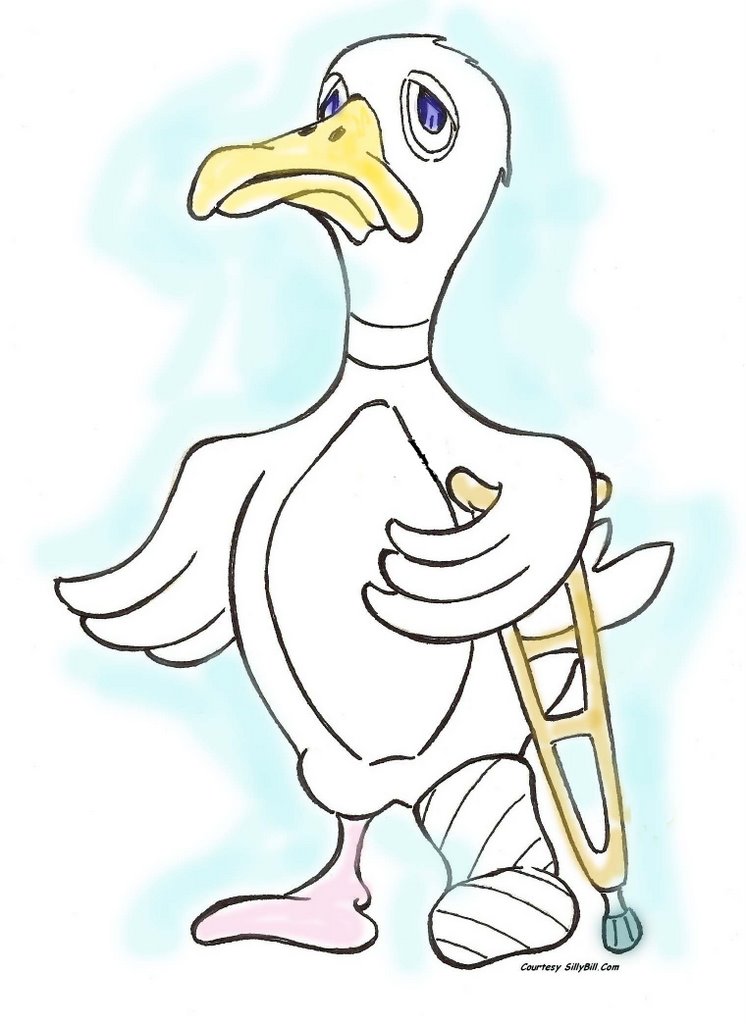
Think George W. Bush is a Lame Duck? Not really. Authentic Lame Ducks aren't over-the-hill politicians. Rather, they are members of a species we see all around us this fall: mortally-wounded stock traders.

See Bulls, Bears . . . and Lame Ducks.

Tuesday, October 07, 2008

What to Tell Your Clients (and Potential Clients)

In Ads That Soothe When Banks Are Failing Stuart Elliot of the NY Times looks at how financial advertisers are dealing with the panic. (Seems like only yesterday when it was only "the turmoil.")

He includes a worthy suggestion from Westport consultant Gary M. Stibel:

“The ads should tell people with money: ‘There is every reason to worry. That’s why we’re here.’ ”

Advertising during the Great Depression

This article is mostly about how internet advertising dollars might shift during an economic downturn. Along the way, the author makes some good points about advertising during the Great Depression (during which many advertising agencies prospered).
There was quite a number of examples of successful brands during the Great Depression, including Chevrolet cars, Camel cigarettes and Procter & Gamble (that gave birth to the phenomenon of soap opera during those hard times). And all of them relied heavily on advertising because they realized that they needed advertising to create and maintain brand loyalty. They simply pretended there was nothing particularly wrong with the economy and consumers still had money to spend - and this proved to be the right approach for them.

We should also keep in mind that advertising is one of the measures to demonstrate to consumers that the company is healthy. . . .

And this explains why those companies that survived the Great Depression and even grew during the recession period were not those that were wise about their budgets and cut on advertising as much as they could - instead those were the companies that continued to push their brands to consumers, thus making those consumers choose their brands over competitors (under-advertised) when making a decision what to spend their limited money on.

No satisfaction

Would it surprise you to learn that "satisfaction with how things are going in the United States" has fallen to 9%, the lowest level Gallup has ever recorded?

Didn't think so.

But the graph accompanying the linked NYTimes article is quite interesting. Notice that the satisfaction level fell to just over 10% at the end of the Carter presidency. It reached 50% only upon Reagan's re-election in 1984, then jumped to 70% by mid-1986. The '87 stock market crash coincided with a falloff. Satisfaction was under 50% when Bush I was elected, and it plummeted to the teens again after Clinton was elected. The 50% mark would not be reached again until 1997. Eyeballing the graph, it looks like on average only 35% to 40% of Americans have felt satisfied during the last three decades. That must mean something.

Satisfaction was over 50% as recently as 2004, as it was in 2000 when Bush II was first elected, but as been in pretty steady decline the last four years.

Wednesday, October 01, 2008

How J.P. Morgan Tamed the Trust Companies

As author of Morgan, American Financier, Jean Strouse "lived" through the Panic of 1907. If Morgan were around today, she writes in The Washington Post, he might be thinking how relatively easy he had it. No inscrutable derivatives. And he'd probably back the bailout.

Morgan would surely note one similarity between a century ago and now: reckless "bankers" running wild. In our Credit Crisis, the culprits are (or were) highly-leveraged investment banks. In 1907, Strouse recalls, the wild and crazy "bankers" were…trust companies.
What set a match to the tinder in October 1907 was a run on New York trust companies. ••• An attempt by speculators to corner the stock of a copper company failed, and as word got out that trust companies had made loans to the speculators, people with money on deposit at the trusts lined up to take it out. The trust companies, the weakest link in the financial system, operated like commercial banks -- accepting deposits, issuing loans and financing speculative schemes -- only with no regulatory supervision or mandated reserves.
Within weeks, the panic had killed off one trust company and shaken others. Banks teetered. The credit crunch threatened to close The New York Stock Exchange. Almost single-handedly, J.P. Morgan quelled the panic. But as November arrived he was still hard at work cleaning up the mess. As Strouse tells it, the new Morgan Library, completed only the year before, was his secret weapon:
[T]he bankers had to bail out a near-bankrupt New York City, and the trust companies, source of the original trouble, weren't in the clear. Sunday night, Nov. 3, Morgan gathered 50 trust company presidents at his library, told them they had to come up with $25 million on their own and left them in a large room filled with Renaissance bronzes, Gutenberg Bibles and tiers of books. He withdrew to his librarian's office. At 3 a.m., he called in one of his sleep-deprived lieutenants, Ben Strong, for a review of a trust company's books. Strong gave his report, then headed to the library's front doors and found them locked. Morgan had the key in his pocket. No one would leave until the trusts ponied up. The presidents continued to talk. At 4:15, Morgan walked in with a statement requiring each trust company to share in a new $25 million loan. One of his lawyers read it aloud, then set it on a table. "There you are, gentlemen," said Morgan.

No one moved.


Morgan took the arm of Edward King, the head of the Union Trust, and drew him to the table. "There's the place, King," he said, "and here's the pen." King signed. The other presidents signed. They set up a committee to handle the loan and supervise the final-stage bailouts of endangered trusts. At 4:45, the library's heavy brass doors swung open and let the bankers out.


As the stock market rallied and gold began to arrive from Europe, the two long weeks of crisis came to an end.

The 1907 run on the trust companies drained their deposits by $275,000,000. That's comparable to perhaps $6 billion today.

The emerging competition

Be sure to read the comments to the Robert Franks article that JLM links to below. There is a tremendous amount of ill will toward "financial advisors" who don't really do much advising at all, who spout the company line and are salesmen. The emerging competition is "do it yourself," even for those who are managing a couple million dollars.

That will prove tough competition, because many people think that they can do at least as well as the market, and no one can promise to outperform the market.

Still, I think it's a dangerous approach for many. Consider this story from today's Journal, Loyalty Pays a Bitter Dividend, about a widow whose husband had a large holding of a local bank stock. Over the years, through a series of acquisitions, that morphed into a sizeable number of Wachovia shares. The Wachovia dividends provided this widow with 1/3 of her income. That's gone now.

Someone should have told her to diversify--that's the first piece of advice she would have had from any financial advisor. Actually, someone did, but she wasn't persuaded. Wachovia's dividend was too hard to replace, not to mention the significant tax cost of diversification. Her mistakes are her own, and she isn't going to be bailed out.

Stories like that help make the case that professional investment supervision does add value to a portfolio, and should help trust departments make their case.

Tuesday, September 30, 2008

Will Four of Five High Net Worth Investors Ditch Their Advisers?

According to a Prince and Associates survey cited by Robert Frank in the Wealth Report, four out of five investors with $1 million or more plan to pull money from their investment advisers. Only one such investor out of fifty would recommend her adviser to a friend.

Perhaps Mr. Prince caught high-net-worth investors on a really bad day – and that's not hard this year. But even if the findings are exaggerated, this sounds like a great time to follow Jim Gust's advice and seek new investment-advisory business.

Monday, September 29, 2008

Never thought I'd read this

Without a trace of irony, the NY Times concludes today's morning update on the drop in the DJIA: "Mainland China’s stock markets in Shanghai and Shenzhen are closed this week as part of a national holiday marking the establishment of China as a Communist country in 1949."

A. G. Edwards Redux?

A recent post here expressed regret that Wachovia had ditched the A. G. Edwards name when it acquired that brokerage firm. Now Citigroup is buying Wachovia's banking operations but not Wachovia's brokerage or fund units.

Will we get to see that A. G. Edwards name again?

Saturday, September 27, 2008

The Man Who Shut Down Merrill Anderson

In 1977 The Merrill Anderson Company moved from 100 Park Avenue to Connecticut. Before purchasing our building in Stratford, we leased space in Westport. Our quarters overlooking the Saugatuck River were just across the bridge from Westport's library and shops. Real convenient.

Struggling over a particularly balky article one day, I failed to notice an eerie silence had descended until I opened my office door. Save for one lonely figure at the reception desk, the place seemed deserted.

"Where is everybody?"

"They went down to Baskin-Robbins. Paul Newman's at Baskin-Robbins!"

Paul Newman died September 26 at age 83. Aside from possessing the ability to shut down The Merrill Anderson Company at will, Newman was a successful race-car driver and pioneered what we now know as entrepreneurial philanthropy.

Google will take you to all the lengthy Newman obituaries in the major media. This one from the Hartford Courant is notable for including Newman's own whimsical pocket autobiography:
Paul Newman is probably best known for his spectacularly successful food conglomerate. In addition to giving the profits to charity he also ran Frank Sinatra out of the spaghetti sauce business. On the downside, the spaghetti sauce is outgrossing his films. He did graduate from Kenyon College magna cum lager and in the process begat a laundry business which was the only student-run enterprise on Main Street. Yale University later awarded him an honorary doctorate of Humane Letters for unknown reasons. He has won four Sports Car of America National Championships and is listed in the Guinness Book of World Records as the oldest driver (70) to win a professionally sanctioned race (24 hours of Daytona, 1995). He is married to the best actress on the planet, was number 19 on Nixon's enemy list, and purely by accident has done 51 films and four Broadway plays. He is generally considered by professionals to be the worst fisherman on the east coast."
Newman wasn't much for celebrity appearances around Westport. But if you ever wandered into a fund-raising lawn party at the local historical society, you might have thought the guy tending bar looked awfully familiar.

Friday, September 26, 2008

Money Disorders: Are They For Real?

Many Americans appear to take pride in their lack of money smarts. The other day a commercial for a debt-counseling firm felt it necessary to inform listeners that heavy borrowing, aka "excessive use of credit," was a leading cause of serious indebtedness. News to you?

But what if Americans aren't merely acting dumb about money? What if they're neurotic?

How to Treat a Money Disorder in the NY Times makes money manias seem endemic:
Among the problem financial behaviors identified by psychologists in recent years are: overspending, underspending (a k a Depression mentality), serial borrowing, financial infidelity (“cheating” on a spouse by spending and lying about it), workaholism, financial incest (lording money over relatives to control them), financial enabling (throwing large sums at, say, adult children who then are not motivated to support themselves), hoarding, and plenty of guilt and shame around poverty and wealth.
If country music star Wynonna Judd had not sought therapy, the Times notes, she might still own five Harleys instead of two.

Is the notion of widespread mental money disorders, such as overspending or hoarding, overblown? Before you decide, consider this comment on the national credit crisis in today's NY Times:

"Right now, players throughout the system are refusing to lend and hoarding cash…."

Should somebody call Doctor Phil?

Thursday, September 25, 2008

The PTA Plan

I agree with Robert Franks, whom JLM quoted below, on the coming storm in providing finacial services to the affluent. Here's the rest of Franks' thought:

It is no wonder that multifamily offices and wealth-management boutiques are thriving. In the coming months, wealthy clients are going to be on a rampage because of the poor performances of many of their investments. Many will rightly blame the conflicts of interest between in-house product manufacturing and distribution to wealthy clients. The wealthy have plenty of choices when it comes to their business.
We believe that trust departments, especially mid-tier trust departments not affiliated with a mega bank, are uniquely situation to capture this business in the coming year. They are local, they are conservative, and most important, they are fiduciaries and proud of it. We are already getting anecdotal evidence of this phenomenon. Trust departments could telescope several years of new business acquisition into the next several months as the financial services landscape is reshaped.

We'd like to help it along. When the going gets tough, the tough start advertising, we like to say. But to undertake a marketing campaign takes too long and it takes too much money and you don't know at the beginning what it will look like at the end. Except that with Merrill Anderson's trust marketing products, none of these objections has any merit.

We'd like to bundle several of our products to sell as an affluent market penetration and realignment package (AMPRP). But I don't care for that acronym. How about the PTA Plan, or Promote Trust Alternatives Plan? Three elements: 1) expansion of in-bank marketing and referral training (our 21 Ways to Spot a Trust Prospect and Contact electronic referral programs); 2) promotion to the public with Trust & Investment Services for You and Your Familiy, 2009 Edition; and 3) outreach to centers of influence, who are being asked right now, "Who should I have handling my investments?" (we offer Estate Planning Studies and Briefs and Estate Planning Report for reaching these key advisors).

Got a better idea for naming the package?

The Battle over Trust Funds for Pets

In Rich Bitch, an Annals of the Law piece in The New Yorker, Jeffrey Toobin uses Leona Helmsley and Trouble to discuss inheritances for pets:
[T]he clear motivation underlying Leona Helmsley’s will—her desire to pass her wealth on to dogs—is more common than might be expected. Pet-lovers (many of whom now prefer the term “animal companion”) have engineered a quiet revolution in the law to allow, in effect, nonhumans to inherit and spend money. It is becoming routine for dogs to receive cash and real estate in the form of trusts, and there is already at least one major foundation devoted to helping dogs.
Leona's love for Trouble was matched, it seems, only by her disdain for almost all members of the human race. Could this be true of others who leave wealth to those who woof?

Wednesday, September 24, 2008

Trusts departments are thriving!

Trustupdates.com reports that seven out of ten trust institutions experienced revenue growth during the second quarter of 2008, although as a whole the assets under management declined by 4%. Mid-tier institutions, those with assets from $1 billion to $10 billion, did the best. Their growth was 8%, and assets declined only 1%.

Also noted in the report, about one-third of trust institutions are expected to increase their fees in 2008, which may also drive revenue growth.

Remember this number?

It was only last July that the Congressional Budget Office projected the cost of the loan bailout at $25 billion.

At the time I wrote:
Wouldn't that be great, if it really only costs that much to fix Fannie and Freddie? But I think the cost will be well over $100 billion, for which the CBO acknowledges there is a 5% chance.
Now we're up to $700 billion, and there's no reason to have more confidence now than there was in July.

Given the grave scope of the mismanagement, and the extraordinary costs, why isn't someone going to jail over this? Why aren't we even talking about that subject?