Wednesday, December 30, 2015
Wealthiest 400 Pay More Tax
Jim Gust wanted tax data more current than 2012. It's here, and it shows that the top 400 taxpayers took a heavy hit.


Bashing Billionaires, Front-Paging Affluenza
The MSM, or at least the NY Tines, has decided: Great wealth is uncool.
His case made national headlines twice: The first time was when a psychologist testified for the defense that Mr. Couch had “affluenza” and was too influenced by privilege and his parents’ permissiveness to know right from wrong.
The second was when a judge appeared to accept the argument, handing down a sentence of 10 years' probation, not prison.We'll be watching a number of trends in the new year: The demand for lower investment costs. The rise of socially responsible investing. The craze for unicorns, Warhols and other alternative assets. Could the growing distaste for people making $10 million, $100 million or more prove to be a bigger wealth-management story in 2016?
Tuesday, December 29, 2015
NYTimes takes aim at family offices
In an article filled with more heat than light, the NYTimes complains that the rich are not paying enough in taxes. It's a familiar story for them, of course. The chief villains include family offices, the carried interest rule, charitable trusts and efforts to reduce or eliminate death taxes. It's a Bernie Sanders road map for tax policy.
The biggest tax favor of them all for the wealthy goes unmentioned—complete tax freedom for muni bond interest. Neither is there a mention of the enormous drain on the Treasury caused by the freedom from taxes for multi-billion dollar endowment funds.
But the complaint isn't really about the loss of tax revenue, it's about the absence of progressivity in the tax burden. The article never mentions that the top 1% already pay more in total income taxes than the bottom 90%—that seems pretty progressive to me. No, the problem is that as a share of total income the rich are paying less than 20% of their total income in taxes, and that's just no fair, that's not enough tax pain.
To achieve this, they must spend millions on sophisticated tax advice, but it's obviously well worth it.
One phrase jumped out at me in the article. The data from the IRS is for 2012, "the latest year for which data is available." Really, the IRS hasn't started tabulating 2013, let alone 2014? Maybe if they spent less time on influencing the political process and targeting conservatives they'd have enough time to do their real jobs?
The biggest tax favor of them all for the wealthy goes unmentioned—complete tax freedom for muni bond interest. Neither is there a mention of the enormous drain on the Treasury caused by the freedom from taxes for multi-billion dollar endowment funds.
But the complaint isn't really about the loss of tax revenue, it's about the absence of progressivity in the tax burden. The article never mentions that the top 1% already pay more in total income taxes than the bottom 90%—that seems pretty progressive to me. No, the problem is that as a share of total income the rich are paying less than 20% of their total income in taxes, and that's just no fair, that's not enough tax pain.
To achieve this, they must spend millions on sophisticated tax advice, but it's obviously well worth it.
One phrase jumped out at me in the article. The data from the IRS is for 2012, "the latest year for which data is available." Really, the IRS hasn't started tabulating 2013, let alone 2014? Maybe if they spent less time on influencing the political process and targeting conservatives they'd have enough time to do their real jobs?
Monday, December 21, 2015
Two Tax Breaks for the Well-Heeled
On the morning of Friday, December 18, the President signed the major tax and spending bill passed by a remarkably compliant Congress. (The legislation, the NY Times explained, "showed just how easily a fractious legislature can seem functional again when there is agreement to spend more money....")
Not until 5:21 P.M. did the email from my Alma Mater arrive.
The renewed exemption for charitable transfers from IRAs is "permanent." That's tax speak for "at least the next few years."
Another tax break, another show

Also of interest to high-net-worthers, kinder tax treatment for investments in Broadway shows. For instance, show-biz investors no longer will be taxed on “phantom profits,” money returned to investors that is less than the amount they had initially invested.
Not until 5:21 P.M. did the email from my Alma Mater arrive.
Make a Tax-Free Gift from your IRA:
Congress passed legislation that would extend the Charitable IRA Rollover incentive for gifts completed in 2015 and future years…. The law allows individuals age 70 1/2 and older to make qualified charitable distributions of up to $100,000 each year from their traditional or Roth IRAs directly to charities…. While you cannot claim a charitable deduction for an Charitable IRA Rollover, this distribution from your IRA counts towards your minimum required distribution and will not be treated as taxable income.What took them so long?
The renewed exemption for charitable transfers from IRAs is "permanent." That's tax speak for "at least the next few years."
Another tax break, another show

Also of interest to high-net-worthers, kinder tax treatment for investments in Broadway shows. For instance, show-biz investors no longer will be taxed on “phantom profits,” money returned to investors that is less than the amount they had initially invested.
Everybody knows that investing in Broadway shows is a loser's game. But then, who knew Hamilton would be a smash hit?
Friday, December 18, 2015
Do Democrats in the White House Mean Higher Stock Returns?
Over the last 50 years, according to a Democrat promo making the Internet rounds, stocks averaged an 11% annualized return when a Democrat occupied the White House. And when a Republican sat in the Oval Office? Less than 3%.
 Democrat Commanders in Chief do go hand in hand with better stock returns. Here we linked to a 2008 NY Times comparison going back to 1929. The performance gap is pronounced. Even so, "hand in hand" isn't necessarily the same as cause and effect.
Because the Republicans retain a reputation as the party of fat-cat billionaires, the gap in stock market returns is counter-intuitive. Which may explain why some investors don't believe it.
Current example, this Well Fargo survey of investors: Only 15% believed a Democrat in the White House would be better for the stock market. Twice as many thought they would profit more from a Republican.
 Democrat Commanders in Chief do go hand in hand with better stock returns. Here we linked to a 2008 NY Times comparison going back to 1929. The performance gap is pronounced. Even so, "hand in hand" isn't necessarily the same as cause and effect.
Because the Republicans retain a reputation as the party of fat-cat billionaires, the gap in stock market returns is counter-intuitive. Which may explain why some investors don't believe it.
Current example, this Well Fargo survey of investors: Only 15% believed a Democrat in the White House would be better for the stock market. Twice as many thought they would profit more from a Republican.
Friday, December 11, 2015
Did a JPMorgan Broker Turn Fiduciary?
After losing his job, a JPMorgan broker turned whistle-blower, saying Morgan had pressured him to put clients into the bank's funds when better choices were available. The New York Times has jumped on his story, here and in a James B. Stewart column.
After JPMorgan fired the broker, client complaints concerning his behavior showed up. The complaints were not written by disgruntled clients. That's the sort of fun fact that draws media attention.
After JPMorgan fired the broker, client complaints concerning his behavior showed up. The complaints were not written by disgruntled clients. That's the sort of fun fact that draws media attention.
Thursday, December 03, 2015
They Retired at 40. But Not Really.
Retire at 40? Some Do, With a Small Fortune. That's the provocative headline on a 1996 WSJ article I came across while cleaning out old files.
Examples mentioned in the article included Eugene Bernosky, who sold the company he co-founded and planned to take it easy and do a little consulting, and a married couple, Lee Leslie and Terri Evans, who quit nine-to-nine work after five years of running a small ad agency.
How have they fared after almost two decades? Googling suggests that modern retirement looks a lot like work.
Bernosky has done a bit of investment banking and helped launch various ventures. Recent project: Zaavy, a company that produces custom jerseys and related items for cycling teams.
Leslie and Evans, according to Linkedin, are still open to marketing/advertising assignments, but perhaps not nine to nine.
•
Most boomers didn't get to retire at 40. But these days they're quitting the rat race in great numbers, and many of them think 60 is the new 40. Wealth managers should not expect them to act like traditional retirees.
Rather than "retire," affluent boomers want to declare financial independence, free at last to work or play at whatever turns them on.
Friday, November 20, 2015
Nest Eggs of Autumn, 1965
In the 1950's Chase Manhattan's nest-eggers sailed and skied and hunted. By 1965, as the iconic ad campaign was winding down, guns and yachts gave way to agriculture and animal husbandry.


Monday, November 16, 2015
Lies, Damn Lies and Politicians' Tax Talk
Why do political candidates assume voters are dumber than dirt when it comes to taxes?
Some conservatives promise tax cuts that pay for themselves. Prairie Home Companion saluted them with a little song, sung to the tune of "When You Wish Upon A Star."
 Others want to ditch the IRS or reduce the Internal Revenue Code to three pages, never explaining how they'll run the country without tax revenue.
Moderates promise lower tax rates without mentioning their plans to expand the tax base by removing deductions and credits. Their "lower rates" often lead to higher tax payments.
Liberals promise to raise tax rates, but only on the really rich. Can you remember any initiative to "tax the rich" that didn't end up taxing the not so rich as well?
It's enough to make you want to vote for "none of the above."
Some conservatives promise tax cuts that pay for themselves. Prairie Home Companion saluted them with a little song, sung to the tune of "When You Wish Upon A Star."

Moderates promise lower tax rates without mentioning their plans to expand the tax base by removing deductions and credits. Their "lower rates" often lead to higher tax payments.
Liberals promise to raise tax rates, but only on the really rich. Can you remember any initiative to "tax the rich" that didn't end up taxing the not so rich as well?
It's enough to make you want to vote for "none of the above."
Wednesday, November 11, 2015
Did Richard Mellon Scaife Waste the Family Fortune?
Should the trustees have allowed Richard Scaife, a Mellon heir, to drain hundreds of millions of Mellon money from a family trust, a fund that otherwise would have enriched his children following his death? His children don't think so. See When Half a Million a Month Isn't Enough.
Court documents included in this Pittsburgh Post-Gazette article show a PNC Bank attorney wrestling with the question of how to rationalize discretionary distributions when a trust beneficiary doesn't seem to need the money. Scaife didn't need to live better; he used the millions to practice philanthropy, fund conservative causes and keep his newspaper afloat.
Readers unfamiliar with the Scaife backstory can read it here, in The Washington Post's extensive 1999 profile.
Court documents included in this Pittsburgh Post-Gazette article show a PNC Bank attorney wrestling with the question of how to rationalize discretionary distributions when a trust beneficiary doesn't seem to need the money. Scaife didn't need to live better; he used the millions to practice philanthropy, fund conservative causes and keep his newspaper afloat.
Readers unfamiliar with the Scaife backstory can read it here, in The Washington Post's extensive 1999 profile.
Wednesday, November 04, 2015
Who Knows What Unicorns Are Worth?
Andrew Ross Sorkin was right about the difficulty of pinning market values on the tech startups known as unicorns. "Millions of Americans own a piece of the hottest private technology companies through their mutual funds," writes Kristen Grind in the WSJ. "But no one knows what those investments are actually worth."
 For example, last June 30 various mutual fund managers valued unicorn superstar Uber at prices ranging from over $40 a share to less than $34. As of the same date, a T. Rowe Price fund manager guessed the software startup Cloudera was worth almost twice the price estimated by another fund manager.

•
As money that once might have parked in CDs and money market funds continues the desperate search for real returns elsewhere, uncertainty and market turbulence increase. Unicorns are one more reason for investors to seek professional, unbiased assistance.
Wednesday, October 28, 2015
Should the Fed Declare the Party Over?

We raise the question mainly as an excuse to introduce you to the artistic creation above. The art mania isn't limited to works on canvas. Installations such as this are much admired, though difficult to store in a free port, much less hang on the wall.
Created by two Italian artists, Sara Goldschmied and Eleonora Chiari, their post-party scene refers to the corrupt high life of Italy in the 1980s. The artwork made news because a museum cleaning crew swept it up and threw it away.
The work's creators were not amused: "It cannot be possible for an installation to end up in the rubbish bin.”
Tuesday, October 27, 2015
A Canvas Craze?
 |
| Delaware Freeport |
Wonder what financial historians a century from now will say about our art craze. Will they be able to figure out why investors paid tens of millions of dollars, even hundreds of millions, for products that consisted of no more than a few hundred dollars worth of wood, canvas and pigment?

Maybe they'll call it just another Tulip Mania.
Sunday, October 25, 2015
Brits Can't Necessarily Disinherit Their Kids
The European notion of forced heirship seems to have seeped across the English Channel. Could it eventually spread to this side of the pond?
The Guardian describes a case where an estranged daughter eventually won a share of her mother's estate, aided by a 1975 Inheritance Act designed to protect adult children.
Estranged offspring hate being cut out of their parents' wills, as the Daily Mail illustrates here.
The Guardian describes a case where an estranged daughter eventually won a share of her mother's estate, aided by a 1975 Inheritance Act designed to protect adult children.
Estranged offspring hate being cut out of their parents' wills, as the Daily Mail illustrates here.
Wednesday, October 21, 2015
How to Avoid Probate: Leave Connecticut!

Now the State of Connecticut has struck back, substituting painfully high probate fees for state funding of its probate courts. The "fees," amounting to an estate tax in drag, are levied on the gross taxable estate, not the probate estate.
If the northeast portion of I-95 seems even more crowded than usual, it's probably Connecticut's hedge fund elite, departing for friendlier tax climes.
Tuesday, October 13, 2015
Phishing for Phools

The volume is Phishing for Phools, authored by two Nobel-Prize-winning economists, George A. Akerlof and Robert J. Shiller. They want us to take behavioral economics more seriously, though their slim volume is intended to entertain as well as inform.
Because people are easily bemused, confused and enticed, the authors believe, free markets need more rules and regulations to function fairly. They're surely right about the human propensity for irrational economic behavior. Whether manipulation and deception is involved is another question. Playing the slots, the authors' first example of irrationality, comes easily to many people. So does the latest gambling craze, fantasy football.
Phishing for Phools is a sign of the times. (I suspect Senator Elizabeth Warren just found the answer to, "What shall I give everybody for Christmas?") For a preview, see Shiller's op-ed in the NY Times. Harvard's Cass Sunstein offers an extensive review here.
Thursday, October 08, 2015
Philanthropy's Name Game Takes a Hit
"Can you tell me the way to the lecture in Higglestone Center?"
"Yes, sir. Continue down Bubba Burns Hall to Axel Turner Door. Turn the Emma Branson Doorknob and walk through to the Prince Abbadabba Arcade. Follow the Arcade to the Jim and Patsy Gotrocks Archway. You'll see Higglestone on your right, just beyond the Hugh Networthy Terrace."The Name Game has gotten out of hand. Donors expect their names on buildings and wings of buildings and floors and rooms and equipment and playing fields and (excuse the expression) you name it.
Worse, old donor names are being replaced by new ones. At New York's Lincoln Center (not yet renamed Trump Center) Avery Fisher Hall just turned into David Geffen Hall.
Now comes a possible road block. A New York Court just ruled that Paul Smith's College may not change its name in order to qualify for a $20 million gift from Joan Weill, wife of Sandy Weill, the retired Citi tycoon.
The college, situated within Adirondack Park, was created more than 75 years ago with a bequest from Phelps Smith. His will required the school to “be forever known” as Paul Smith’s College of Arts and Sciences, in honor of his father.
The Weills, philanthropists par excellence, deserve lasting recognition. However, they already have their names on numerous benefactions. Does the court decision suggest that the Name Game may be reaching its limits? Or will "lasting recognition" become merely temporary?
 |
| Paul Smith's College |
Wednesday, October 07, 2015
Digital Assistants for the Individual Executor
If you're the executor of your rich uncle's estate, you can hire a trust company to handle much of the drudgery. Executors of smaller estates may find help online. Executor.org charges $99 a year, EstateExec has a $79 one-time fee. Both encourage the amateur executor to keep good records.
Do you know of other noteworthy sources of online assistance?
Do you know of other noteworthy sources of online assistance?
Thursday, October 01, 2015
How to Prosper by Living Long: the Tontine
You and a lot of others each invest a set amount in a pooled fund. The fund pays out, say, 4 percent a year, equally divided among you and your fellow investors. As other investors die off, your payments rise. By the time half have died off, your payment should double. And if you live long enough….
The tontine "might be the iPhone of retirement products,” says Moshe Milevsky, an associate professor of finance at York University in Toronto. Is he on to something?
Earlier post: Bring Back the Tontine.
The tontine "might be the iPhone of retirement products,” says Moshe Milevsky, an associate professor of finance at York University in Toronto. Is he on to something?
Earlier post: Bring Back the Tontine.
Wednesday, September 30, 2015
Wealth Management Ads, Fall of ’65
A few ads from the year When Wall Street Was Sitting Pretty.
New England had lots of antique shops five decades ago; visiting them was a popular fall pastime.


Boston Safe Deposit and Trust, alas, did not survive but was subsumed into what's now BNY/Mellon.


New England had lots of antique shops five decades ago; visiting them was a popular fall pastime.

In the 1960's, only Merrill Lynch's thundering herd was bigger than Bache and Co.

"To manage capital profitably, someone must know the score…." Where but in Boston would you have found a wealth manager who considered being off key to be a fate worse than death?

Here's a BNY ad from the fall of '65. Like Merrill Anderson's founder, BNY's agency favored illustrations over photos in ads.

Here's another fall tradition. Last Saturday morning my daughter's neighbor and a couple of friends were working away in the driveway with bushel baskets of apples and a cider press.

Tuesday, September 29, 2015
When Wall Street Was Sitting Pretty

Fifty Septembers ago the magazine offered a much prettier picture. Wall Street in the vicinity of The New York Stock Exchange was a symphony of color, superimposed on financial headlines.
At the time the Dow Jones Industrial Average was flirting with 1,000, a lofty height unimaginable back in the Depression. Members of the Greatest Generation who started investing after WWII were doing very well indeed.

The New York Stock Exchange was still a big deal in 1965. To build new business for its member firms the Exchange ran a series of ads. Here's one.

The ad's advice is prudent. Investors should buy stocks only with money they won't need in the foreseeable future, define their goals, study the companies that interest them. And, of course, consult a registered representative at a member firm.
Today we know The New Yorker cover painted too rosy a picture. The mid-1960's marked the crest of the great postwar investment boom. The Dow wouldn't flirt with 1,000 again until the '80s.
If that 1965 New Yorker cover marked the end of an investment era, might this year's cat-and-mouse cover also herald a turning point? Since the Dot.Com bust of 1999, stock prices have soared, plunged, soared and, lately, plunged again. Plenty of sound and fury, more than enough fear and anxiety, but little or no net progress.
Back in 1999, Warren Buffett forecast that investors might have to wait 17 years for the beginning of another great bull market. That is, until 2016. So cheer up! Maybe we have only one more year of fear and anxiety to go.
Saturday, September 26, 2015
Yale 11.5, Harvard 5.8
 For the fiscal year ending June 30, Yale's endowment recorded an 11.5% return, down from the previous year's 20.2% but handily beating Harvard's 5.8% return. (MIT outpaced even Yale, returning 13.2%.)
Hedge funds and private equity (giddy up, you unicorns!) now dominate Yale's portfolio. Because they're favored by Yale's endowment manager, David Swensen, these alternative assets should remain popular with UHNW investors.

•
Speaking of unicorns, if you're looking for an Advent calendar for a private equity player, The Metropolitan Museum of Art has just the ticket.
Thursday, September 17, 2015
Is “The Girl in the Spider's Web” Still Rich?

Lisbeth shouldn't have to work for a living, Larsson left her with a net worth of half a billion or so. Is Jeremy MacMillan still running her family office?
Sunday, September 13, 2015
Best Wealth Management Commercial, U.S. Open
Before Federer and Djokovic finish their match, let's declare BNY/Mellon the clear winner for "Best Wealth Management Commercial" during ESPN's TV coverage of the US Open tennis.
BNY/Mellon's "Perlman" reinforces the theme of its print ads: unlike most banks, we actually manage our clients' investments. In the commercial, the violin soloist at a Perlman performance turns out to be the ungifted Rhea, not Itzhak.
For years and years, we heard that banks were dweebs who ought to outsource the job of choosing investments. The outsources, of course, were no better than the banks. It's fun to see BNY/Mellon strike back.
Tuesday, September 08, 2015
JEB's tax plan: 1987 Redux
In a WSJ op-ed Jeb Bush proposes dropping income tax rates back to 1987 levels. He implies that he would also make hedgies treat their carried interest (their share of the fund's gains) as regular income. And, yes, Jeb would end the taxation of private wealth transfers. No death tax.
How much influence will Jeb's ideas have on the tax reform effort expected in 2017?
How much influence will Jeb's ideas have on the tax reform effort expected in 2017?
Monday, September 07, 2015
Post-Death Facebook Posts
"We're still waiting for real news, like post-death Facebook posts." I complained recently.
My wait may be over. Eter9, now in beta, will use artificial intelligence to keep me posting for eternity.
The BBC explains here.
My wait may be over. Eter9, now in beta, will use artificial intelligence to keep me posting for eternity.
The BBC explains here.
Friday, September 04, 2015
Will the Mouse of Wall Street Find More Cheese?

Swarte's analysis was incomplete. A Facebook comment offers the necessary addition: "Fear, anxiety and greed."
Can the mouse still expect greed to be rewarded, despite the market correction? The New Yorker's James Surowiecki offers room for hope. Surowiecki points out that the economy looks better than the market. With obvious exceptions like Apple, China's woes shouldn't do significant harm to American companies.
Yale's Robert Shiller sees the mouse in peril. CAPE, the modified p/e ratio he helped to develop, continues to run dangerously high.
It is entirely plausible that the shaking of investor complacency in recent days will, despite intermittent rebounds, take the market down significantly and within a year or two restore CAPE ratios to historical averages. This would put the S.&P. closer to 1,300 from around 1,900 on Wednesday, and the Dow at 11,000 from around 16,000. They could also fall further; the historical average is not a floor.What do you think? Will the mouse find more cheese, or will the Dow collapse?
Saturday, August 29, 2015
Wall Street's Best Euphemism
What marketing genius thought of correction as the term for a stock market drop of less than bear-market proportions?

Correction leads investors to look on the bright side and stop worrying. Stock prices went wrong ("Did you really buy Exxon at $100?") but now they're corrected. Aren't you glad?
Old line wealth managers wondered if our latest correction would panic clients of online investment services. Betterment's Dan Egan thought not:
“The vast majority of our … customers are normal people going on with their lives. We are not going to be the ones who force our clients to pay attention to the stock market since we know that is not good behavior.”
Nevertheless, Egan took the precaution of posting What to Do After a Market Drop. The contents nicely mirror what non-robotic advisers were telling their clients.

Your obedient blogger is not on Ric Edelman's email list, but for some reason Ric sent along this revealing chart – a good way to demonstrate that stock prices go up a lot more than they go down.
Ironic, isn't it? Except in the very short term, the stock prices reset by a correction almost always prove to be pessimistic, and therefore incorrect.
The Trust Officer and the Orphan
This week's fiduciary feel-good story, spanning almost half a century, from Ron Lieber in The New York Times.
Thursday, August 20, 2015
Police Officer Loses Job and Webber Inheritance
The Webber case, involving an elderly woman who was leaving more than $2 million mostly to charities until she met a young police officer, is decided at last. The officer, already fired from the force, loses his inheritance as well.
The court found Aaron Goodwin exerted undue influence over Geraldine Webber, who was in her 90s when she made a new will leaving Goodwin her waterfront home and other assets.
The Portsmouth Herald, our local paper, covered the Webber case like a blanket, spotlighting local attorneys who had refused – or in one case agreed – to draft her new will and questioning the actions or inactions of the police department and its commissioners.
How much of the more than $2 million is left to distribute, under Webber's earlier will, has yet to be reported.
Postscript: Morning paper just arrived. Can't accuse them of downplaying the story.

The court found Aaron Goodwin exerted undue influence over Geraldine Webber, who was in her 90s when she made a new will leaving Goodwin her waterfront home and other assets.
The Portsmouth Herald, our local paper, covered the Webber case like a blanket, spotlighting local attorneys who had refused – or in one case agreed – to draft her new will and questioning the actions or inactions of the police department and its commissioners.
How much of the more than $2 million is left to distribute, under Webber's earlier will, has yet to be reported.
Postscript: Morning paper just arrived. Can't accuse them of downplaying the story.

Wednesday, August 19, 2015
Retirement Investing: Plan B?
"We shall fight on the beaches, we shall fight on the landing grounds…." Oh, wait! That was Winston Churchill in 1940, not opponents of the Labor Department's proposed fiduciary standard for investment advice. Nevertheless, they showed their fighting spirit at last week's hearings.
Requiring fiduciary-quality advice would not reduce costs, representatives of the investment-products industry contended. They repeated their warning in TV commercials. Workers seeking fiduciary guidance would have to pay up, shelling out the same one percent annually as richer folks. And the industry's fierce resistance ("We shall never surrender!") would send compliance costs through the roof.
Perhaps some sort of fiduciary standard for investment advisers to 401(k) plan investors may yet emerge. But the pale, anemic regulation probably won't be worth much.
So it's time for Plan B: If sellers of investment products can't be turned into fiduciaries, perhaps they can be sidelined.
Plan B proponents advocate drastic steps to simplify retirement investing. They would replace today's jungle of retirement plans and accounts with just one vehicle. John N. Friedman calls it the Universal Retirement Savings Account. Investment choices ideally would be limited to low-expense index funds or life-cycle funds.
Unfortunately, history shows Plan B is a bad bet. Government efforts at simplification almost always fail– look at the Internal Revenue Code. Restricting investment choices to a few simple, inexpensive products is equally difficult. If this is a free country, shouldn't investors be free to buy pricey investment products without interference from the Nanny State?
Anybody got a Plan C?
Anybody got a Plan C?
Monday, August 17, 2015
Needed: Post-Death Media
The British may now make "pre-death" videos (h/t to Gerry Beyer's blog for calling attention to this item). Yes, and generations ago, people wrote pre-death letters. We're still waiting for real news, like post-death Facebook posts.
Friday, August 14, 2015
“America in Circulation” is Worth a Visit
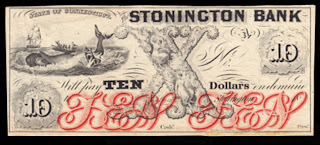
The Museum of American Finance offers an online historical survey consisting of American paper money. Prepare to be amazed by the variety of bills and notes, some dating back to colonial times.
State bank notes often paid tribute to local enterprises. Stonington on the Connecticut shore once thrived as a whaling port.
This legal tender note was issued about a century after the Lewis and Clark expedition.

State bank notes often paid tribute to local enterprises. Stonington on the Connecticut shore once thrived as a whaling port.

This legal tender note was issued about a century after the Lewis and Clark expedition.

Sunday, August 09, 2015
Genuine Stock Picks, Fake News . . . or Vice Versa
In The New York Times, Joe Nocera recalls when Jon Stewart, late of The Daily Show, took on Wall Street. Most famously, "the Cramer takedown."
Officially, Jim Cramer was an authentic stock analyst and Jon Stewart hosted a fake news program. In reality, many a millennial looked to The Daily Show, not the networks, for news, and Cramer himself acknowledged his CNBC role as an entertainer.
Confusing? Not really. As George Burns might have said, "Authenticity - if you can fake that, you've got it made."
Officially, Jim Cramer was an authentic stock analyst and Jon Stewart hosted a fake news program. In reality, many a millennial looked to The Daily Show, not the networks, for news, and Cramer himself acknowledged his CNBC role as an entertainer.
Confusing? Not really. As George Burns might have said, "Authenticity - if you can fake that, you've got it made."
Monday, August 03, 2015
Don't Spend the Kids' Inheritance
Milllennials could need all the windfalls they can get. Steve Ratner in his NY Times column shows how 18- to 34- year olds are financially disadvantaged compared to their counterparts in previous generations. Most of them won't inherit much, but every little bit will help.
Postscript: Picked up my Monday NY Times this morning and noticed the print edition was light as a
 feather. The paper's future resides online, and the transition is already noticeable. For instance, the print version of Ratner's column was accompanied by only one chart. The online version is graphically enriched.
 One of the added graphics shows millennials are poorer than their age-group used to be. Another displays a major reason why.
Postscript: Picked up my Monday NY Times this morning and noticed the print edition was light as a
 feather. The paper's future resides online, and the transition is already noticeable. For instance, the print version of Ratner's column was accompanied by only one chart. The online version is graphically enriched.
 One of the added graphics shows millennials are poorer than their age-group used to be. Another displays a major reason why.
Subscribe to:
Posts (Atom)

 Posts
Posts


