Showing posts with label Bayou. Show all posts

Wednesday, September 04, 2013

The Willing Suspension of Disbelief

In 2003, a research company met with J. Ezra Merkin, a prominent Wall Street financier who had earned a fortune investing his clients’ money with Bernard L Madoff. 
During the meeting, according to a new court filing, Mr. Merkin … warned the unnamed company never to “go long in a big way” with Mr. Madoff. He joked that “Charles Ponzi would lose out because it would be called the ‘Madoff scheme,’ ” according to notes from the meeting.*** 
Some new details came from a phone call Mr. Merkin recorded during the fall of 2005, between himself and Mr. Madoff. After a different Ponzi scheme came to light involving the Bayou Group, a hedge fund firm in Stamford, Conn., Mr. Merkin told Mr. Madoff that this would further stoke suspicions about his business.
“You know, I always tell people, as soon as there is a scam in the hedge fund industry, someone is going to call about Bernie. It’s guaranteed,”••• 

Also included in the trustee’s amended lawsuit is a recounting of a meeting between Mr. Merkin and representatives of Ivy Asset Management, another firm that steered money to Mr. Madoff. At the meeting, Ivy raised questions about the uncanny consistency of Mr. Madoff’s returns.
When Mr. Merkin likened Mr. Madoff to the wizard of Oz, an employee at Ivy said, “Toto is still tugging at the curtain.”
To which Mr. Merkin replied, “The curtain is winning.”
Until Madoff was finally arrested in 2008, Merkin and others kept feeding millions into the massive fraud. Merkin himself claims to have lost $100 million.

Sunday, August 19, 2012

Was That Sam Israel Laughing?

The case of Sam Israel and the ponzi scheme he called Bayou just keeps getting weirder:  Goldman, Still Playing In Bayou's Mud.

Tuesday, June 26, 2012

Does Your Hedge Fund Manager Have Time to Talk?

A medium-security facility at Butner
Prompted by an upcoming book on Connecticut's notorious Ponzi artist, Joe Nocera of the NY Times went to the Butner Federal Correctional Complex in North Carolina to talk with the subject, Sam Israel III.

The manager of the mostly mythical Bayou funds said hedge fund investors should  investigate before they invest:
Seek as much transparency as possible. If they do not understand exactly how a manager is making money, do not invest. If there is a secret process that cannot be explained, run. Go see the organization yourself, talk to the employees. The manager cannot see everyone or he could not be making money; if he has all the time in the world for you, that is a flag.
Good advice, but unlikely to stop investors for stumbling into the next Bayou. Sam Israel's approach, short-term trading of stocks, sounded simple enough. Who knew his accountant was as fictitious as his returns?

Monday, January 31, 2011

Bayou (Strike one!) Madoff (Strike Two!)

Before the owners of the NY Mets invested big-time with Bernie Madoff and made handsome fictitious profits, they entrusted millions to, yes, our old friend Sam Israel and his Ponzi scheme.

Why is truth so implausible compared with fiction?

Fred Wilpon and Saul Katz may have to give back their Madoff "profits." Will they also have to fork over additional millions?

Wednesday, July 28, 2010

Benefactor with a Checkered Past

You may already know the story of Mandi Schwartz:

[A] Yale hockey player stricken with leukemia, she needs a stem-cell transplant to survive, and her family and friends are searching everywhere to find her one.

Now, we read in the NY Times, there are Questions About Yale Cancer Patient's Benefactor:
Spearheading the effort has been Tedd Collins IV, who founded two charities to help leukemia patients after his 26-year-old daughter died last summer while battling the disease. By all accounts, Collins has been an untiring advocate for Schwartz, whose transplant is scheduled for next month.

But as Schwartz’s teammates and Yale officials suggested that people lend support directly through Collins’s charities, what they did not know was that he has spent the better part of a decade entangled in lawsuits and fraud accusations, according to court records and interviews.
In 2005, after a failed Internet venture, Collins founded Trust Management Associates. Allegations against Collins include:
  • Offering a 35 percent return in little more than a year to a South Carolinian whose investment then vanished.
  • Taking nearly $200,000 from a Florida paramedic to set aside in a trust for the paramedic's daughter. This fund also went missing.
At this writing Collins has not been charged with a crime. Federal prosecutors, the IRS and the Secret Service are continuing their investigation.

Postscript: Collins was a middleman linked to the collapse of Sam Israel's Bayou funds, the Times reports. Small world, isn't it?

Saturday, June 26, 2010

Bayou Boomerangs on Goldman Sachs

We first encountered Sam Israel's Bayou fund almost five years ago: Mr. Barnum, meet the hedge funders!

Sam's now serving 22 years, but Bayou continues to make news, as The Times reports:
Goldman Sachs has been ordered to pay $20.58 million to creditors of a failed hedge fund ….

The award represents the first time that a bank has been held accountable for a Ponzi scheme because of its role as a middleman.

Goldman cleared trades and lent money to the Bayou Group, a Connecticut hedge fund that collapsed in 2005, when state and federal investigators said the firm defrauded investors of hundreds of millions of dollars.
Other Wall Street firms serving as prime brokers, the Times observes, may now feel obliged to better scrutinize their hedge fund clients’ activities.

A perhaps related question, born of ignorance: As directed trusts grow in popularity, could trust companies be called upon to monitor decisions of the trusts' investment advisers more closely?

Wednesday, April 22, 2009

Cost of Not Spotting Bayou Funds Fraud? $800,000

Hennessee Group LLC and principal Charles Gradante have agreed to pay more than $800,000 to settle charges stemming from the Bayou hedge funds fraud, reports Marketwatch.

Around 40 clients invested (and lost) in Sam Israel's hedge funds on Hennessee's recommendation.

Wednesday, February 11, 2009

Sam Israel's Girlfriend Pleads Guilty

Remember Samul Israel III, the hedgie who hid the losses recorded by his Bayou Fund? After faking suicide and fleeing rather than reporting to prison, Sam forfeited $500,ooo bail and got up to 10 years added to his 20-year sentence.

His girlfriend, who helped him stage the "suicide," has pleaded guilty and will serve less than a year.

She'll probably be out before we know what happens to Bernard Madoff, who may be negotiating a plea bargain.

Wednesday, July 02, 2008

Bayou Sam Finally Heads for the Slammer

A few weeks ago Sam Israel, the miracle-working hedge-fund manager whose reported returns were always above average, staged his suicide on a bridge over the Hudson instead of reporting to prison. This morning he walked into the Southwick, Massachusetts police station and surrendered.

Tuesday, June 10, 2008

Bayou's Last Bow?

Remember Sam Israel and Bayou, the miraculous hedge funds that never seemed to have a bad quarter? (See Mr. Barnum, meet the hedge funders.)

Yesterday Sam was due to report to a Massachusetts prison and serve a 20-year term for fraud. He didn't show. His car was found, abandoned, on the Bear Mountain Bridge. Scrawled in the dust on the windshield was the phrase, "suicide is painless."

End of the Bayou story? Maybe. Nobody saw Sam jump off the bridge; his body has not been found in the river below. Could the miracle worker have had one last illusion up his sleeve?

Friday, October 14, 2005

Hedge funds, red flags and colorblind investors


An October 7th panel discussion entitled, "Lessons From the Swamp -- What We Can Learn from the Bayou Debacle," attracted about 140 investors, regulators, academia and portfolio managers to the Yale School of Management last week. “There were ‘screaming red flags‘ that with proper due diligence investors could have picked up on,” said one panelist.
And it's likely investors will be fooled again, said Stuart Robinson, an FBI agent who supervises the white-collar investigative squad in Fairfield County.

"I'd like to propose to you that it is overwhelmingly likely that there are other Bayou's out there," he said. "Just because Bayou got caught, nothing has truly changed. It's an industry geared to very smart people that get in over their heads so they commit criminal acts. These are folks . . . who are geared toward reporting perfection in their professional lives."

For some managers who aren't realizing the results they want, "lying is the only way to earn a living the way they are accustomed to," Robinson said.
In fact, "the next Bayou" seemed to have emerged already. A few days earlier, Lehman Brothers charged a West Coast hedge-fund firm, Wood River Capital Management, with fraud. The SEC followed with charges that two of Wood River's funds had invested nearly two-thirds of their assets in one stock while promising clients diversified investments.

The stock, a tiny wireless venture called Endwave, repaid Wood River's faith by losing most of its value.

Yesterday's Wall Street Journal (subscribers only) commented:
As investors and securities firms assess possible losses related to the ailing hedge fund Wood River Partners LP, questions are growing about how sophisticated market participants overlooked a series of red flags surrounding the firm.
Investors, institutions and wealthy individuals, have been pouring money into hedge funds at a prodigous rate. Question is, how many wealth managers can match Yale's David Swensen in his ability to pick top-performing funds and avoid the disasters?

And even if you have a "second Swensen" on your team, hedge funds can be a dicey game for your clients. See The Guardian's cheery news item: World's hedge funds face crisis as Refco suspends trading.

Saturday, September 17, 2005

Mr. Barnum, meet the hedge funders!

"There's a sucker born every minute," said Phineas T. Barnum. He certainly would have enjoyed the saga of the Bayou funds, chronicled extensively in today's New York Times.

Sam Israel's investment approach for his Bayou funds is said to have appealed to investors because it was understandable. No fancy swaps, no leveraged bets on toxic tranches of CDOs. Just good, old fashioned short-term trading in stocks that always seemed to work out well.

Was he actually the only person on the planet who could trade stocks for consistent profits month and month and year after year? If so, why wasn't he world famous? Some of the smarter money must have had its doubts all along.

As the chart from Bayou's sales brochure shows, the funds never seemed to have a bad year.
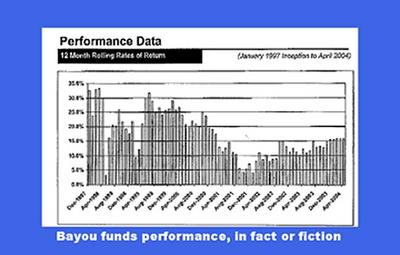
They must have had a really great Sharpe Ratio. Alas, William F. Sharpe himself says his ratio is useless for evaluating the "abolute return" potential of hedge funds. The ratio is too easy to fudge. Sharpe points out that Long-Term Capital Managment had a great Sharpe ratio just before it went bust in 1998. The Bayou funds troubles may have started shortly thereafter.

Bayou's admirable returns, it seems, weren't merely merely fudged, they were imagined. (It helps when your "independent auditor" is your CFO.)

Every affluent investor is a potential sucker. Yet in Bayou's case the biggest sucker of all may have been the manager, Sam Israel III. When his funds’ reported assets were over $400 million, he seems to have been down to $100 million or so. And that sum he supposedly entrusted to a miracle worker to invest in “two private, managed, buy/sell leveraged transactions” that in ten years would turn $100 million into $7.1 billion!

LIke to know what annualized return would be required to achieve that miracle?

Fifty-three percent!

Can regulators protect affluent investors against themselves? It won't be easy. The 100 hedge fund managers of Greenwich, CT, are already threatening to leave the country if efforts are made to place them under adult supervision.

Looks like responsible wealth managers and trustees will have to try to provide the protection. That won't be easy, either.

Offer too much protection and clients will think you're way too 20th-century fiduciary and take their business elsewhere.

Offer too little and the suddenly-poorer clients will sue the pants off you.

Life is hard, isn't it?

P. S. According to today's New York Times, Israel told his CFO that the miracle worker had been “referred to us by Alan Greenspan.” Nice touch!