From an April 1959 issue of The New Yorker:

[An old post that seemed worth repeating.]
 Just one problem: Bright, imaginative grandchildren weren’t going to let a stretch IRA dribble out payments decade after decade. They would empty the account and use the after-tax proceeds to buy a beach house, start a business, back a Broadway musical. or who knows what.
There is nothing wrong with trying to minimize your taxes or the tax bill for your heirs. That’s a smart money move. However, IRAs and 401(k)s weren’t meant to be used as a way to transfer wealth. They were designed to encourage people to save by giving plan participants and/or account holders — not their children or children’s children — a tax break. The loophole created by the law that has allowed beneficiaries to stretch out their tax burden was a bonus, not an entitlement that should never be touched.I’m with Singletary. The death of the stretch IRA is timely.
 |
| Illustration: Sydney Morning Herald |
We are beginning to work on automation for estate planning—the one area that advisors love to insist cannot be automated. We are using our access to data to build out the algorithms to automate estate-planning recommendations and then create the appropriate legal documents. It’s all rules-based, and when it comes to most lawyers, it’s an antiquated industry.
 |
| Fred Trump in 1950 |
When asked whether they had discussed wealth transfers with their advisors, the response was mainly ‘no’, with comments such as: "They don’t have the expertise or experience to help like in the past"; "No point, they just want to sell you inappropriate and expensive “products"; and my personal favourite: "Yes. Some. But they nod out of deference. Silly people."
I am divorced. I recently learned from one of my children that my ex is leaving them uneven shares of his wealth. He’s leaving less to our son, the child he dislikes. His rationale is that this particular child has poor money-management skills
My will, so far, is divided evenly. As I’ve told my children repeatedly, I love them equally, and I want this love reflected in my will.
Should I change it to give more to the child disliked by his father, in order that the children come out more or less equal? Would the other child, our daughter, feel slighted and less loved?Yes, use your will to equalize things, rules The Ethicist, and explain your strategy to your daughter.
 |
| Samuel Pepys |
 |
| Nathaniel Crew |
 |
| The Horatio Street townhouse |
Tom has come to my office and we have come up with a plan. While New York never recognized common law marriage, Pennsylvania did until recently. Bill Cornwall and Tom Doyle vacationed there a number of times, and New York Courts will recognize common law marriages if they would be recognized in a state where a couple visited, even if the visit was brief. I have made Tom Doyle’s rightful claim to 69 Horatio Street. It is a claim born of love and the cruel refusal of New York to recognize gay marriage for so many years.Could the plan succeed? In any event, the moral of the story is that Bill Cornwall should have shaped his estate plan sooner and better.

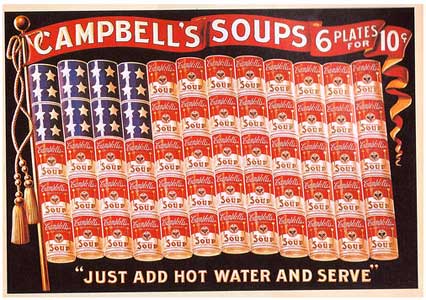 |
| Vintage Campbell's Soup ad |
According to the Marital Separation Agreement, the four children were to receive 50% of Billhartz’s “estate” (an undefined term), divided evenly. In the end, though, they cumulatively ended up with less than 34% of Billhartz’s assets, divided unevenly. None theless, after receiving notice of this discrepancy, all four children executed an agreement (the “2007 Waiver Agreement”), in which they accepted the lesser shares set out for them in the trust and waived all potential claims they may have been able to assert against either the Estate or the trust. The payments to the children totaled approximately $20 million; each daughter received about $3.5 million, while Ward received $9.5 million.How do federal courts enter the story? Even though the divorce agreement was not honored, it was used to claim that $3.5 million per child was a deductible payment of indebtedness rather than an estate-taxable transfer. The IRS objected but ultimately agreed to allow an estate-tax deduction for slightly more than half the payments.
 Within 200 years wealthy humans will have become godlike cyber-organisms. So predicts Yuval Noah Harari, a professor at the Hebrew University of Jerusalem,
 Upstairs at Chicago's Goodman Theater: Women in mourning clothes. Funereal organ music. Ushers in tasteful black, some sporting veils.
The organ music faded…."Good morning friends," [estate attorney Robert] Hamilton said in a warm, tender baritone. "I am brother Hamilton, your minister for today's service, 'In Memoriam of the Estate Tax.'"Thus does the Chicago Tribune describe estate planning enlivened by a touch of theater. Three-fifths of FUNDS, as my bride learned in her fundraising days, is FUN. Funereal fun, in this case.***This was an estate-planning seminar in mourning clothes. (Indeed the federal estate tax itself is not even actually dead, just largely irrelevant to the vast majority of tax payers.) The title was "Outfoxing Uncle Sam: How to Plan Your Estate," and the goal was donations — the kind of large, end-of-life charitable donations that a theater patron might bequest in a will.
 |
| David G. Klein |
Financial advisers and estate-planning professionals say many of their clients feel uncertain about the kind of world their heirs will inhabit…. These concerns are making it hard to steer estate-planning conversations beyond simply the next generation to thinking many decades, or even centuries, down the line….
***Add in uncertainty about what the family will look like, and what kind of tax rules and other financial issues they will face…. It can make recommending… handing assets over to a dynasty trust…very tricky.

 Posts
Posts


