Republicans call it the death tax and claim the levy forces the sale of family farms and businesses. Liberals demand evidence of such sales. That's hard to find, as this column demonstrates.
Nevertheless, farm and business owners are right to wish the death tax would go away and stay away. We explained why some years ago. Whether the business or farm owner is paying the last generation's tax on the installment plan or paying insurance premiums to fund the present generation's tax, the annual expense can be a significant drag on operations.
Under the current estate tax, most owners should die tax free. Their advisers may tell them to set aside funds anyway. Better safe than sorry.
Tuesday, May 12, 2015


Monday, May 11, 2015
Art Investment Sells for $179.57 MIllion.

Picasso's "Les femmes d'Alger (Version 'O')," above, sold at Christie's for a hammer price of $160 million. Christie's fees bring the total cost to $179.57 million, a new record.
In 1997 the painting sold at auction for $31.9 million. In another 18 years, assuming the same rate of appreciation, the Picasso should fetch $800-900 million. In twenty years, maybe a billion!
Will art as an asset class really perform that well? For billionaires, borrowing money to purchase art costs next to nothing these days. Even semi-billionaires may find lenders willing to consider art as collateral. But sooner or later the flow of easy money is likely to slow. What do you think?
Update: Later media reports put the total price at 179.4 million.
It's Not Easy Being Fiduciary
Investment advisers who aspire to the fiduciary life don't have it easy, as Steven G. Blum explains here.


What about online investment services, so-called robo advisers? Are they fiduciaries? Yes, writes Norb Vonnegut. Robo advisers stand on the buy side – that is, the client's side – not the sales side.
But as Vonnegut illustrates, even human fiduciaries can succumb to temptations offered by the sales side. Remember when bank trust officers were criticized for pushing the bank's own products? In Vonnegut's example, the tables are turned: a trust officer puts a client in an outsider's relatively expensive S&P index fund instead of the bank's lower-fee version.
•
Norb Vonnegut has written novels skewering brokers (Top Producer) and hedgies (Gods of Greenwich). I hereby remake my resolution to read them.
Sunday, May 10, 2015
The 4% solution
The New York Times discusses the "4% rule" of thumb that says if a retiree uses a 4% withdrawal rate from a retirement portfolio there is no chance of running out of money during retirement—at least based upon the past performance of the financial markets. The rule has come in for criticism in todays ultra-low interest rate environment. The article does a nice job of presenting the origins of the rule and recent variations.
I found the comments quite entertaining, ranging from astute to woefully ignorant, as usual.
I found the comments quite entertaining, ranging from astute to woefully ignorant, as usual.
Tuesday, May 05, 2015
Should Investors Divest From Fossil Fuels?
Maybe yes
From a Reuters dispatch at Business Insider:
From a Reuters dispatch at Business Insider:
Since the divestment movement launched three years ago, some 650 individuals and 180 institutions, including 50 new foundations, which hold over $50 billion in total assets, pledged to divest from fossil fuels over five years using a variety of approaches.
One of the signatories is the Rockefeller Brothers Fund. Stephen Heintz, an air [sic] of Standard Oil tycoon John D. Rockefeller, said the move to divest away from fossil fuels would be in line with his wishes.
Would Rockefeller go green?

“We are quite convinced that if he were alive today, as an astute businessman looking out to the future, he would be moving out of fossil fuels and investing in clean, renewable energy...."(At least they didn't call him an airhead.)
The Church of England also has decided to sell its investments in coal and oil-sand producers.
Maybe no
Swathmore, described as the birthplace of the divestiture movement, has declined to dump its fossil-fuel stocks. The college opts to stick with its investment guideline that requires management for “the best long-term financial results, rather than to pursue other social objectives.”
Two big guns of university investing, Harvard and Yale, also have declined to divest.
What next?
The Rockefeller Brothers Fund has dumped its coal investments and proposes to gradually ease out of oil. Institutional investors who decline to do the same may see socially responsible investing as a slippery slope. Few public corporations are free from all social stigmas.
Swathmore, described as the birthplace of the divestiture movement, has declined to dump its fossil-fuel stocks. The college opts to stick with its investment guideline that requires management for “the best long-term financial results, rather than to pursue other social objectives.”
Two big guns of university investing, Harvard and Yale, also have declined to divest.
What next?
The Rockefeller Brothers Fund has dumped its coal investments and proposes to gradually ease out of oil. Institutional investors who decline to do the same may see socially responsible investing as a slippery slope. Few public corporations are free from all social stigmas.
For instance, maybe endowments should divest companies that pay CEO's more than twice what said CEO's are worth. But then, where could they reinvest?
Sunday, May 03, 2015
He Willed His Ashes to Islay
 |
| Kilnaughton Bay, Islay |
I would have loved to have been executor of that will.
Here is a glimpse of Bob Simon interviewing the laird of Islay, whose ancestors once owned the whole island.
Thursday, April 30, 2015
Art as Hot Investment (Again)
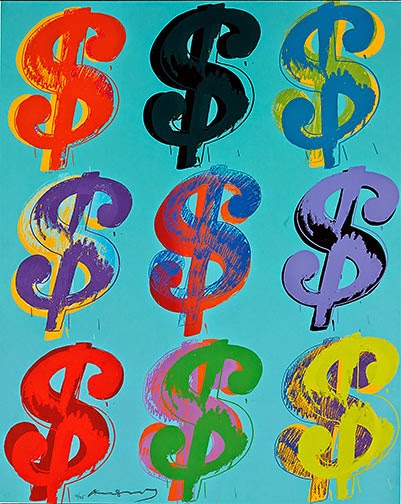 |
ANDY WARHOL, Dollar Signs $ (9), 1982
|
The wealthiest Americans have grown wealthier since the Great Recession, and many are investing their wealth in art. Especially with bonds and other assets offering rock-bottom yields, the art market — where reports of record-high sales now emerge regularly — has an obvious appeal. According to a survey last year by Deloitte and ArtTactic, an art-research firm, 76 percent of art buyers viewed their acquisitions as investments, compared with 53 percent in 2012.To meet perceived demand, art marketing has gone digital, with online auctions and web sites offering "quotes" on investable works. Thanks to high-tech depositories and storage facilities, today's art investors need not make physical contact with the artworks they trade. Better yet, they can replace one art asset for another without worrying about tax on capital gain. Like real estate investors, they can defer taxes by swapping one "property" for another.
Art investors do have a few nagging worries. Expected profits may vanish if an investor in contemporary art doesn't have an informed feel for value, and one court says that's the investor's loss. Also, tax-deferred swaps are getting too popular. The IRS is taking notice.
Biggest worry: investment fads are too good to last, and art is no exception. If you're not elderly enough to remember the last boom and bust, see this 1993 Times story: What's the Worst Place To Keep Art? A Portfolio.
Wednesday, April 29, 2015
Advertising Rule From Mad Men Days
If Sterling Cooper (the Mad Men agency now swallowed up by McCann) had a wealth management account, they would have known the rule well:
The bigger the bull market, the greater the ad spending.
Corollary: When bears emerge, wealth managers lose the urge to splurge.
True half a century ago, and probably true still.
The rule may seem illogical. Investors fear loss more than they desire gain, so bear markets should make them more willing to seek expert help. Wealth managers take the contrary view: They find new accounts easiest to come by near market highs because bull markets make investors greedy.
This year, with the market near nominal highs, ads for wealth management are plentiful. Both BNY Mellon and Bessemer Trust had ads in last Sunday's NY Times magazine. Half a century ago, when the Dow flirted with highs it would not reach again until the 1980's, fiduciaries also were advertising briskly. For example:

In 1965 senior execs were paid a pittance by today's compensation standards, but this one didn't suffer. He got to fly on the new company plane! Chase Manhattan chose a more leisurely theme:

Vintage autos are just as appealing today as they were fifty years ago. Here's a bonus ad from the same issue of The New Yorker, featuring a car that's still fondly remembered. So fondly that Lincoln may bring out a new Continental.

Art directors probably haven't received their due on Mad Men. It was the art director who realized the Continental ad required lots of white space and an understated headline.
Finally, one more colorful collage from Irving Trust:

The bigger the bull market, the greater the ad spending.
Corollary: When bears emerge, wealth managers lose the urge to splurge.
True half a century ago, and probably true still.
The rule may seem illogical. Investors fear loss more than they desire gain, so bear markets should make them more willing to seek expert help. Wealth managers take the contrary view: They find new accounts easiest to come by near market highs because bull markets make investors greedy.
This year, with the market near nominal highs, ads for wealth management are plentiful. Both BNY Mellon and Bessemer Trust had ads in last Sunday's NY Times magazine. Half a century ago, when the Dow flirted with highs it would not reach again until the 1980's, fiduciaries also were advertising briskly. For example:
In 1965 senior execs were paid a pittance by today's compensation standards, but this one didn't suffer. He got to fly on the new company plane! Chase Manhattan chose a more leisurely theme:
Vintage autos are just as appealing today as they were fifty years ago. Here's a bonus ad from the same issue of The New Yorker, featuring a car that's still fondly remembered. So fondly that Lincoln may bring out a new Continental.
Art directors probably haven't received their due on Mad Men. It was the art director who realized the Continental ad required lots of white space and an understated headline.
Finally, one more colorful collage from Irving Trust:
Note the elephant on the Thailand medal at lower right.
Sunday, April 26, 2015
Webber Case (Our Own Jarndyce and Jarndyce) Goes to Trial

Unlike most "undue influence of perhaps not competent old person" cases, charitable beneficiaries under an earlier will, not disinherited family members, are the driving force in the contest. Last year a potential settlement was reached, leaving the police officer with more than $400,000, but charitable beneficiaries objected.
A dozen or so lawyers are now involved. If the police officer wins, considered a long shot, an appeal is possible. In Dicken's Jarndyce and Jarndyce, the lawyers finally got it all. Could it happen here?
See the Portsmouth Herald preview of the court proceedings.
Thursday, April 23, 2015
When Half a Million a Month Isn't Enough
H/T to Wealth Adviser for reminding us wealth can be relative.
The two children of Richard Mellon Scaife, who died last year, claim that his trustees should not have allowed Scaife to spend more than $300 million from a trust left by his mother, Sarah Mellon Scaife. The trustees may have been inclined to let Scaife spend freely (mostly on conservative causes and charitable gifts) because his mother left his two children a trust of their own. It pays each of the grandkids about half a million a month.
Most people can live well on $6 million a year. Perhaps because wanting more seemed unseemly, Jennie Scaife sought to have information about what her grandmother had left her expunged from court records. The court has refused.
Yet wealth truly is relative. When your father was a billionaire, your lifestyle and the maintenance of your various homes may seem crimped if you have less than $10 million a year to spend.
Half a million a month amounts to roughly $100,000 per week, before taxes. After taxes, perhaps no more than $60,000. These days, in places like Palm Beach and Nantucket, that kind of money may not go too far.
The two children of Richard Mellon Scaife, who died last year, claim that his trustees should not have allowed Scaife to spend more than $300 million from a trust left by his mother, Sarah Mellon Scaife. The trustees may have been inclined to let Scaife spend freely (mostly on conservative causes and charitable gifts) because his mother left his two children a trust of their own. It pays each of the grandkids about half a million a month.
Most people can live well on $6 million a year. Perhaps because wanting more seemed unseemly, Jennie Scaife sought to have information about what her grandmother had left her expunged from court records. The court has refused.
Yet wealth truly is relative. When your father was a billionaire, your lifestyle and the maintenance of your various homes may seem crimped if you have less than $10 million a year to spend.
Half a million a month amounts to roughly $100,000 per week, before taxes. After taxes, perhaps no more than $60,000. These days, in places like Palm Beach and Nantucket, that kind of money may not go too far.
Tuesday, April 21, 2015
Financial Wisdom of the Scots
From proverbs collected by Ben Schott:

"Bashfulness is an enemy to poverty" sounds odd to modern ears. Perhaps bashfulness helped to build wealth because a shy Scot wasn't inclined to show off by squandering money on a gilded coach (or, in today's terms, on a gold-plated Bentley).
And, yes, wealth can be ruinous. Fortunately, trust companies exist to help today's wealthy families limit the harm.
Monday, April 20, 2015
From Robo-Advisers to Real Robot Advisers?
Fans of human wealth management deride inexpensive, online investment services as robo-advisers. Where's the personal touch? Where's the ability to encourage the timid, soothe the nervous and restrain the reckless?
It's coming, if not already here. As border agents, writes UNC professor Zeynep Tufekci, robot "avatars" with emotion-detecting software do a better job than humans in detecting visitors with invalid documents.
We'll see how far robots can go as wealth managers. Meanwhile, perhaps we should worry about their intrusion into domestic life. Husbands, beware! What woman wouldn't prefer a perceptive, sensitive companion that recognizes her every mood?
It's coming, if not already here. As border agents, writes UNC professor Zeynep Tufekci, robot "avatars" with emotion-detecting software do a better job than humans in detecting visitors with invalid documents.
Today, machines can process regular spoken language and not only recognize human faces, but also read their expressions. They can classify personality types, and have started being able to carry out conversations with appropriate emotional tenor."Most of what we think of as expertise, knowledge and intuition," Tjufekci observes, "is being deconstructed and recreated as an algorithmic competency."
We'll see how far robots can go as wealth managers. Meanwhile, perhaps we should worry about their intrusion into domestic life. Husbands, beware! What woman wouldn't prefer a perceptive, sensitive companion that recognizes her every mood?
Tuesday, April 14, 2015
Could Laurence Fink’s Capital Gains Tax Cut Save the Economy?
Recovery from the Great Recession has been slow. Economic growth, productivity gains and stock market performance are generally expected to remain sluggish. One reason: many major corporations seem more inclined to tread water or downsize, via stock buybacks, than to invest in new business opportunities and productivity enhancements.
 Laurence Fink, who as head of Blackrock might be called the world's most important shareholder, wants CEOs to stiffen their spines. Rather than give in to "activist investors" seeking quick payoffs from buybacks and enhanced dividends, they should be running their companies the old-fashioned way: doing their best to get bigger and better for the benefit of their long-term shareholders.
To ease the pressure for short-term payoffs, Fink proposes that capital gains be taxed as ordinary income when investments are held for only one or two years.
“Since when was one year considered a long-term investment? A more effective structure would be to grant long-term treatment only after three years, and then to decrease the tax rate for each year of ownership beyond that, potentially dropping to zero after 10 years.”
This blogger will buy that. Can't imagine Congress joining me.
To ease the pressure for short-term payoffs, Fink proposes that capital gains be taxed as ordinary income when investments are held for only one or two years.
“Since when was one year considered a long-term investment? A more effective structure would be to grant long-term treatment only after three years, and then to decrease the tax rate for each year of ownership beyond that, potentially dropping to zero after 10 years.”
This blogger will buy that. Can't imagine Congress joining me.
Monday, April 13, 2015
Death Tax Repeal Act of 2015 passes Ways and Means
On a party-line vote, H.R. 1105, The Death Tax Repeal Act of 2015, passed the Ways and Means Committee on March 25 and was sent along to the House for consideration. The alleged "cost" of enactment is scored at a loss of $269 billion over ten years.
That the advocates for death tax repeal might get this far is not surprising. The freshman Representative from South Dakota, Kristi Noem, has personally experienced the federal estate tax, and as a consequence has made it one of her life missions to repeal it. Her rancher father died unexpectedly, while she was at college. She left school to help manage the farm. The devastating premature loss of her parent was made much worse when the family was slammed with the federal estate tax.
“We made the decision to take out a loan, so we didn’t have to sell our land and potentially lose the farm. The decision impacted nearly every financial choice we made for a decade. No family should have to go through something like that. I am committed to repealing this unjust – and frankly, immoral – tax that hurts small businesses and family farms most. Today marks a step forward toward a time where hard work is respected and death is no longer a taxable event.”
The surprising part is the bill itself. The estate and generation-skipping tax would be repealed, but the gift tax would be retained! Why would we create an even greater incentive to not put estate plans into motion until death?
Still more odd, the basis rules would be retained--so, full basis step-up at death, carryover basis for gifts. The fact that the gift tax rate would be reduced to 35% is small comfort. The lifetime federal gift exemption and annual exclusion would be retained.
My guess is that, somehow, keeping the gift tax lowered the "cost" of death tax repeal. In practice, of course, it would do no such thing. But that's the way tax scoring works in DC.
That the advocates for death tax repeal might get this far is not surprising. The freshman Representative from South Dakota, Kristi Noem, has personally experienced the federal estate tax, and as a consequence has made it one of her life missions to repeal it. Her rancher father died unexpectedly, while she was at college. She left school to help manage the farm. The devastating premature loss of her parent was made much worse when the family was slammed with the federal estate tax.
“We made the decision to take out a loan, so we didn’t have to sell our land and potentially lose the farm. The decision impacted nearly every financial choice we made for a decade. No family should have to go through something like that. I am committed to repealing this unjust – and frankly, immoral – tax that hurts small businesses and family farms most. Today marks a step forward toward a time where hard work is respected and death is no longer a taxable event.”
The surprising part is the bill itself. The estate and generation-skipping tax would be repealed, but the gift tax would be retained! Why would we create an even greater incentive to not put estate plans into motion until death?
Still more odd, the basis rules would be retained--so, full basis step-up at death, carryover basis for gifts. The fact that the gift tax rate would be reduced to 35% is small comfort. The lifetime federal gift exemption and annual exclusion would be retained.
My guess is that, somehow, keeping the gift tax lowered the "cost" of death tax repeal. In practice, of course, it would do no such thing. But that's the way tax scoring works in DC.
Friday, April 10, 2015
How the Rich Really Spend
A recent post refers you to data showing upper-income people spend more on education and financial products and less, proportionate to their incomes, on basics such as food or transportation.
Eeven B. Owen, prominent hedge fund manager, has expressed outrage:
What do upper-income people really spend their money on? Federal income tax. The top 20% of earners pay 84% of the tax. The bottom 40% pay nothing; most receive money via tax credits.
When you expand the data to include payroll taxes, the bottom 40% does pay a little, but only 5% of the total. And as an expert at the Tax Policy Center observes, payroll taxes are different from the federal income tax because paying them brings the promise of a future benefit.
Eeven B. Owen, prominent hedge fund manager, has expressed outrage:
Do you know how much I spend on meals? Even my breakfast – full English, with kippers, flown in daily from London– costs me a fortune. Transportation? When you need a private jet to get to Greenwich from your yacht in the Caribbean, your commuting costs are off the chart!Sorry, couldn't resist. Anyone who doesn't realize that people with high incomes spend proportionately less on the basics isn't likely to read The Atlantic or The Wall Street Journal.
What do upper-income people really spend their money on? Federal income tax. The top 20% of earners pay 84% of the tax. The bottom 40% pay nothing; most receive money via tax credits.
When you expand the data to include payroll taxes, the bottom 40% does pay a little, but only 5% of the total. And as an expert at the Tax Policy Center observes, payroll taxes are different from the federal income tax because paying them brings the promise of a future benefit.
Thursday, April 09, 2015
Another estate planning novelty from Robin Williams
Coming soon to Merrill Anderson's Investment and Trust Newsletter, "The Michael Jackson Problem, and the Robin Williams Solution."
Jackson's estate gave his his publicity rights only a nominal value, and the IRS valued those rights at hundreds of millions of dollars. The two side are currently battling in the Tax Court over $500 million in additional estate taxes and $200 million in penalties.
Perhaps that was the inspiration for an unusual element of Robin Williams' trust concerning the commercial use of his likeness. First, such use is sharply constrained for the next 25 years. That will dramatically reduce the theoretical value of his publicity rights. More importantly, those rights pass to a charity. No matter what value the IRS assigns to those rights, there will be a fully offsetting charitable deduction for them.
The Hollywood Reporter has the story, and suggests that this could be the wave of the future.
Jackson's estate gave his his publicity rights only a nominal value, and the IRS valued those rights at hundreds of millions of dollars. The two side are currently battling in the Tax Court over $500 million in additional estate taxes and $200 million in penalties.
Perhaps that was the inspiration for an unusual element of Robin Williams' trust concerning the commercial use of his likeness. First, such use is sharply constrained for the next 25 years. That will dramatically reduce the theoretical value of his publicity rights. More importantly, those rights pass to a charity. No matter what value the IRS assigns to those rights, there will be a fully offsetting charitable deduction for them.
The Hollywood Reporter has the story, and suggests that this could be the wave of the future.
Wednesday, April 08, 2015
Spending by the rich
The Atlantic comments on a Wall Street Journal article. I link to them because they are not behind a paywall.
The rich spend a lot of money to stay rich. The top 10% spend more on pensions, education and insurance, both in absolute numbers and as a percentage of income, than do other groups.
The rich spend a lot of money to stay rich. The top 10% spend more on pensions, education and insurance, both in absolute numbers and as a percentage of income, than do other groups.
Friday, April 03, 2015
Who Gets Robin Williams' Tux?
“I’ve sent three sons to very expensive Ivy League schools thanks to the dysfunctional nature of estate planning for families with stepchildren,” says attorney William Zabel.
Current example: Robin Williams' Heirs Fight Over Assets With Sentimental Value.
Current example: Robin Williams' Heirs Fight Over Assets With Sentimental Value.
Mad Men Ads of 1970 (the Worst Was Yet to Come)
Watching the last half of Mad Men's final season? Reportedly the story picks up in 1970, a bad year that ushered in a worse decade.
How bad? It was the year the Beatles broke up. The 1970s brought long lines at gas stations, double-digit drops in the purchasing power of a dollar, and the worst stock market bust, in real terms, since the Great Depression.
 The 1970s are remembered as the decade that taste forgot. For good reason. See ad at right. (To all who were offended by my 1970s' plaid suit, sincere apologies.)
Even the 1970 ads from trust companies seemed to lose their zing.
This US Trust ad is OK, I guess (I may have written it) but it falls far short of the psychological insights that Merrill Anderson's founder crafted. (Had to look up congenerics. They are companies in the same or similar industry that offer noncompeting products or services. Investopedia labels Citigroup's merger with Travelers Insurance, now undone, as congeneric.)

By 1970 Chase Manhattan's iconic nest eggs had been replaced by a mess of pottery:

Is there a museum that would have accepted such a collection in 1970? What about now?
More than a nest egg is missing from the ad. Chase's trust division has become the "planning division."
How bad? It was the year the Beatles broke up. The 1970s brought long lines at gas stations, double-digit drops in the purchasing power of a dollar, and the worst stock market bust, in real terms, since the Great Depression.
The 1970s are remembered as the decade that taste forgot. For good reason. See ad at right. (To all who were offended by my 1970s' plaid suit, sincere apologies.)Even the 1970 ads from trust companies seemed to lose their zing.
This US Trust ad is OK, I guess (I may have written it) but it falls far short of the psychological insights that Merrill Anderson's founder crafted. (Had to look up congenerics. They are companies in the same or similar industry that offer noncompeting products or services. Investopedia labels Citigroup's merger with Travelers Insurance, now undone, as congeneric.)
Is there a museum that would have accepted such a collection in 1970? What about now?
More than a nest egg is missing from the ad. Chase's trust division has become the "planning division."
Monday, March 30, 2015
Investing in Mutual Funds Made Simple
Mutual fund investors must be bewildered by their thousands of choices, we observed recently.
 Not necessarily. Mere handfuls of funds attract much of the money. "Passive" investors – that is, indexers – have an especially narrow focus. Eighty-five percent of the dollars in S&P 500 index funds reside in just five funds.
What's more, Jonathan Clements reports in the WSJ, investors in S&P 500 index funds appear to strengthen their advantage by exercising patience. As shown at right, they enjoy superior dollar-weighted returns, presumably because they better resist the impulse to buy high, sell low.
Will robo-advisers extend the advantage of patient investing to a wider range of wealth builders?
Not necessarily. Mere handfuls of funds attract much of the money. "Passive" investors – that is, indexers – have an especially narrow focus. Eighty-five percent of the dollars in S&P 500 index funds reside in just five funds.What's more, Jonathan Clements reports in the WSJ, investors in S&P 500 index funds appear to strengthen their advantage by exercising patience. As shown at right, they enjoy superior dollar-weighted returns, presumably because they better resist the impulse to buy high, sell low.
Will robo-advisers extend the advantage of patient investing to a wider range of wealth builders?
Thursday, March 26, 2015
You're a Hedgie? How Embarrassing!
Way back when, I avoided mentioning my job in market research. Too embarrassing. Now hedge-fund guys and gals face a similar problem. Subpar returns lead to poor image, and poor image leads to dissembling.
"Mentions of hedge-fund employment in marriage announcements have declined by 20% since 2007," reports Rob Copeland in The Wall Street Journal.
Out of more than 8,000 hedge funds, "only 1,176 firms use the term hedge fund in the 'about us' section of their SEC investment adviser registration."
Favored euphemisms for hedge fund:
"Mentions of hedge-fund employment in marriage announcements have declined by 20% since 2007," reports Rob Copeland in The Wall Street Journal.
Favored euphemisms for hedge fund:
Alternative asset manager
Investment holding company
Private partnership
Can rebranding save the day?
Investment holding company
Private partnership
Can rebranding save the day?
Tuesday, March 24, 2015
The Unbearable Complexity of Almost Everything Financial
"The complexity of our financial lives is so extreme that we must painstakingly manage each and every aspect of it,"laments Ron Lieber in The New York Times. He cites Social Security.
 In my parents' time, the breadwinner claimed Social Security when he retired, his stay-at-home wife claimed her spousal benefit, and that was that. Today? Couples need to study a book or two and seek expert counsel or risk leaving money on the table.
If Social Security has become too complicated, "tax-favored" retirement plans have become a national disgrace. We have pensions (often underfunded) and 401(k)s (often overpriced). We have IRAs and spousal IRAs and self-directed IRAs and Roth IRAs and SEP IRAs and rollover IRAs and stretch IRAs and …..
Yet everyone agrees, few Americans are putting aside enough for retirement. Those who do must contend with thorny thickets of rules and regulations. As a result, financial planners devote more and more time to questions relating to the transfer, withdrawal and bequeathing of retirement funds.
Meanwhile, basic investing leaves people utterly bewildered: Thousands of mutual funds. More than a thousand exchange traded funds. A confusing, ever-growing array of packaged investment products. (If a fund is formed to invest in a portfolio of hedge funds that invest in other hedge funds, do you call it a fund of funds of funds?)
In "the landscape of confusion and tedium that characterizes our financial lives," Lieber observes, "every task seems to require its own multichapter management manual."
Can this 21st-century alchemy succeed?
In my parents' time, the breadwinner claimed Social Security when he retired, his stay-at-home wife claimed her spousal benefit, and that was that. Today? Couples need to study a book or two and seek expert counsel or risk leaving money on the table.If Social Security has become too complicated, "tax-favored" retirement plans have become a national disgrace. We have pensions (often underfunded) and 401(k)s (often overpriced). We have IRAs and spousal IRAs and self-directed IRAs and Roth IRAs and SEP IRAs and rollover IRAs and stretch IRAs and …..
Yet everyone agrees, few Americans are putting aside enough for retirement. Those who do must contend with thorny thickets of rules and regulations. As a result, financial planners devote more and more time to questions relating to the transfer, withdrawal and bequeathing of retirement funds.
Meanwhile, basic investing leaves people utterly bewildered: Thousands of mutual funds. More than a thousand exchange traded funds. A confusing, ever-growing array of packaged investment products. (If a fund is formed to invest in a portfolio of hedge funds that invest in other hedge funds, do you call it a fund of funds of funds?)
In "the landscape of confusion and tedium that characterizes our financial lives," Lieber observes, "every task seems to require its own multichapter management manual."
•
Most investors won't read the manuals; they will seek human guidance. They are most likely to turn to brokers, who can't always offer disinterested help. Hence the well-intentioned movement to transform investment salespeople into fiduciaries.Can this 21st-century alchemy succeed?
Sunday, March 22, 2015
Repeat Offender in the Investment Jungle
In the 1990s Charles Howard's stock manipulations helped sink two banks. He served three years in prison and was barred from serving as an investment adviser.
By 2002 he was back in business as…an investment adviser. Now he's been sentenced to seven to twenty years for a second round of fraudulent activities.
After three years, the Monadnock Ledger-Transcript reports, he may be eligible for home confinement. Let's hope his return to wealth management takes a little longer.
By 2002 he was back in business as…an investment adviser. Now he's been sentenced to seven to twenty years for a second round of fraudulent activities.
After three years, the Monadnock Ledger-Transcript reports, he may be eligible for home confinement. Let's hope his return to wealth management takes a little longer.
Monday, March 16, 2015
Three Bank Ads From Spring, 1965
OK, Boston has set a new record for the amount of snow falling in one winter. Time to think spring. For inspiration, three ads from half a century ago.

The country gentleman in the Chase nest egg ad contrasts with the urbane financier portrayed by Citi, or as it was known in those days, First National City:

Note the double sales pitch: We'd like to manage your personal portfolio, and we want your company's pension plan, too.
Fifty years ago, pension plans actually had genuine, full service trustees. Corporate fiduciaries eventually lost the business because they were perceived as too timid, too dull. MBAs told companies they should regard their pension plans as profit centers. In hindsight, it wasn't the MBAs' finest hour.
Though the Irving ad below doesn't feature fiduciary services, the salute to world's fairs reminds us of what people were looking forward to in the spring of 1965. New York's 1964-65 World's Fair was not as grand as the 1939-40 extravaganza, but as the fair's Disney exhibit sang, "It's a small world, after all."

Fifty years ago, pension plans actually had genuine, full service trustees. Corporate fiduciaries eventually lost the business because they were perceived as too timid, too dull. MBAs told companies they should regard their pension plans as profit centers. In hindsight, it wasn't the MBAs' finest hour.
Though the Irving ad below doesn't feature fiduciary services, the salute to world's fairs reminds us of what people were looking forward to in the spring of 1965. New York's 1964-65 World's Fair was not as grand as the 1939-40 extravaganza, but as the fair's Disney exhibit sang, "It's a small world, after all."
Sunday, March 08, 2015
The Man Who Reshaped Trust Marketing
 |
| Thomas J. Stanley, 1944-2015 |
Then along came a professor from Georgia, brandishing research. The marketers had it wrong.
Many big spenders were simply spending their big incomes, Thomas Stanley asserted, not accumulating wealth. Big hat, no cattle.
Many wealth accumulators, by contrast, shunned conspicuous consumption. They didn't act rich. They lived in ordinary houses, drove ordinary cars, wore ordinary clothes. They looked like the people next door.
Year after year, Stanley filled hotel ballrooms, delivering his contrarian message to gatherings of trust officers, brokers and investment advisers. In 1996 he and a colleague, William D. Danko, published their bestseller, The Millionaire Next Door.
Both The Washington Post and The New York Times offer tributes to Stanley, who died recently in a car crash. William J. Bernstein, in his primer for millennial investors, calls The Millionaire Next Door "the most important book you'll ever read."
Both The Washington Post and The New York Times offer tributes to Stanley, who died recently in a car crash. William J. Bernstein, in his primer for millennial investors, calls The Millionaire Next Door "the most important book you'll ever read."
Tuesday, March 03, 2015
Those Weirdo MIllennials
Bloomberg Business takes an irreverent look at Millennials as prospective Wall Street customers.
They're supposedly due to inherit $30 trillion, and maybe they're not really so weird. According to a Federated Investors survey, they're most likely to get investment tips from friends, least likely to spring for paying an investment adviser. Just like their parents and grandparents.
They're supposedly due to inherit $30 trillion, and maybe they're not really so weird. According to a Federated Investors survey, they're most likely to get investment tips from friends, least likely to spring for paying an investment adviser. Just like their parents and grandparents.
Saturday, February 28, 2015
Warren Buffett‘s Bad Investments
In his letter to Berkshire Hathaway shareholders, Warren Buffett looks back on his investment mistakes. Some bad moves occurred early on. Others he committed when he was old enough to know better. His purchase of Dexter Shoe, for instance. By the 1990s, most New Englanders could have told him the region's shoe industry was in hospice care.
Perhaps that misjudgment related to his earlier faith in New England's vanishing textile industry, which first moved south, then overseas. But without that faith, the name Berkshire Hathaway never would had gotten a second wind.
Here, from 1964, is an ad from the "old" Berkshire Hathaway.

Perhaps that misjudgment related to his earlier faith in New England's vanishing textile industry, which first moved south, then overseas. But without that faith, the name Berkshire Hathaway never would had gotten a second wind.
Here, from 1964, is an ad from the "old" Berkshire Hathaway.
Friday, February 27, 2015
They Lived Long and Prospered
Leonard Nimoy as Mr. Spock voiced the words: "Live long and prosper." He will be missed.
So will Irving Kahn, who lived those words.
Wall Street's oldest active professional investor, Kahn made his first stock trade in the summer of 1929 and became a disciple of Benjamin Graham. Until last fall he was still reporting for work three days a week at his midtown office. Kahn died at age 109.
Related post: Good Advice From a 108-Year-Old Investor.
So will Irving Kahn, who lived those words.
Wall Street's oldest active professional investor, Kahn made his first stock trade in the summer of 1929 and became a disciple of Benjamin Graham. Until last fall he was still reporting for work three days a week at his midtown office. Kahn died at age 109.
Related post: Good Advice From a 108-Year-Old Investor.
Thursday, February 26, 2015
Wealth Management for the Deluxe Lifestyle

BNY Mellon boasts of a 97% client retention rate. First Republic spotlights one of its entrepreneur banking customers. Bessemer Trust expresses willingness to manage new wealth alongside old wealth. Glenmede, despite having dropped "Trust" from its logo, features its status as a privately-held trust company.
For readers of the magazine who are not yet really rich, Fidelity, Fisher, Schwab and Merrill Edge also offer wealth-management help.
Back in Mad Men days, nobody would have expected to see those ads in the Sunday Times magazine. A quick look at the comparable magazine section for February, 1965 reveals that ads for women's fashion and home furnishings dominated. Men were offered stereo record players.
 Ads for investment services and products? Back then they were found in the Sunday business pages. Mutual funds were a hot topic, as shown at right.
One reason for the migration of investment ads to the magazine section of the Sunday NY Times was the need to reach women. Equally important, wealth managers to the truly wealthy wanted to burnish their upper-crust image: "We manage family fortunes for the sort of people who own multimillion-dollar condos and buy expensive watches without looking at the price tag."
Neither of those motivations is new. As we've shown you from time to time, back in the 1960s Chase Manhattan and U.S. Trust regularly advertised in The New Yorker. On that magazine's pages their messages mingled with ads from purveyors of women's fashions and suppliers of all manner of upscale merchandise. And, of course, Chase ads could run in full color.
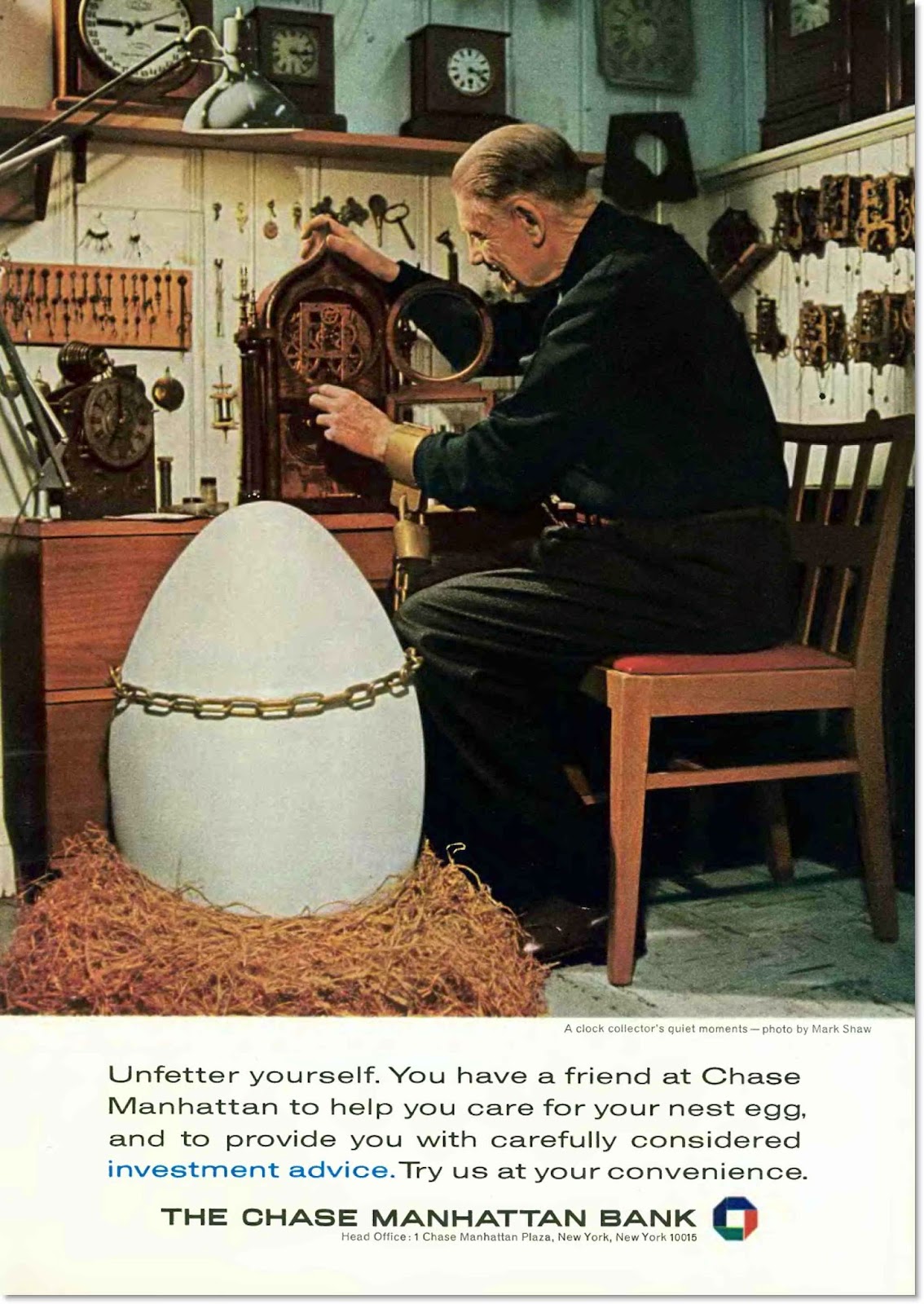
Here's a nest egg ad from the winter of 1964-65, portraying a clock collector. Does he seem a bit stolid for the Swinging Sixties?
Thursday, February 12, 2015
Another item for the estate planning checklist
Designate a "legacy contact" for your Facebook account.
The person won't know about the special status until you die, unless you tell him or her beforehand.
The person won't know about the special status until you die, unless you tell him or her beforehand.
Monday, February 09, 2015
In Defense of Investment Advisers

Investment advisers, not to mention brokers, appear redundant. – useless or worse. William Berstein sees them as a threat to financial health and happiness:
As an investor, you must recognize the monsters that populate the financial industry. *** … most “finance professionals” don’t even realize that they’re moral cripples, since in order to function they’ve had to tell themselves a story about how they’re really helping their customers.Some critics are less polite.
Polite or not, the critics ignore a key reality: Most people cannot invest sensibly on their own. At best, perhaps a third are willing and able to put their money into a few diversified, low-cost funds and stay the course.
Others need somebody to hold their hands and discourage them from buying high, selling low. Some are reluctant investors. In begone times they would have been contented savers, putting their money into 3.5-percent savings accounts and 6-percent CDs. Nowadays they must seek investment help or grow poorer.
In short, most people with money to invest still need advisers. What’s different is the adviser’s mission. Instead of tilting with windmills and seeking to beat the market, the adviser’s aim should be to produce better results for the investor than the investor would achieve on his or her own.
And that goal should be often achievable;. The bar is set surprisingly low. From 1994 through 2013, the S&P 500 produced an annualized return of 9 percent. The average stock fund investor earned 5 percent.
Some estimates suggest the gap in returns is even greater after accounting for all fees and other expenses.
Does a 20 percent increase in investment performance sound worthwhile? By controlling expenses with ETFs and limiting fruitless trading, an adviser could achieve that impressive improvement merely by increasing the investor’s annualized return from 5 percent to 6 percent. A low-cost, exceptionally patient adviser might achieve 7 percent – a 40 percent improvement!
Helping clients beat the average investor rather than beat the market doesn’t sound glamorous. It won’t earn advisers enough to acquire a beach house in Malibu. But it is doable.
Like politics, investing is the art of the possible.
Sunday, February 08, 2015
Nigeria Forever!
From today's email. Or so I conjecture.
I hereby would want to bring to you the good news about your long awaiting fund, The Federal Ministry of Finance, Nigeria, and the Banking industry here in Nigeria in-conjecture with Central Bank Of Nigeria held meeting in Abuja regarding all foreign payment.
Saturday, February 07, 2015
Tips For Donors and Charities
Paul Sullivan's Wealth Matters column reveals an unusual corner of philanthropy: helping companies with ill-gotten gains give away their tainted funds.
Lesson for donors: Giving money away usefully can be hard work. Wealthy individuals who fund a new dorm for their alma mater or a new wing for the local hospital have it easy. Donors who have to come up with their own ideas do not. Giving away money effectively, Steve Jobs believed, was more difficult than making it.
Lesson for charitable recipients: Donors expect feedback. Most charities who received portions of the ill-gotten gains failed to report on how they used the money. The minority who did won additional grants.
Lesson for donors: Giving money away usefully can be hard work. Wealthy individuals who fund a new dorm for their alma mater or a new wing for the local hospital have it easy. Donors who have to come up with their own ideas do not. Giving away money effectively, Steve Jobs believed, was more difficult than making it.
Lesson for charitable recipients: Donors expect feedback. Most charities who received portions of the ill-gotten gains failed to report on how they used the money. The minority who did won additional grants.
Friday, February 06, 2015
Paul Gauguin, From Wealth Manager to Destitute Artist
At age 23, Paul Gauguin started a successful career as a Parisian stockbroker. He fell in with the arty set, including Pissarro and Degas.
If Gauguin didn't invent the midlife crisis, surely he perfected it. In his late 30's he abandoned his job, his family and middle-class life to become an artist. Economically, it was downhill all the way. Only after Gauguin's death in 1903, sick and destitute in Tahiti, did his paintings become prized.
Fast forward to 2015. One of Gauguin's works, painted during his first stay in Tahiti, just changed hands at a price higher than any other painting is known to have fetched: nearly $300 million!
What do you suppose the wealth manager turned artist would have made of that news?
If Gauguin didn't invent the midlife crisis, surely he perfected it. In his late 30's he abandoned his job, his family and middle-class life to become an artist. Economically, it was downhill all the way. Only after Gauguin's death in 1903, sick and destitute in Tahiti, did his paintings become prized.
Fast forward to 2015. One of Gauguin's works, painted during his first stay in Tahiti, just changed hands at a price higher than any other painting is known to have fetched: nearly $300 million!
What do you suppose the wealth manager turned artist would have made of that news?
 |
| This Gauguin sold for a record price of almost $300 million. |
Thursday, February 05, 2015
About those tax "cost" estimates
A client recently had a question about the current issue of Estate Planning Report:
JCT does not explain their methodology or assumptions for specific line items. Frankly, the numbers make no sense to me. I take it that they assumed the restoration was for one year only, that the charitable rollover would be repealed for years 2 – 10, so the later years cost far less. But then why don’t they cost zero? How do they lose $19 million in year 10 for donations made in year 1?
But even worse, let’s unpack the numbers a bit to see what they mean. By definition, the donations are coming from those over 70 1/2 and can’t exceed $100,000. For the sake of round numbers, let’s assume that their tax rate is 23.9%. To lose $239 million in one year, you have to assume that $1 billion would have otherwise been included in the income of these retirees, presumably as required minimum distributions. To get to that number you need to have 10,000 retirees each make a maximum $100,000 charitable rollover contribution—that seems absurdly high to me. Alternatively, 100,000 taxpayers could donate $10,000 each, but that still seems equally unlikely. I doubt that there are that many IRAs large enough to sustain such large donations, especially just in the last two weeks of the tax year when such rollovers were allowed. Remember, only those over age 70 1/2 are even eligible. Presumably only those with IRAs worth $1 million or more would consider such a large donation, and GAO reported there are only about 600,000 IRAs that large in the country.
But still worse than that, they also must have assumed that the affected seniors would not have exercised their right to simply take the RMD, give it to charity, and claim the deduction in the usual way! That seems like the most unlikely assumption of all. That’s why I concluded the paragraph with the notion that the JCT seems to be assuming that charitable gifts won’t be made at all in the absence of this provision.
Am I missing something?
I’m not sure what the dollar amounts mean in the second paragraph?? Tax cost the first year is $239 million and the ten-year cost is only $384 million.These are the numbers that the Joint Committee on Taxation submitted as the lost revenue for allowing the tax-free rollover of funds from an IRA to a charity. Here’s my source. You may recall that in December Congress reinstated the tax-free charitable rollover for a single year, and it has now expired again. They scored it as losing $239 million in the first year and from $12 to $19 million every year after that. It’s line A8 of the table.
JCT does not explain their methodology or assumptions for specific line items. Frankly, the numbers make no sense to me. I take it that they assumed the restoration was for one year only, that the charitable rollover would be repealed for years 2 – 10, so the later years cost far less. But then why don’t they cost zero? How do they lose $19 million in year 10 for donations made in year 1?
But even worse, let’s unpack the numbers a bit to see what they mean. By definition, the donations are coming from those over 70 1/2 and can’t exceed $100,000. For the sake of round numbers, let’s assume that their tax rate is 23.9%. To lose $239 million in one year, you have to assume that $1 billion would have otherwise been included in the income of these retirees, presumably as required minimum distributions. To get to that number you need to have 10,000 retirees each make a maximum $100,000 charitable rollover contribution—that seems absurdly high to me. Alternatively, 100,000 taxpayers could donate $10,000 each, but that still seems equally unlikely. I doubt that there are that many IRAs large enough to sustain such large donations, especially just in the last two weeks of the tax year when such rollovers were allowed. Remember, only those over age 70 1/2 are even eligible. Presumably only those with IRAs worth $1 million or more would consider such a large donation, and GAO reported there are only about 600,000 IRAs that large in the country.
But still worse than that, they also must have assumed that the affected seniors would not have exercised their right to simply take the RMD, give it to charity, and claim the deduction in the usual way! That seems like the most unlikely assumption of all. That’s why I concluded the paragraph with the notion that the JCT seems to be assuming that charitable gifts won’t be made at all in the absence of this provision.
Am I missing something?
Subscribe to:
Posts (Atom)

 Posts
Posts


