Friday, September 30, 2005

Who's even less trustworthy than an accounting firm? Wealth managers!

Accounting firms haven't been getting a lot of good press lately. Latest example, today's reports that KPMG has agreed to pay $195 million to wealthy clients who say the accounting firm sold them illegal tax shelters.

Curiously enough, CPAs and accounting firms were the only financial advisers rated “very trustworthy” by even a bare majority (53%) of respondents to the latest U.S. Trust survey of wealthy folks.

Only 41% deemed private banks very trustworthy, and only 38% were very trustful of fee-based investment managers in general.
Those rated least trustworthy were: mutual fund companies, rated very trustworthy by 21%, insurance companies (20%), and stockbrokers or brokerage firms (19%).
Could it be that today's financial advisers possess less integrity than those of generations past? Or do we simply live in a cynical age?

Thursday, September 29, 2005

Keep your rich uncle on life support!

As Tom Herman reports in The Wall Street Journal (subscribers only), “The timeliest tax advice for thousands of the nation’s richest people couldn't be simpler: Keep breathing — at least until New Year’s Day.”

Don Weigandt of J.P. Morgan Private Bank in LA gave Herman illustrations of why the wealthy need to hang on until 2006:
Suppose someone who is single dies this year and leaves a taxable estate of a mere $2 million. The federal estate tax this year would be $225,000, according to calculations by Mr. Weigandt. But if that person lives until next year, the federal estate tax would be zero.

The rewards for survival get bigger as the size of the estate grows. Suppose a single person with a taxable estate of $5 million dies next year, instead of this year. The tax savings typically would be $255,000, says Mr. Weigandt. Or suppose someone with a taxable estate of $10 million dies next year instead of this year. The tax savings would be $305,000.

For someone with a taxable estate of $100 million, the federal estate tax typically would be $46,285,000. But if that person lives at least until Jan. 1, 2006, the federal estate tax would be only $45,080,000 -- a savings of $1,205,000.

There are other financial incentives to survive into 2006. The annual gift-tax exclusion is scheduled to rise next year, to $12,000 from $11,000, allowing wealthy people to move even more money out of their estates, tax-free.

Although the estate-tax issue often has been in the headlines over the past few years, the percentage of estates taxed by the federal government is very small. In recent years, for example, the number of taxable estate-tax returns represented only about 1.2% to 2.3% of total adult deaths each year, according to the Internal Revenue Service. But organizations such as the National Federation of Independent Business say those numbers are deceptive and that the "death" tax deserves to die. President Bush also has called for permanent repeal.

New IRS statistics show only 65,039 estate-tax returns were filed in 2004, says Martha Britton Eller, economist at the IRS Statistics of Income Division in Washington. That was down from 66,044 in 2003. Many estates weren't taxable. For example, of the 2004 total, only 31,329 -- or less than half the total -- were taxable, Ms. Eller says.

Most of these taxable estates represented the merely rich, not the super rich. For 2004, more than 22,200, or more than 70% of all taxable estates, were valued at less than $2.5 million. And only 1,328 were valued at $10 million or more.

Based on current law, the estate-tax exemption level is scheduled to remain $2 million in 2006, 2007 and 2008, then rise to $3.5 million in 2009 before vanishing entirely in 2010 -- only to return at the $1 million limit in 2011, unless Congress changes the law before then, as it probably will.

Copyright 2005 Dow Jones & Company, Inc.

Does your bank or trust company offer health club and/or home health-care services to the elderly wealthy in your market? Think about it!

Sunday, September 25, 2005

Where the absolutely awesome wealth is

Thanks to 100+ hedge-fund managers, assorted investment bankers and other Wall Streeters, Greenwich, CT is virtually oozing with money, as today's Stamford Advocate reports.

Hedge-fund managers are crowding into the Forbes 400 list of richest Americans (where it takes darn near $1 billion just to make the cut). Today's New York Times offers a comparison of how today's 400 compare with the those on the list 20 years ago.

Friday, September 23, 2005

"Put not your trust in money, but put your money in trust.”

That advice, offered by Oliver Wendell Holmes Sr. to young ladies, was essential in the 19th century. Back then, women who failed to put their money in trust before marriage had to hand over the funds to their husbands.

And it’s still good advice, according to “Beyond the Prenup” (subscribers only) in The Wall Street Journal.
Protecting wealth from the financial ravages of divorce has long been a key concern of families, who often enlist lawyers to draft a detailed prenup spelling out what's his and hers before the wedding invitations are sent out.
But wealth managers are increasingly trying other strategies -- especially the creative use of trusts, which can be effective in sheltering assets a spouse has earned before the marriage or will inherit.
* * *

Premarital planning tactics vary depending on whether the assets in question were generated by the bride or groom or their parents. If it's the parents that are wealthy, advisers recommend that they leave gifts or inheritances to their children in trust, rather than outright. In general, inherited property and gifts, even those received during marriage, are considered out of the marital estate, but income and appreciation may not always be.

When parents transfer family wealth into trusts, that property is segregated into its own bucket, clearly outlining what's inherited or given and what's not. By contrast, says New York lawyer Arlene Dubin, a gift or inheritance deposited into a bank account runs the risk of being subject to division at divorce, if it's commingled with marital assets such as a joint tax refund or even a paycheck.

Saturday, September 17, 2005

Mr. Barnum, meet the hedge funders!

"There's a sucker born every minute," said Phineas T. Barnum. He certainly would have enjoyed the saga of the Bayou funds, chronicled extensively in today's New York Times.

Sam Israel's investment approach for his Bayou funds is said to have appealed to investors because it was understandable. No fancy swaps, no leveraged bets on toxic tranches of CDOs. Just good, old fashioned short-term trading in stocks that always seemed to work out well.

Was he actually the only person on the planet who could trade stocks for consistent profits month and month and year after year? If so, why wasn't he world famous? Some of the smarter money must have had its doubts all along.

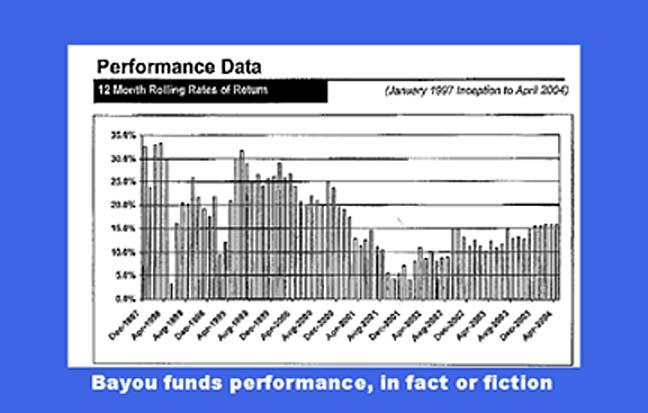
As the chart from Bayou's sales brochure shows, the funds never seemed to have a bad year.

They must have had a really great Sharpe Ratio. Alas, William F. Sharpe himself says his ratio is useless for evaluating the "abolute return" potential of hedge funds. The ratio is too easy to fudge. Sharpe points out that Long-Term Capital Managment had a great Sharpe ratio just before it went bust in 1998. The Bayou funds troubles may have started shortly thereafter.

Bayou's admirable returns, it seems, weren't merely merely fudged, they were imagined. (It helps when your "independent auditor" is your CFO.)

Every affluent investor is a potential sucker. Yet in Bayou's case the biggest sucker of all may have been the manager, Sam Israel III. When his funds’ reported assets were over $400 million, he seems to have been down to $100 million or so. And that sum he supposedly entrusted to a miracle worker to invest in “two private, managed, buy/sell leveraged transactions” that in ten years would turn $100 million into $7.1 billion!

LIke to know what annualized return would be required to achieve that miracle?

Fifty-three percent!

Can regulators protect affluent investors against themselves? It won't be easy. The 100 hedge fund managers of Greenwich, CT, are already threatening to leave the country if efforts are made to place them under adult supervision.

Looks like responsible wealth managers and trustees will have to try to provide the protection. That won't be easy, either.

Offer too much protection and clients will think you're way too 20th-century fiduciary and take their business elsewhere.

Offer too little and the suddenly-poorer clients will sue the pants off you.

Life is hard, isn't it?

P. S. According to today's New York Times, Israel told his CFO that the miracle worker had been “referred to us by Alan Greenspan.” Nice touch!


Thursday, September 15, 2005

From the databank: Millionaires

Last year the U.S. produced new millionaires at the rate of 619 per day. What a country!

Number of Americans with a net worth (not counting primary residence) of at least $1 million last year, as estimated in the Merrill Lynch/Cap Gemini World Wealth Report:
2.5 million

Number of people worldwide with a net worth of at least US$1 million:
8.3 million

Number of millionaires worldwide with net worth of $1 million to $5 million:
7.4 million

Number of millionaires worldwide with net worth of $5 million to $30 Million:
744,000

Number of millionaires worldwide with net worth of $30 million or more:
77,500

Number of U.S. households, as estimated by the Boston College Center on Wealth and Philanthropy, with a net worth (not counting primary residence) of $1 million or more:
7.4 million

Number of millionaire U.S. households sorted by age of householder:
Under age 35: 211,000
Age 35-44: 1.0 million
Age 45-64: 3.9 million
Age 65 and older: 2.3 million

Notice that most U.S. millionaire households contain no individual millionaires (7.4 million households but only 2.5 million millionaires). Rather, they consist of households where she has $600,000 and he has $500,000, or he has $800,000 and she has $400,000, etc.

If you're looking for business where the big money is, find one of the maybe 20,000-to-30,000 Americans with a net worth of $30 million or more. Grab his or her family-office business and you're all set.

But if you're looking for a host of clients who will need all the trust and investment help you can give them in the challenging years ahead, give a thought to those "no millionaire" millionaire households. There sure are a lot of them!

Charitable IRA rollovers

According to an e-mail that I received yesterday from Trusts & Estates magazine, Congress is poised to try out the "charitable IRA rollover" concept for the rest of the year in connection with tax relief for Hurricane Katrina. Key portion of the e-mail:
If you have clients who would like to donate more to Katrina relief and who have funds tied up in IRA accounts, this could be part of your year-end strategy. Under the pending legislation, anyone 70 1/2 years old and older would be allowed to roll over amounts from their IRA accounts (and other pension plans that can first be rolled into an IRA) directly to a qualified charitable organization on a tax-free basis.

Taxpayers aged 59 1/2 years old and older would be able to transfer IRA funds to a charitable remainder trust and give that remainder to charity without tax consequence.

I've tried to find the legislation, but according to Tax Notes the language hasn't been drafted yet. I take it that the transfer to charity would count toward the year's minimum distribution requirements, which would be a big part of the appeal. The provision would apparently expire at the end of this year, so it will be important to get the word out quickly.

Thursday, September 08, 2005

A trustee is held liable for bad estate planning advice

Following up on her banker's advice to create and fund a Crummey trust to lower future estate taxes, an individual had her lawyer draft the trust, and began making contributions to it. Unfortunately, the lawyer neglected to include a Crummey power of withdrawal for the beneficiaries, making this a somewhat rare form of that trust.

After a number of contributions were made, the trustee noticed the drafting deficiency and called it to the attention of the draftsman. The draftsman disagreed that a mistake had been made. Neither of them reported the question to the grantor. Oddly, the trustee continued to encourage contributions to the trust "to lower estate tax obligations." Perhaps the trustee expected a retroactive trust amendment or something. Needless to say, the defective trust saved no estate taxes, so the furious beneficiaries sued the trustee for their mother's lawyer's mistake (deeper pockets, perhaps?).

The Wisconsin Supreme Court held that the trustee had no fiduciary duty to review the trust, nor to call the defects to the attention of the grantor. However, continuing to recommend contributions to a trust when the purpose of saving estate taxes could not be met was negligence. Decision for the beneficiaries. [Hat tip: Gerry Beyer.]

Wednesday, September 07, 2005

Can US Trust come back?

As reported here, Peter Scaturro, Schwab's choice to head up the once-renowned trust institution, hopes that hedge funds, private placements and other alternative investments can lead to a revival.

Vote delayed

As JLM surmised yesterday, the vote on estate tax repeal was cancelled, given the urgency of finding a good political response to Katrina. That doesn't kill the reformation process, but it may weaken it. Now under consideration: a tax holiday for aviation fuel, and tax incentives for building new refineries.

Tuesday, September 06, 2005

Estate tax reformation watch

According to today's Tax Notes a cloture vote on the estate tax repeal bill, passed earlier this year in the House, is the second item on the docket when the Senate returns from recess. However, the chances of success are limited, from the same article:

In a Farm Broadcasters News Conference last week, Finance Committee Chair Chuck Grassley, R-Iowa, called the chances of achieving full repeal “zero.”

“We're short of 60 votes,” he said.

What's more, one would think that estate tax repeal wouldn't go down well before all the Katrina-rlated issues are addressed. On the other hand, does this make a compromise plan more likely? Or will the Democrats sense victory and decide to stonewall?

Wednesday, August 31, 2005

Multi-family offices

Bloomberg Wealth Manager has published its second annual review of multi-family offices (PDF download required). Assets managed by these competitors to trust departments grew by 26.6% last year. These are major firms--the mean amount under management was $1.0 billion, the median $2.8 billion. The account minimum ranges from $750,000 to $100 million, with $10 million being most typical.

Part of the growth in the last year came from the phenomenon of single family offices becoming clients of multifamily offices, presumably because it was too hard to keep up with the technological requirements on a standalone basis.

Although these organizations are primarily about asset management, 63% of them also offer trust management in-house, and 27% provide trust service on an out-sourced basis. Have any of you, our trust and private banking department clients, run into these companies? Do you consider them important competitors?

Monday, August 29, 2005

John Roberts, probate realist

Roberts quote from today's New York Times article on the Supreme Court nominee:

“. . . probate disputes begin with a death but have a way of never dying themselves.”

Thursday, August 25, 2005

From the databank: hedge funds

Number of hedge funds reported by The Wall Street Journal to have set up shop in Greenwich, Connecticut, in the last few years:
More than 100*
*The office of Bayou Funds was located just over the Greenwich border on the Stamford shoreline.

The New York Times estimate of the total number of hedge funds at year-end 2004:
3,307

Total number of hedge funds as estimated in today's Wall Street Journal (subscribers only):
Over 8,000

Total assets held in hedge funds at end of 2004:
Over $1,000,000,000,000

Average earnings of a top-25 hedge-fund manager in 2001:
Almost $136,000,000

Average earnings of a top-25 hedge-fund manager in 2004:
$251,000,000

Amount earned last year by Greenwich resident Edward Lambert, called world's highest-paid hedge-fund manager by Institutional Investor:
$1,200,000,000

Number of cases brought by the SEC, 2000-2004, alleging fraud by hedge-fund advisers:
51

Total amount that the SEC alleges hedge-fund investors lost through fraud:
Over $1,100,000,000

How long a retirement should we plan for?

Half of today's college students will live to be 100 years old, according Nobel Prize winning economist Robert Fogel, as reported by Robert Samuelson. That's well above the prediction of today's actuarial tables, which Fogel believes are too conservative. He says that in the late 1920s, life insurers "put a cap of 65 on life expectancy." We all know how wrong that is.

One who enters the workforce at age 25, retires at 65 and lives to 100 will spend nearly one half of his or her adult life in retirement, not working. Is that economically tenable? Samuelson advocates the politically unpopular solution of raising the retirement age to 70 over time. I think he's on the right track.

Do today's trust prospects have a good understanding of their likely longevity?

Thursday, August 18, 2005

Personal finance blogs in the spotlight

The Wall Street Journal today offers a roundup of noteworthy blogs covering investment and money management subjects. Only one or two of the mentioned blogs seem even indirectly related to financial services marketing. The value of blogging in this arena remains to be demonstrated, though I think that the potential is huge.

Wednesday, August 17, 2005

Circular 230 will plague us for some time

The flyer for the 40th Heckerling Institute on Estate Planning (the "Miami Institute" to the old-timers) just came in today. You can find more information here. I note with interest a brand new topic, one of the special sessions: The Gathering Storm—Circular 230: What Does It Mean and What Do We Do? Among the questions to be explored: "Should every item of paper and electronic mail generated by a law or accounting firm contain a statement that it cannot be used to avoid tax penalties?"

I submit that to reasonable men, the question answers itself. When disclaimers get plastered on everything, they soon mean nothing. However, it seems that to the regulators (and those who must follow their commands), there's no such thing as too much information.

Another blog about estate planning

Law professors have been prolific pathbreakers in the blogosphere, and lawyers are entering the fray as well. You and Yours Blawg contains the observations of a New Jersey lawyer about estate planning, among threads. Although the blog (or blawg, as some lawyers seem to prefer) doesn't solicit business, I suspect that it could be a valuable practice development tool.

Sunday, August 14, 2005

Repent! The end is nigh

Funny thing happened on the way to the teller window at the bank the other day. Picked up a muni fund prospectus and saw there was a sales load of 4.5%. Gosh, I thought, when you added in the first year's fees and expenses, a hapless investor would lose one-twentieth of his money at the start. How terrible!

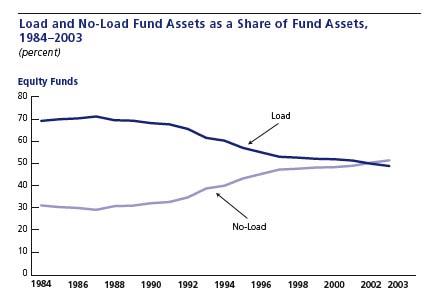
A generation ago, that thought never would have occured to most investors. Load funds were the norm. Without brokers, mutual funds never would have gained traction in the first place. Now the tide is turning, as this chart from the Mutual Fund Fact Book shows.

But managers of no-load funds, except for index funds, shouldn't feel smug. Take a look at the new book by David Swensen, Yale's all-star endowment manager. Here's an excerpt from the publisher's blurb:
In Unconventional Success, investment legend David F. Swensen offers incontrovertible evidence that the for-profit mutual-fund industry consistently fails the average investor. From excessive management fees to the frequent "churning" of portfolios, the relentless pursuit of profits by mutual-fund management companies harms individual clients. Perhaps most destructive of all are the hidden schemes that limit investor choice and reduce returns, including "pay-to-play" product-placement fees, stale-price trading scams, soft-dollar kickbacks, and 12b-1 distribution charges.
To read more about Swenson, see Joseph Nocera's column in The New York Times.

Friday, August 12, 2005

Estate Tax: Exempt $3.5 million and tax the rest at 15% ?

According to today's Washington Post, that's the leading alternative to repeal at the moment.

By the way, why do reporters keep writing about the estate tax affecting "only the top 1%"? That top one percent represents those who leave the estates from which the tax is extracted. Being dead at the time, they don't really "pay" anything. Basically, their heirs pay. Mightn't an estate have two or three, six or eight, or even 10 or 12 heirs?

Monday, August 01, 2005

Banking's black eye: How did deferred annuities get misdelivered?

Seemed like a good idea: Wrap mutual fund shares in an annuity contract for tax deferral. Sell the packages to high-tax-bracket investors who have maxxed out their 401(k) and IRA contributions. Sellers would get high but inconspicuous sales commissions; buyers who invested aggressively and held for 20 years might make a buck.

One problem: When the others in your foursome are talking hedge funds, do you want to confess to buying an annuity?

A worse problem arrived with the Bush tax cuts. When you can pay 15% tax now on realized gains and dividends, why pay ordinary income tax of 30% or more later?

The marketing of variable annuities needed rethinking. Apparent result: A new target market consisting of unsophisticated senior citizens who chafed at low CD yields and liked the sound of "Your heirs will get back every cent you invest, guaranteed!"

To make sure the new market wouldn't refuse delivery, sales commissions were revved up. In his June 8 column, Jonathan Clements of The Wall Street Journal marveled at how much "annuity gladiators" could rake in:
I can't recall precisely when I got my first message, and I have no idea how I got on this particular email distribution list. But at some point last year, I started receiving emails aimed at insurance agents, offering to pay me commissions of 8%, 10% and even 13% for selling annuities.
The results have been disastrous. Horror stories abound, like this one from a Jane Bryant Quinn column last year. The selling of variable annuities made a list of Top Ten Investment Scams. An elder law center discusses annuity sales in the same breath as Ponzi schemes. (Rumors that the ghost of Charles Ponzi is suing for libel could not be confirmed.)

Can someone explain how banks got caught up in this sorry mess? Suicidal tendencies? A sick urge to get rid of customers over 65? Bank of America certainly didn't help its public image. Neither did Citizens, a Royal Bank of Scotland unit that's $3 million poorer as a result. Can regulators save banks and other annuity sales channels from themselves, or will stronger steps be necessary?

If that question sounds over-dramatic, read on.

This year, 2005, marks the centennial of the beverage we know today as Classic Coke. In 1905 people probably thought of it as New Coke.

The original Coca-Cola had been formulated in Atlanta a generation earlier, in 1886, and the Coca-Cola Company quickly became the Google of its time. From 1890 to 1900, sales of Coca-Cola syrup increased by 4000%!

Despite, or perhaps because of, this smashing success, in 1905 the Coca-Cola Company revamped its formula. No more cocaine.

Please note that "cocaine" was not a loaded word in the 19th century. Cocaine was merely a routine stimulant, found not only in soda-fountain tonics but also in painkillers, including Bayer Aspirin. Only when cocaine became widely abused by addicts was it outlawed.

Today, one response to annuity sales abuse would be to make variable annuities a "controlled investment product." No sales to investors over 50 without a prescription. To be valid, the prescription would have to be signed jointly by the investor's lawyer, a tax accountant and a trust officer or wealth manager.

Waddiyathink?

Free plug: The old delivery truck shown above is actually a toy coin bank, available from the Coca-Cola store.

Thursday, July 28, 2005

The gap between what the wealthy want and what financial advisors are delivering

Interesting, if somewhat predictable, information in this survey by SEI Investments. Another boost for "holistic" planning.

Tuesday, July 26, 2005

Estate tax reform delayed

Earlier this year a compromise on the future of the federal estate tax looked possible. Senators Kyl and Baucus were negotiating a middle ground that might attract enough democratic votes to avoid a filibuster. However this item from Tax Notes (paid subscription required) indicates that nothing will happen before the August recess. Senate Majority Leader Frist was threatening to call for a vote on full estate tax repeal, but Finance Committee Chairman warned against the move.

"I've observed very intense efforts on the part of Sen. Baucus to work on a compromise and I think that he's sincerely trying to get Democrats on board," Grassley said. "I think that anything that would go for complete repeal, even though I support complete repeal, might blow the whole thing up."

So, maybe in September?

Monday, July 25, 2005

He gave up peddling trusts and annuities.

Yes, this Californian had a better idea. Instead of a slimey life selling living-trust packages and annuities to unsuspecting seniors, he opted for good old, straightforward fraud.

Thursday, July 21, 2005

Why estate tax repeal doesn't much matter

William J. Bernstein, the Oregon neurologist who turned his hobby, portfolio theory, into a second career, doubts that estate tax repeal would create a new class of perpetually wealthy Americans.

Even with the widening acceptance of dynasty trusts, says Bernstein, vast familial wealth will shrink "faster than the prawn plate at a Cajun wedding."

Read his reasons here.

Tuesday, July 19, 2005

"Hi! I'm from the Government, and I'm here to cut your taxes"

Did you notice? President Bush asked Congress to map out income-tax hikes totaling as much as $600 billion to $800 billion over ten years. That's how much the Administration needs to kill the monstrous alternative minimum tax without increasing future budget deficits.

What's that? You say it's long been obvious the AMT soon must be done away with or toned down? Maybe so. But future budget deficits have been estimated on the assumption that those AMT revenues will keep on snowballing, engulfing and devouring the incomes of Americans with incomes of $75,000 and up. As this article in today's New York Times suggests, many of your trust and investment clients are among the victims.

Conspiracy theorists suspect the AMT was deliberately designed to cancel much of the benefit of the Bush tax cuts. Nah! Too clever.

But speaking of conspiracies, what's all this talk about killing the death tax? Even if the federal estate tax is abolished, various states are busy revving up their own death taxes. Incautious enough to die in Connecticut? Beware of a death tax with a top rate of 16%. Washington State? 19%

Florida, by contrast, allows residents to die tax free. Could that have anything to do with the 15%-or-more population increase that Florida expects by 2010?

Friday, July 15, 2005

Does Circular 230 Apply to Bank Newsletters?

When playing audit lottery with a tax shelter, some taxpayers were in the habit of buying "insurance" in the form of a legal opinion. The opinion would provide a basis for going ahead with an "aggressive" transaction. It would not guarantee success in a fight with the IRS, but it would show that the taxpayer had exercised reasonable precautions, enough to preclude the imposition of tax penalties.

An unhappy IRS modified Circular 230 last December, changing the rules for giving tax advice. Estate plannners are now justifiably afraid that the rules may apply to them as well.

Attorney and estate planner Natalie Choate penned "How I Will Comply With Circular 230" for the July 2005 issue of Trusts & Estates magazine (not available online, so far as I can tell). Planners need to be concerned with "covered advice," "other written advice," and, according to Ms. Choate, "preliminary advice."

I believe that articles in bank newsletters fall well outside the scope of Circular 230, and if they are covered, they should be considered preliminary advice. As such, it could be prudent to include a disclaimer that "Articles in this newsletter are not intended to be tax or investment advice. Please consult an appropriate professional before taking action or making any decision."

However, at least one of Merrill Anderson's clients believes that newsletter articles that touch on tax matters that are favorable to taxpayers constitute "other written tax advice." As such, to avoid compliance with all the strictures of Circular 230, such articles must include a somewhat more draconian disclaimer. The one this particular client chose is:

This written advice is not intended or writtten to be used, and it cannot be used by any taxpayer, for the purpose of avoiding penalties that may be imposed on the taxpayer. Before making any decisions or taking any action, seek the advice of qualified tax or investment professionals.

Yes, the client insisted on the boldface type, which was suggested in the December regulations but relaxed in the May amendments. The type still needs to be as large as the text copy.

My sense is that this is a bit of an over reaction, but at the same time compliance matters do need to be taken seriously. What are the other trust and private bankers saying about Circular 230?

Tuesday, July 12, 2005

Index funds

Jeremy Siegel's new book, The Future for Investors, Why the Tried and True Triumph Over the Bold and the New, includes an interesting exercise in what happens when you invest in an index fund. The current incarnation of the S&P 500 dates back to 1957. The index has been adjusted over the years, because it has to be. Some companies merge, spin pieces off, or are bought by others. The economy is changing over time, and the Index needs to evolve with it to remain an accurate barometer.

Professor Siegel posed the question, what if I bought the original 500 stocks instead of replicating the index? He had three alternatives for dealing with corporate reorganizations, from sticking to the originals only to owning all their descendants. The critical point is that none of the portfolios ever added any of the 917 stocks added to the S&P 500 over the years.

I was surprised to learn that Professor Siegel's portfolios beat the S&P 500 handily. No Microsoft? Limit yourself to big firms from the 50s, and beat the returns from firms delivering the information age economy? But of course it's true, which is why it made it into the book.

This seemed like just the thing to share with the readers of our Investment and Trust Newsletter, so I did a one page summary of Siegel's findings. I was promptly chastised by our clients, who fell into two camps. One side claimed we were slamming index funds, which was a problem become some trust departments rely on index fund investing for smaller trusts. The other school objected that we were endorsing index funds, or at least offering approval of a passive investment approach, which was inconsistent with their investment service.

Needless to say, we respond quickly to client concerns, and the page now covers tax basis and tax management for investment portfolios.

Any suggestions for covering investment matters for wealth management customers in a way that won't ruffle any feathers out there?

Monday, July 11, 2005

History of the estate tax

As you follow the estate tax debate cited below, you'll need a crib sheet on the history of the tax. I pinched this one from the National Center for Policy Analysis.
The first estate tax -- enacted July 6, 1797, to help pay for naval rearmament -- required only the purchase of federal stamps for wills and estates, but was terminated four years later because the need for the revenue passed.

A direct tax on inheritances imposed in 1862 during the Civil War ranged from 0.75 percent to 5 percent.

The top rate was raised to 6 percent in 1864; but the tax was then abolished July 14, 1870.

In 1898, an estate tax with a top rate of 15 percent on estates over $1 million was imposed to pay for the Spanish-American War -- then repealed on April 12, 1902.

America's fourth estate tax, enacted in 1916, set a top rate of 10 percent on estates over $5 million. It was raised to 25 percent in 1917, but this rate applied only to estates over $10 million. Unlike its predecessors, it was not repealed after the war, although the top rate was dropped to 20 percent in 1926.

President Franklin Roosevelt raised the top rate to 60 percent in 1934, and to 70 percent in 1935. The same bill increased the top income tax rate to 75 percent and increased corporate taxes. Altogether the law raised just $250 million annually.

Today [2005] the estate tax goes up to 47 percent. It exists only to redistribute income, since its revenue yield is negligible. But estate planning makes the tax virtually voluntary, according to estate tax experts.
Source: Bruce Bartlett, senior fellow, National Center for Policy Analysis, July 19, 2000.

The original modern estate tax, circa 1916, sounds good to me. Ten percent rate, $5 million exemption.* Why can't Congress learn to leave well enough alone?

* February 2010 update. I miswrote here. The ten percent rate only kicked in at $5 million, but lower rates, starting at one percent, applied to estates over $50,000.


Sunday, July 10, 2005

The final push on estate tax repeal is coming

The surest signal yet that resolution of death tax issues is near is this article: Few Wealthy Farmers Owe Estate Taxes, Report Says - New York Times. Not mentioned in the article is the fact that the presence of death taxes has pushed many farm families to sell out to corporate agribusiness. I can't document how widespread a phenomenon that is (the same is true in the newspaper publishing industry, which was documented in Congressional testimony), but I have anecdotal first hand experience.

One can see the seeds of compromise here. It is very true that middle class farmers stand to lose if carryover basis is brought back into the law. It was the farm lobby that forced repeal of carryover basis in the late 70s (who the heck can guess the tax basis of a tractor?).

I believe that we were on course for bringing the estate tax issue to resolution this month, either with full repeal (30% chance) or a negotiated settlement that would accelerate a larger exemption (70% chance). However, the O'Connor retirement has upset that applecart, and if Rehnquist (and others?) also decide to retire most other Senate business is predicted to grind to a halt.

Saturday, July 09, 2005

How to succeed in business: follow Wachovia's lead

When the Senior Assistant Blogger lived in Connecticut, he banked at Home Bank and Trust Company of Darien, which was acquired by a Stamford bank, which became Fairfield Country Trust, which merged with a New Haven bank and became Union Trust, which merged with First Union. If the SAB still lived there, his bank would now be called Wachovia.

Which is why he was interested to come across this article on Wachovia from the Gallup Management Journal. And like any civilian with long acquaintance with large banks, he was blown away to read therein a truly astonishing research finding:
In recent years, most major companies have realized that improving service quality and increasing customer loyalty are key to driving their bottom-line performance.
Will wonders never cease?

Seriously, folks, the article sheds helpful light on the efforts needed to improve service quality. Remember: The higher the level of bank-customer satisfaction, the more likely that customers will use additional services — like wealth management or trusteeship.

Friday, July 08, 2005

Russians now can die tax free. Why not us?

From an editorial in today's Wall Street Journal:
Karl Marx must be rolling in his grave, and don't even ask about V. I. Lenin: Russia eliminated its inheritance tax last month. Its move comes after January's decision by the government of Sweden, the birthplace of the modern-day welfare state, to eliminate its estate tax. Like the Russians, the Swedes have come to believe that the tax is unjust and economically counterproductive. Russia and Sweden join Argentina, Australia, Canada, India, Mexico and Switzerland as nations that don't make death a taxable event.
Subscribers to the Online WSJ can read the entire editorial here.

Wednesday, June 22, 2005

Advising the women millionaires

Did you know that most of the young millionaires in the UK are women? So reports this article, which offers provocative thoughts on what women want from their financial advisers.

Do women generally prefer to deal with women advisers? Or are women like my late mother-in-law still around? Daughter of a Wall Street mogul, she was financially astute herself but refused to believe a woman banker or broker could have a useful thought in her head.

Is estate tax reform coming?

According to this morning’s Wall Street Journal (subscription required), the Senate is close to a compromise on reforming the estate tax. We have no details as yet on tax rates or effective dates, but the smallest exemption being discussed is $3 million.

There will undoubtedly be additional adjustments, such as elimination of carryover basis, perhaps an additional exemption for family owned businesses.

Reportedly the White House is holding out for total repeal, which is unlikely. According to the Journal, advocates of repeal in the House are likely to accept the compromise.

The target for passage is the end of summer, which means before the August recess (around the ERTA anniversary?). I put the chance of passage of a compromise by August at 75%, because according to Tax Notes the repeal wing is quite strong, strong enough to see that something happens. Yet the Democrats have proved tenacious enough in blocking certain judges and the Bolton nomination that there is no chance for a stand-alone estate tax repeal bill passing. If Kyl strikes a compromise, the Senate Republican leadership is likely to endorse it, and I doubt Bush would veto it.

If the estate tax is changed, Merrill Anderson will have marketing materials in response.

Selling financial services with newsletters

Haven't posted for awhile because I was in Washington DC at the PrimeVest National Sales Conference. Merrill Anderson creates PrimeVest's client newsletter, and we do this with an unusual sales model. Each individual rep buys copies of the newsletter, for his or her clients (or other usage) and pays for the newsletter through commission reduction. Thus, Merrill Anderson has to sell each rep individually, for the most part.

Do the newsletters work? We didn't get any stories along the lines of "I distributed X copies of newsletters and received Y inquiries." We do have plenty of satisfied customers, and they did report getting comments on a fairly regular basis.

More important, usage of the newsletter is positively correlated with success as a PrimeVest registered rep. Overall, just 8% of PrimeVest reps have signed up for the newsletter. Among the "cream" of the brokers, those attending the National Sales Conference, we had a 27% market share. The top 25 reps constitute the "President's Club," and here we count 35% as our customers.

What do the newsletters do? Mostly, they put the face and contact information of the rep in front of the client. The content is polished and professional, good for the rep to associate with.

Drop me an email if you'd like to see a sample.