
Tuesday, May 14, 2013
“That Awkward Age”
The New Yorker just posted this to my Facebook page. It's so pertinent to many families – including mine – that I'll forgive them for confusing "deduction" with "exemption."


Friday, May 10, 2013
Stock Certificates: Going, Going …
If your broker jumped out the window during the Great Depression, you were sorry you left your shares in street name. Prudent investors obtained stock certificates and tucked them in their safe deposit boxes.
For decades seasoned investors continued the precaution. In the 1960's, Robert Morse's Bert Cooper, most venerable of the Mad Men, probably still held tight to his shares. The younger generation more likely left their stocks with their brokers.
Holding on to stock certificates had its inconveniences, as did holding bearer bonds with coupons that had to clipped in order to collect interest payments. That's why Chase Manhattan advertised custody accounts in those classic nest egg ads. Trust institutions held customer certificates in their own vaults or, in later years, in depositories.
In the 21st century securities certificates have become an anachronism. Soon they'll vanish altogether, at least for publicly-traded businesses. The coup de grace was superstorm Sandy. Flooding much of downtown Manhattan, Sandy left Depository Trust and Clearing with 1.7 million soaking wet certificates. One million seven hundred thousand!
How will we introduce kids to the world of investing if we can't give them a couple of shares of Apple?

At least old stock certificates, found at sites such as Scripophily, will help preserve the history of American business. This Edison certificate is signed by the great man himself.

For decades seasoned investors continued the precaution. In the 1960's, Robert Morse's Bert Cooper, most venerable of the Mad Men, probably still held tight to his shares. The younger generation more likely left their stocks with their brokers.
Holding on to stock certificates had its inconveniences, as did holding bearer bonds with coupons that had to clipped in order to collect interest payments. That's why Chase Manhattan advertised custody accounts in those classic nest egg ads. Trust institutions held customer certificates in their own vaults or, in later years, in depositories.
In the 21st century securities certificates have become an anachronism. Soon they'll vanish altogether, at least for publicly-traded businesses. The coup de grace was superstorm Sandy. Flooding much of downtown Manhattan, Sandy left Depository Trust and Clearing with 1.7 million soaking wet certificates. One million seven hundred thousand!
How will we introduce kids to the world of investing if we can't give them a couple of shares of Apple?

At least old stock certificates, found at sites such as Scripophily, will help preserve the history of American business. This Edison certificate is signed by the great man himself.

Tuesday, May 07, 2013
The Warren Buffett show
Many
years ago, my Dad got a great stock tip: Buy Berkshire Hathaway at $33,000 per
share. Alas, that was too steep for him
at the time. Years later, when the B shares were created, he did buy some of
those. Accordingly, he can go to the annual meeting if he wishes, and he can
bring 3 guests. Five years ago, he took my Mom.
This
year I mentioned to Dad my interest in going to hear Warren Buffett speak. Mom came along for the trip, though her
interest in investing is low to none. We preceded the visit to Omaha with an
excellent trip to Branson.
When
my folks went the meeting five years ago, there were about 5,000
attendees. They took in the cocktail
party Friday, the barbecue Saturday night, the brunch on Sunday. This year, I
heard later, there were 30,000 attendees.
The cocktail party was an absolute zoo, so we skipped the other free
meals.
The
meeting started at 9:30, the movie at 8:30, so we planned to get to the arena
at about 8:00. Big mistake. The traffic to the arena was backed up about
a mile, three of the four parking lots at the arena were already full. We took our seats at about 8:45. Turns out the doors were scheduled to open at 7 am, but they opened early because it was unseasonably cold (presumably because of global warming). When thanked for this courtesy by a questioner, Buffett responded that if Berkshire sold coats they would not have opened the doors early.
My
first impression: Can the shareholders
of Berkshire Hathaway really be this young?
Loads of 20-somethings, 30-somethings.
I guess they must be, because guest privileges couldn’t account for all of it.
Second impression: It would be great if
they streamed this to the internet, to reduce costs and congestion all around.
I had thought to mention some of the meeting highlights, but the NYTimes Dealbook blog beat me to it. The Breaking Bad bit during the movie was particularly good. The contrast between Buffett and Munger was striking, they make a great team. The questions were mostly intelligent, the answers always were. I'd like to go again next year.
Sunday, May 05, 2013
Buffett and Munger on Estate Planning
From Dealbook's report on the Berkshire Hathaway shareholder meeting:
A shareholder and estate planning expert takes the mic. He says that many of his clients want to follow Mr. Buffett’s plan to leave his children a significant sum of money, but donate most of his enormous wealth to charity.
“The idea is leave enough to do anything, but not enough to do nothing,” the investor says. “How much is that?”
The audience laughs. Mr. Buffett responds that children’s behavior is often more dictated by how their parents act rather than how big their inheritance is.
Mr. Munger demurs on answering the question, saying it’s a bad idea to discuss one’s will with one’s children — if they will be treated unequally.
Saturday, May 04, 2013
The Fiduciary Way to Win the Derby

Good cheer should fill the offices of Bessemer Trust Monday morning. Orb, owned by Bessemer chairman Stuart Janney III and his cousin, former chairman Ogden Mills "Dinny" Phipps, won the Kentucky Derby.
For decades, the Phipps family and their Hall of Fame trainer, Shug McGaughey, have been a force in racing. But this is their first Derby win.
Moral: Invest for the long term. Patience is a fiduciary virtue.
Friday, May 03, 2013
Exchange Traded Funds: Negative Returns?
Carl Richards doesn't think much of exchange traded funds. But his Bucks post sounds like a rave review compared to the slam John Bogle delivered in a 2011 journal article:
Related post: For Higher Returns, Fire Your Broker?
During the five years ended June 2010, ETF investors earned far less than the ETFs in which they invested by a truly remarkable cumulative total of 28 percentage points (average ETF, +15%; average ETF investor -13%), reaffirming an apparently enduring principle of mutual fund performance: Fund investors can be their own worst enemies.On the web and out in the real world, there are some who hope to teach investors to profit from ETFs. Could a buy-and-hold strategy catch on?
Related post: For Higher Returns, Fire Your Broker?
Wednesday, May 01, 2013
The Future of Estate Planning?
Two planners offer a well-organized webinar, including doses of pertinant data:
Future of the Estate Planning Profession: What Practitioners Must Know and Do
Future of the Estate Planning Profession: What Practitioners Must Know and Do
One of the planners, Martin Shenkman, discusses the trust-planning impact of higher top tax rates on gains and dividends here.
Tuesday, April 30, 2013
The Case of the Inherited Tax Shelter
 Should a woman who inherits a $43-million UBS account, sheltered years earlier by her husband, receive leniency from Uncle Sam?
Would your answer differ if the widow were age 49 instead of 79?
Would you be influenced by her failure – more likely, her advisers' failure – to disclose her inheritance to Uncle Sam until 2009, when a list of owners of UBS shelters went public?
Mary Estelle Curran has served a prison term most tax evaders can only dream of: five seconds probation. She also may be the only 79-year-old Palm Beach multimillionaire to be described as a "homemaker."
 Despite this setback, Uncle Sam's attempts to crack down on offshore shelters are expected to continue. In January Wegelin, Switzerland's oldest private bank, went out of business after pleading guilty to helping more than 100 Americans shelter more than $1.2 billion.
Monday, April 29, 2013
Changing the Investment Landscape
Crowdfunding. In theory, a really great idea. In practice, investor beware. The Washington Post explains.
Sunday, April 28, 2013
Saturday, April 27, 2013
Estate Planning Revisited
Paul Sullivan's Wealth Matters column includes a plug for living trusts in California. He also notes that some folks who made $5-million or $10-million gifts in trust may forget they intended to replace cash with non-liquid assets. (Forget about a $5-million gift? Maybe Scott Fitzgerald was right about the rich being different.)
The Wall Street Journal's estate planning update spotlights possible crackdowns on GRATs and dynasty trusts.
The Wall Street Journal's estate planning update spotlights possible crackdowns on GRATs and dynasty trusts.
Friday, April 26, 2013
Twitter: Compare and Contrast
 |
| Graphic by Matt Huynh for The New York Times |
How Twitter is becoming your first source of investment news
Maybe I shouldn't:
Twitter has no place on Wall Street
Would you risk a client's money on a tweet? What about your own money?
Tuesday, April 23, 2013
Shakespeare's Will
On April 23, 1616, William Shakespeare died. Robert Brustein's imaginative new play, "Last Will," depicts the ailing Bard's estate planning, guided by his sniveler of a lawyer.
Read Shakespeare's will here. For an actual page from the will, and a link to a more scholarly analysis, go here.
Read Shakespeare's will here. For an actual page from the will, and a link to a more scholarly analysis, go here.
Monday, April 22, 2013
Bring Back the Tontine?
Does the secret of financial security in retirement reside in a product devised by a 17th-century Italian banker? In a WSJ column University of Toronto professor Moshe Milevsky proposes the return of the tontine.
The Tontine Coffee House on Wall Street, established in 1793, is still remembered because it became overcrowded with brokers. They decided to move out and form a stock exchange.
Imagine a group of 1,000 soon-to-be retirees who band together and pool $1,000 each to purchase a million-dollar Treasury bond paying 3% coupons. The bond generates $30,000 in interest yearly, which is split among the 1,000 participants in the pool, for a guaranteed $30 dividend per member. A custodian holds the big bond and charges a trivial fee to administer the annual dividends. So far this structure is the basis for all bond index funds. Nothing new. But in a tontine arrangement the members agree that—if and when they die—their guaranteed $30 dividend is split among those who are still alive.
So if one decade later only 800 original investors are alive, the $30,000 coupon is divided into 800, for a $37.50 dividend each. Of this, $30 is the guaranteed dividend and $7.50 is other people's money.
Then, if two decades later only 100 survive the annual cash flow is $300, which is a $30 guaranteed dividend plus $270. When only 30 remain, each receives $1,000 in dividends—a 100% yield in that year alone.
Back in the Gilded Age, Milevsky notes, almost half of U.S. households owned some sort of tontine insurance. The policies appear to have been a form of deferred annuity, spiced up with a longevity bonus. Popularity led to excess – some tontine products amounted to little more than swindles, according to Wikipedia. Since 1906 tontines have been banned in the U.S.
Could the tontine make a comeback?
 |
| Francis Guy, The Tontine Coffee House. New-York Historical Society |
Sunday, April 21, 2013
Seniors, Beware of the Alphabet!
According to Bucks, seniors must beware of financial advisers bearing a bewildering assortment of letters after their names. More than 50 combinations are in use, according to the Consumer Financial Protection Bureau. Here are 46:
AEP, APA, APR, ARA, ARPC, ARPS, BCE, C(k)P, CAPP, CES, CEP, CFG, CFP, CHFP, CIS, CPC, CRC, CRFA, CRP, CRSP, CSA, CSEP, CWPP, CASL, CEPP, CHC, CLU, CRPC, CRPS, CSFP, CTEP, MCEP, PRPS, PRP, PPC, QKA, QFP, QPA, QPFC, REBC, RFC, RFP, RP, RICP, RMA, RPA
How many can you identify? If you need a cheat sheet, see Appendix B of the CFPB report.
AEP, APA, APR, ARA, ARPC, ARPS, BCE, C(k)P, CAPP, CES, CEP, CFG, CFP, CHFP, CIS, CPC, CRC, CRFA, CRP, CRSP, CSA, CSEP, CWPP, CASL, CEPP, CHC, CLU, CRPC, CRPS, CSFP, CTEP, MCEP, PRPS, PRP, PPC, QKA, QFP, QPA, QPFC, REBC, RFC, RFP, RP, RICP, RMA, RPA
How many can you identify? If you need a cheat sheet, see Appendix B of the CFPB report.
Saturday, April 13, 2013
What One Trillion Dollars Looks Like
H/T to the Bogleheads for calling attention to this: One picture is worth a trillion dollars.
Update: Scroll down the Boglehead comments and admire the one hundred trillion dollar bill from Zimbabwe.
Update: Scroll down the Boglehead comments and admire the one hundred trillion dollar bill from Zimbabwe.
The WSJ weighs in . . .
. . . on the President's proposal to cap deferrals in qualified retirement plans.
Thursday, April 11, 2013
Followup on the Super IRAs
I just thumbed through the "green book" explanation of the revenue segment of the President's proposed budget. Contrary to my assertion below, limiting plan contributions once a taxpayer has about $3 million is going to raise an extraordinary amount of money, $800 million in the first year alone!
I would dearly love to see the math on that one.
Remember, the new provision only prevents new contributions once the limit is breached, it does not demand disgorgement or taxation of excess accumulations.
For the sake of argument, we'll assume that those facing the contribution limit lose the right to make a $50,000 contribution, the 2012 limit for SEPs (it's $51,000 in 2013, could be more by fiscal 2014). I assume that Treasury assumed the $50,000 would still be paid as compensation, and would be taxed. Let's say the applicable tax rate would be 40%, so this taxpayer will pay an additional $20k in income taxes.
That means that to raise $800 million in new revenue there are already 40,000 taxpayers still in their earning years who have accumulated more than $3 million in qualified retirement plan benefits (all plans and all IRAs are aggregated for this test). All of them would otherwise make a maximum contribution. Is that credible? This small group has $120 billion in qualified retirement plan assets?
Am I missing something? I must be, because these numbers don't make sense to me.
I would dearly love to see the math on that one.
Remember, the new provision only prevents new contributions once the limit is breached, it does not demand disgorgement or taxation of excess accumulations.
For the sake of argument, we'll assume that those facing the contribution limit lose the right to make a $50,000 contribution, the 2012 limit for SEPs (it's $51,000 in 2013, could be more by fiscal 2014). I assume that Treasury assumed the $50,000 would still be paid as compensation, and would be taxed. Let's say the applicable tax rate would be 40%, so this taxpayer will pay an additional $20k in income taxes.
That means that to raise $800 million in new revenue there are already 40,000 taxpayers still in their earning years who have accumulated more than $3 million in qualified retirement plan benefits (all plans and all IRAs are aggregated for this test). All of them would otherwise make a maximum contribution. Is that credible? This small group has $120 billion in qualified retirement plan assets?
Am I missing something? I must be, because these numbers don't make sense to me.
Obama proposes rolling back the estate tax exemption
The Obama budget includes a truly odd detail in the estate tax area. He proposes, as he has done before, going back to the 2009 estate tax regime, with a 45% tax rate and an exemption of $3.5 million and no inflation indexing. Presumably he'd go back to the $1 million gift tax exemption, though this detail wasn't mentioned. This rollback despite the fact that Congress just made permanent a higher exemption and lower tax rate.
But that's not the odd part. Obama proposes going back to 2009 in 2018, two years into the term of the next president! By some crystal ball gazing, he's determined that 2018 will be the optimum moment for a massive estate tax increase. But for the rest of his term, low estate tax rates will be just fine.
He can't be serious, can he?
But that's not the odd part. Obama proposes going back to 2009 in 2018, two years into the term of the next president! By some crystal ball gazing, he's determined that 2018 will be the optimum moment for a massive estate tax increase. But for the rest of his term, low estate tax rates will be just fine.
He can't be serious, can he?
A block on the "super IRA"
You may recall that last year Mitt Romney revealed he had an IRA worth between $20.7 million and $101.6 million. How is that possible, when the contribution limits are so low? Two elements. First, Romney had participated in an SEP-IRA, which had much higher limits. Second, his employer, Bain Capital, permitted plan participants to invest in its takeover deals. Some of these were spectacularly successful. Per the Wall Street Journal, some Bain employees saw their IRAs blossom 583-fold in just 20 months.
Obama would like to put a brake on that. Once your retirement account is more than $3 million, no more contributions for you. However, the account could keep growing, so in fact the $100 million IRA remains theoretically possible. Here's how Tax Notes explains it:
Obama would like to put a brake on that. Once your retirement account is more than $3 million, no more contributions for you. However, the account could keep growing, so in fact the $100 million IRA remains theoretically possible. Here's how Tax Notes explains it:
While the administration has been describing the proposal as a $3 million limit to tax-preferred retirement accounts, the green book explanation of the provision states that taxpayers would be prevented from making additional contributions or receiving additional accruals in retirement plans in excess of the amount necessary to provide for the maximum annuity allowed for tax-qualified defined benefit plans.Interestingly, they do not mention any dollar impact of this proposal, which suggests that it is negligible. This change would be for the sake of "fairness," that is, for the sake of appearances. But it would be a nightmare to administer.
Section 415 currently limits that amount to $205,000, payable in the form of a joint and 100 percent survivor benefit commencing at age 62. That amount is adjusted for inflation. Under Obama's proposal, the maximum accumulation currently for a person age 62 would be approximately $3.4 million. The green book states that assets in the plans could continue to grow with investment earnings and gains, even if a taxpayer was prohibited from contributing. A taxpayer subject to the limitation at one point could make additional contributions if his investment performance was lower than actuarial assumptions, or if the maximum defined benefit level increased because of cost of living adjustments. Excess contributions and accruals would be treated similarly to excess deferrals under current law.
Wednesday, April 10, 2013
Is another tax hike on the rich coming?
President Obama has proposed one.
Limiting the value of deductions to 28% has been discussed before. The article doesn't make clear if that applies to the former tax freedom of muni bond interest, but it should, for the sake of consistency. The charities will be going nuts over this one.
The proposal includes a cap on IRAs of $3 million. This is the first time I've heard that idea, and I'm curious as to just what they mean by that. How could it be enforced? It reminds me of the unlamented repealed tax on "excess accumulations" in retirement plans. Ever more complexity, more work for accountants. I'll see if I can find the budget documents on Tax Notes tomorrow.
I think this goes nowhere, given that we already raised taxes on "the rich" once this year. Maybe we should wait and see how that works out before going to the well again.
Limiting the value of deductions to 28% has been discussed before. The article doesn't make clear if that applies to the former tax freedom of muni bond interest, but it should, for the sake of consistency. The charities will be going nuts over this one.
The proposal includes a cap on IRAs of $3 million. This is the first time I've heard that idea, and I'm curious as to just what they mean by that. How could it be enforced? It reminds me of the unlamented repealed tax on "excess accumulations" in retirement plans. Ever more complexity, more work for accountants. I'll see if I can find the budget documents on Tax Notes tomorrow.
I think this goes nowhere, given that we already raised taxes on "the rich" once this year. Maybe we should wait and see how that works out before going to the well again.
Art As a Billion-Dollar Asset Class
More than a score of philanthropists have made, or promised to make, gifts of $1 billion or more. Normally the gifts take the form of securities or cash. Leonard Lauder's $1.1-billion gift to The Metropolitan Museum of Art consists of art, including 33 Picassos and 17 Braques.
Will we be hearing a lot more about art as an asset class from Sotheby's and Christie's?
The New York Times features a few highlights from Leonard Lauder's collection of cubist art here.
Will we be hearing a lot more about art as an asset class from Sotheby's and Christie's?
 |
| Picasso's "The Scallop Shell," 1912 |
Sunday, April 07, 2013
1968: End of an Investment Era
Mad Men resumes today. Even the Brits are excited. Reliable sources say the new shows pick up the story in 1968.
So far, the turmoil of the 1960s has barely touched Mad Men. That's fairly true to life. If your kids hadn't turned hippie and you didn't have to dodge the draft, 1968 might have left you unscathed. Certainly the prototype wealthy man and wealthy woman in these 1968 Chemical ads look as Old Money as ever.


Nevertheless, for the stock market the end was nigh.
So far, the turmoil of the 1960s has barely touched Mad Men. That's fairly true to life. If your kids hadn't turned hippie and you didn't have to dodge the draft, 1968 might have left you unscathed. Certainly the prototype wealthy man and wealthy woman in these 1968 Chemical ads look as Old Money as ever.


Nevertheless, for the stock market the end was nigh.
In 1968, the stock market had been rising, with only minor interruptions, for two decades, and the last recession, in 1961, was a distant memory. Many hot initial public offerings doubled the first day they traded. American households had a record 23.7 percent of their assets in stocks -- a figure not exceeded until 1998, when it hit 24.3 percent. (In 1978, after a brutal bear market, the figure was down to 8.5 percent.)Floyd Norris included that description in his timely 1999 NY Times column, 1968 Redux. Not until 1982 would another great Bull Market begin – and by then, investors had taken the worst beating, after taking inflation into account, since the Great Depression.
Thursday, April 04, 2013
Deluded Doctors? Lazy Lawyers?
"I've never known a doctor who bought a stock." Back in the twentieth century a fellow physician made that declaration in a Medical Economics article. His point: Doctors didn't buy stocks; they merely allowed stocks to be sold to them.
These days, reports Paul Sullivan in his Wealth Matters column, doctors are more likely to think they can pick hot investments. Lawyers, by contrast, may be too busy even to read their brokerage statements. Not prudent, as we reported here.
Doctors' belief that smarts are more important than knowledge may carry over to estate planning. Julie M posted this comment on Sullivan's column:
As an estate planning attorney of 20+ years, I have to say doctors (specialists, not GPs) are my worst clients -- they know more than I do about tax law & asset protection because they went to a seminar in Las Vegas .... And, they are impossible to schedule because it all revolves around them and their demands. I've seen too many doctors taken in by scam artists because (1) doctors think they are smarter than everyone else and (2) they are unwilling to admit when they've made a poor decision and tend to throw good money after bad.
***
PS -- most lawyers are no better.
Words of Financial Wisdom
Dover Publications was plugging a book of quotations the other day. The thoughts expressed on this sample page seemed worth sharing.
David Stockman certainly would approve of the first one.
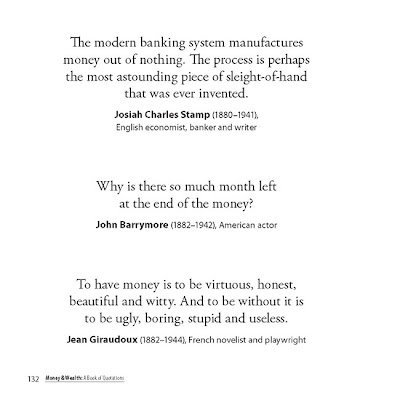
David Stockman certainly would approve of the first one.

Monday, April 01, 2013
Some Ads Age Better Than Others
Merrill Anderson produced this U.S. Trust ad in 1963. Illustrator John Northcross certainly flattered the investment thinkers. Today, alas, it looks like a meeting of the White Men In Suits Investment Club.
And not without reason. In 1963 even some of the trust company's female customers believed investing was, by its very nature, a man's world.

Happily, 1963 also featured transcontinental jets and an all-mighty dollar. Americans could live lavishly as they drummed up business around the world. These Irving Trust ads still please the eye.


And not without reason. In 1963 even some of the trust company's female customers believed investing was, by its very nature, a man's world.

Happily, 1963 also featured transcontinental jets and an all-mighty dollar. Americans could live lavishly as they drummed up business around the world. These Irving Trust ads still please the eye.


Wednesday, March 27, 2013
Brooke Astor's Son Loses His Appeal
We are not convinced that as an aged felon Marshall should be categorically immune from incarceration.
***The lack of a criminal history is an ordinary circumstance that does not vitiate a prison term for obtaining millions of dollars through financial abuse of an elderly victim.
So ends (barring further legal maneuvers) a saga of elder abuse first noted on this blog almost seven years ago. Anthony Marshall, elderly son of Brooke Astor, faces three years in prison, The NY Post reports.– Justice Darcel Clark, New York State Appellate Court
Tuesday, March 26, 2013
“Take My Inheritance, Please!”
Today's NY Times offers a special Your Money section, a co-production with APMs "Marketplace Money." The theme: people get emotional about money. True, though not exactly breaking news.
Among Young Inheritors, an Urge to Redistribute, indicates new money isn't always welcome. One heir chose to share his $900,000 inheritance with his extended family. Others gave inheritances to worthy causes, apparently without personal cost. One gets the impression there was "plenty more where that came from."
Among Young Inheritors, an Urge to Redistribute, indicates new money isn't always welcome. One heir chose to share his $900,000 inheritance with his extended family. Others gave inheritances to worthy causes, apparently without personal cost. One gets the impression there was "plenty more where that came from."
One also suspects some heirs lack computational skills. A million dollars or so will not support "a life of leisure and luxury" for long.
Growing Up With a Trust features Stuart Lucas. Back in 2006 this blog plugged his book.
Monday, March 25, 2013
Do Estate Taxes Face Extinction?
Despite concern over wealth inequality, estate taxation may be on the way out. See Is the Estate Tax Doomed?
For much of history, it was easier for a government to record the value of an estate than to track income on an annual basis. The lesson is clear: estate taxation first arose because it was easy, not because of concerns about inequality.The Times op-ed drew plenty of comments. This one comes from Alice Clark in Winnetka:
The inheritance tax predates capitalism. The Romans used it. Some of my ancestors were serfs, tied to the land in Lower Saxony. At the death of the male head of household, the nobleman who owned my ancestors received one half of all of their property. I'm sure that they hid what they could, but it's hard to hide cows.
“Profitable Sunrise” – Ponzi Globalized
Like to make 2 percent or more a day –yes, a day – on your money? Welcome to Profitable Sunrise, a pyramided Ponzi scheme.
Ostensibly based in Manchester, England, Profitable Sunrise may originate in Eastern Europe. Somewhere I read that certain Internet operations were traced to Virginia.
And where do clueless investors or daring "in-and-outers" wire their money? According to this post, to Baltikums Bank in Nicosia, Cyprus!
It is a small world, after all.
(It's also a world in which everything you read on the Web isn't necessarily so. Baltikums Bank's Cyprus branch appears to be in Limassoi, not Nicosia.)
Ostensibly based in Manchester, England, Profitable Sunrise may originate in Eastern Europe. Somewhere I read that certain Internet operations were traced to Virginia.
And where do clueless investors or daring "in-and-outers" wire their money? According to this post, to Baltikums Bank in Nicosia, Cyprus!
It is a small world, after all.
 |
| Ledra Street, Nicosia, Cyprus Photo via Wikimedia Commons |
(It's also a world in which everything you read on the Web isn't necessarily so. Baltikums Bank's Cyprus branch appears to be in Limassoi, not Nicosia.)
Saturday, March 23, 2013
The Jimmy Fallon tax credit
TaxProf Blog has the reports.
I think that such narrowly drawn tax provisions are very bad policy, and wonder how they can withstand constitutional scrutiny. But they do, because as it turns out, no one has standing to object to them.
I think that such narrowly drawn tax provisions are very bad policy, and wonder how they can withstand constitutional scrutiny. But they do, because as it turns out, no one has standing to object to them.
Monday, March 18, 2013
The Richest Woman In the World
 |
| Pilbara, Western Australia Photo via Wikimedia Commons |
Finnegan spins a fascinating tale. It includes knock-down, drag-out fights over Gina's father's estate and a family trust.
Thursday, March 14, 2013
Clothes No Longer Make the Man

Because a guy wearing an old sweater and stained khakis wouldn't have looked rich.
Half a century later, rich men display a variety of looks: bespoke suit, black tee shirt, jeans and boots, hoodie . . . . Mark Shaw, the Chase photographer, would have a tough time depicting a generic "rich man."

Before that best-seller, Dr. Stanley wrote "Marketing to the Affluent." A generation later, aspiring brokers and investment advisers still might find it worth reading.
Postscript: Strictly speaking, Mark Twain pointed out, clothes do make the man: "Naked people have little or no influence on society."
Monday, March 11, 2013
Do Investment Managers Need Consultants?
"There are all these piranhas circling, " says The Oracle of Tampa.
Sunday, March 10, 2013
Former Hedge Fund Manager Arrested
 … in the Uffizi Gallery in Florence.
"Florian Homm, a flamboyant former hedge fund manager who spent the last five years in hiding, was arrested in Italy," the NY Times reports. He faces extradition to the United States on securities fraud charges,
Subscribe to:
Posts (Atom)

 Posts
Posts


