Monday, March 28, 2016

At Schwab, Art and Investing Don't Mix

As you read here, artist-investor Sarah Meyohas came up with the idea of trading the stocks of small, thinly-held companies and charting the resulting fluctuations in share price as paintings. She set up a TD Ameritrade account for the project but used her Schwab account for her first painting, Paradise INC. 


Schwab, Felix Salmon reports, was not amused. It has cancelled the artist's account.

Sunday, March 20, 2016

Seinfeld's VWs as Tangible Investments

A good number of classy collectible cars sold for less than their estimates at Gooding's Amelia Island auction. The softening in the market for tangible investments such as art apparently extends to Ferraris as well.

Nevertheless, humble VWs from Jerry Seinfeld's collection did surprisingly well.

For instance, this 1964 Camper (I love it!) sold for $99,000, at the high end of its estimate.


Seinfeld's 1960 Beetle, owned for 30 years by a school teacher and driven for less than 16,000 miles. did even better. Expected to sell for $50,000 or so, it fetched $121,000.


Volkswagens may look out of place among Duesenbergs and Aston Martins, but as this 1966 VW ad says . . .

Friday, March 18, 2016

Should $78 Trillion in IOUs Spook Global Investors?

Is your obedient blogger wrong to find this really scary?
Twenty countries of the Organization for Economic Cooperation and Development have promised their retirees a total $78 trillion, much of it unfunded....
That is close to twice the $44 trillion total national debt of those 20 countries, and the pension obligations are “not on government balance sheets...."

Friday, March 11, 2016

Even if Active Investing Doesn't Pay, We Need It

Fewer than one of five actively managed equity mutual funds did better than comparable index funds over the past ten years. Although results over shorter periods weren't quite so bad. the majority of actively managed funds underperformed. As a result, Jason Swieg reports in the WSJ, some fund managers have thrown in the towel. They're buying a few ETFs rather than assembling portfolios of stocks.

Meanwhile, investors continue flocking to index funds.  Yet as a Cullen Roche column points out, all investors cannot do nothing but index. Active investors and active investment managers are needed to keep the market honest. See also Is Passive Investment Actively Hurting the Economy in The New Yorker. (Are index funds really responsible for the higher fees charged by large banks?)

Inexpensive online investment services based on index funds seem destined to become the basic investment platform for millennials. Even so, as their wealth grows they might enjoy setting up a side account of shares in selected companies, They'll gain the sense of being actual stockholders. And despite returns likely to be sub par, they'll be performing a public service – doing their part to keep stock prices in line with business realities.

If Congress Won't Tax Carried Interest as Income…

. . . maybe New York and neighboring states should pick up the "lost" revenue. By collecting the equivalent of what hedgies save by having the carried-interest portion of their compensation taxed as capital gain, New York State figures it might collect $3.7 billion a year. For New York's ploy to work, neighboring states would have to follow suit. It's suggested that The Merrill Anderson' Company's home state, Connecticut, could collect a half billion or so annually. See New York Challenges a Tax Privilege of the Rich.

Thursday, February 18, 2016

Should Perfect Son Inherit More Than Troublesome Daughter?


From Annie's Mailbox: A couple have two grown children – a perfect son and a troubled daughter who has received significantly more financial aid. Their old wills leave the son 60 percent of their estate and put 40 percent in trust for the daughter.

Their problem, if you can call it that: The couple's net worth has grown to around $12 million.  Penalizing the daughter for the funds expended on her behalf now feels mingy. Should they change their wills?

Yes, Annie's Mailbox advises. Leave the son and daughter equal inheritances.

That's usually good advice. Parents who follow it may earn the gratitude of the beneficiary who would have received more as well as the one who would have received less. Being the favored child can have its downside in later life.

Related post: Why Some Wills Don't Treat Children Equally.

Asset Allocation Takes a One-Two Punch

When professional stock-picking lost credibility, wealth managers turned to asset allocation – the process of dividing client assets between equities and fixed income in proportions appropriate to age and circumstances. (Getting older? Lighten up on stocks.) Target-date funds give investors glide-path investment programs that jettison stocks as they age.

Could it all be a waste of time and money?

David A. Levine, a former chief economist at Sanford C. Bernstein & Company, believes asset allocation is wrong-headed.  In a pair of New York Times columns he delivers the old one two.

ONE
Target-date funds are misguided. Investors should not move out of equities so drastically as they retire. They shouldn't move out at all. Even in retirement, their investment horizons are like the ever-receding horizon confronting a mariner at sea. If you are 99 and investing what soon may be your family's inheritance, you still should be thinking long term.

TWO
The ideal asset allocation for the long-term investor is 100 percent equities. "Both the historical record and logic argue very strongly for stocks over bonds. Yes, stocks are more volatile, but if you recognize that the “investment horizon” is always long and always receding into the future, your best bet is to put virtually all of your liquid assets into the stock market."

Levine makes a point courageous investors might ponder, This doesn't mean advisers should worry about asset allocation going out of style. Marketing of the concept has been so successful that many investors believe asset allocation is designed to increase returns rather than reduce volatility.

Friday, February 12, 2016

The Thoroughly Modern 'Sixties

Technical progress has slowed, some claim. Life around 1910, when many homes still lacked electricity, was primitive compared to the 1960's. Five decades later, we have computers and smartphones, but really, are we living much better than they did in the 'Sixties?

You couldn't Skype in 1966. But as the Bell System boasted, you could talk with most anyone, anywhere, who had a telephone.


Winter recreation? In 1966 the new adult toy of choice was the snowmobile, featured in this Chase Manhattan ad.


All in all, life in 1966 was pretty good, if you didn't mind hippies or second-hand cigarette smoke.

Wednesday, February 10, 2016

Art – the “Investment Asset” That's Easy to Fake

Can you tell a painting by Rothko, worth many millions, from a fake, one of the forged works sold by Kneoedler Gallery?


The second painting is the forgery, and it was good enough to fool the chairman of Sotheby's. Domenico De Sole and his wife paid over $8 million for the fraudulent asset in 2004. They just settled their suit against Knoedler's.

Wednesday, February 03, 2016

David Bowie's Will: Father Played Fair

As we noted the other day, one third of parents leave their children unequal inheritances. Previous generations were much more likely to treat their children equally.

So you might say David Bowie executed an old-school will. He left equal shares of his estate, estimated at $100 million or so,  to his son from his first marriage and his teenage daughter. (Her inheritance will be held in trust.)

Bowie also upheld old-school values by leaving seven-figure bequests to his personal assistant and his daughter's nanny.

Tuesday, January 26, 2016

Why Some Wills Don't Treat Children Equally

In 2010, according to this research, one third of parents with wills were planning to divide their estates unequally among their children. Fifteen years earlier, only 16 percent of parents were planning unequal distributions.

Why the trend to inequality? Mainly, the growing complexity of families as the result of widowhood or divorce. Stepchildren may get less than natural children. Children seldom seen after a divorce may receive less than children from a second marriage.

Stepchildren are wise not to expect to inherit much from a new step-parent. Their odds improve after ten years, and improve further if they produce babies for their parent and step-parent to fancy.
(A broker once told me that elderly English family members like to "baby fancy." Nice term.)


Friday, January 22, 2016

The Art (Literally!) of Investing

Sarah Meyohas, “Liberty Bancorp Inc. on January 14, 2016."
Sarah Meyohas studied finance at Wharton and fine art at Yale. The New York Times reviews her exhibit in which she combines her two interests. Daily Ms. Meyohas sits at a desk and invests, moving in and out of a thinly traded stock. Then she sketches the stock's price changes on canvas.

Before you laugh, consider that her painted charts sell for $10,000 each. 

Tuesday, January 19, 2016

Is $5 Million the New Million?

In 2015, for the first time, more than one million U.S. households had a net worth of more than $5 million. 

report from Phoenix Marketing International also estimates that the number of HNW households, those with at least $1 million in investable assets, has reached a new high of more than six million. 

Wednesday, January 13, 2016

Powerball Madness

The NYTimes weighs in here on the vital question of whether one should take the lump sum or the annuity if one wins the $1.5 billion PowerBall jackpot on Wednesday. Demonstrating the Times' usual blind faith in government fulfilling the promises it makes, the author advocates for taking the annuity.  Admittedly, if you take the lump sum you get an immediate $1 billion haircut, counting the income taxes, and that is hard to make up.  That's painful.

But the author naively ignores the effect of estate taxes.  Unless the winner is in his 20s, there is a very good chance of dying before the annuity is fully paid off.   The remaining payments may be discounted to present value, but that figure is then taxed and the tax must be paid within nine months.

Think of it this way.   Assume that the winner takes his first $50 million annuity payment and is hit by drunk driver and dies in 2106.  The taxable value of the remaining payments will be roughly $900 million, so a federal estate tax of $360 million will be immediately payable.  Where will that money come from?  Let's say the feds agree to take the $50 million annual payments until the estate tax obligation is paid off.  That delay will trigger penalties and interest, which will also have to come out of the annuity payments.

Will the heirs ever receive a dime?  Or does the federal estate tax effectively turn the prize from a term certain annuity to one that disappears at the death of the winner?

A surprising number of commenters to the Times article were aware of this issue, which the author was not. By "surprising number" I mean "any."

Sunday, January 10, 2016

UK's Oldest Bank Recalls a Refugee Crisis

Sir Richard Hoare (1648-1719)
the bank's founder
Does Hoare's Bank, where Samuel Pepys kept his money, attract wealth management business because it's old and boring, or because it now offers a mobile banking app?

In any case old can be interesting. Hoare's history yields fascinating stories. Example: When Russia invaded the Northern Caucusus, it created a 19th-century parallel to the Syrian refugee crisis.
 [B]y 1859 huge numbers of Circassians were setting out across the Black Sea for Constantinople. So many, in fact, that it proved impossible to secure sufficient transport. As a result, reported The Levant Herald: vessels are crammed to suffocation with the exiles, who endure on the voyage to the Bosphorus all the horrors of another “middle passage”. During the past stormy season in the Black Sea above a dozen wrecks of these emigrant vessels occurred, hurrying many hundreds of these miserable creatures to death.i By January 1860 up to 20,000 people had made the perilous crossing. But while willing to receive them, the Turkish authorities were unable to cope with such a sudden influx of cold, hungry, exhausted and penniless refugees. Packed into insanitary encampments on the outskirts of Constantinople, it was not long before many began succumbing to disease. 

Thursday, January 07, 2016

The More Things Change . . .

. . . the more they stay the same. Two ads from fifty years ago prove the point.

Manny Hanny urged men of wealth to consider not only their net worth but their legacy. "What will happen to your accumulated property when it becomes the inherited property of your family?"


 With the revelation of VW's "clean diesel" finagling, this headline couldn't be more timely

Tuesday, January 05, 2016

Another Tax Skirmish for Campbell's Soup Heirs

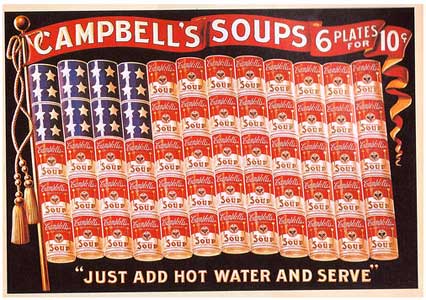
John T. Dorrance,  inventor of Campbell's condensed soup, died in 1930. As every student of estate planning learns, Dorrance had maintained a home in New Jersey and another in a classier Pennsylvania neighborhood. At his death, both New Jersey and Pennsylvania claimed him as a resident and levied tax. The U.S. Supreme Court declined to intervene.

Vintage Campbell's Soup ad
In 1995 a grandson, John "Ippy" Dorrance, made news by renouncing his citizenship for tax reasons and moving to Ireland before selling a large chunk of Campbell's stock.

Another grandson sought to  tame the estate-tax dragon with life insurance. In 1966 Bennett and Jacquelyn Dorrance bought policies from five companies with a face value of almost $88 million.

At that time the insurance companies were "mutuals." Policyholders had membership rights. When the insurers became stock companies, the Dorrances and other policyholders received shares.

When the Dorrances later sold their shares, how should they have calculated their capital gain? Were the entire sales proceeds  capital gain?  Or did they have a "cost basis," even though they had merely paid premiums, not purchased stock?

Reversing a District Court decision, the Ninth Circuit U.S. Court of Appeals says the Dorrances' cost basis is zero.

Video clip of Appeals Court panel here.

Wednesday, December 30, 2015

Wealthiest 400 Pay More Tax

Jim Gust wanted tax data more current than 2012. It's here, and it shows that the top 400 taxpayers took a heavy hit.

Bashing Billionaires, Front-Paging Affluenza

The MSM, or at least the NY Tines, has decided: Great wealth is uncool. 

For the Wealthiest, a Private Tax System That Saves Them Billions, the article Jim Gust spotted online, was the front-page lead in today's print edition. Below the fold, surely not by coincidence (and not the sort of tabloid fodder the Times generally front-pages) was the capture of Ethan Couch, ‘Affluenza’ Teenager.
His case made national headlines twice: The first time was when a psychologist testified for the defense that Mr. Couch had “affluenza” and was too influenced by privilege and his parents’ permissiveness to know right from wrong.
The second was when a judge appeared to accept the argument, handing down a sentence of 10 years' probation, not prison.
We'll be watching a number of trends in the new year: The demand for lower investment costs. The rise of socially responsible investing.  The craze for unicorns, Warhols and other alternative assets. Could the growing distaste for people making $10 million, $100 million or more prove to be a bigger wealth-management story in 2016?

Tuesday, December 29, 2015

NYTimes takes aim at family offices

In an article filled with more heat than light, the NYTimes complains that the rich are not paying enough in taxes.  It's a familiar story for them, of course.  The chief villains include family offices, the carried interest rule, charitable trusts and efforts to reduce or eliminate death taxes.  It's a Bernie Sanders road map for tax policy.

The biggest tax favor of them all for the wealthy goes unmentioned—complete tax freedom for muni bond interest.  Neither is there a mention of the enormous drain on the Treasury caused by the freedom from taxes for multi-billion dollar endowment funds.

But the complaint isn't really about the loss of tax revenue, it's about the absence of progressivity in the tax burden.  The article never mentions that the top 1% already pay more in total income taxes than the bottom 90%—that seems pretty progressive to me. No, the problem is that as a share of total income the rich are paying less than 20% of their total income in taxes, and that's just no fair, that's not enough tax pain.

To achieve this, they must spend millions on sophisticated tax advice, but it's obviously well worth it.

One phrase jumped out at me in the article.  The data from the IRS is for 2012, "the latest year for which data is available."  Really, the IRS hasn't started tabulating 2013, let alone 2014? Maybe if they spent less time on influencing the political process and targeting conservatives they'd have enough time to do their real jobs?


Monday, December 21, 2015

Two Tax Breaks for the Well-Heeled

On the morning of Friday, December 18, the President signed the major tax and spending bill passed by a remarkably compliant Congress. (The legislation, the NY Times explained, "showed just how easily a fractious legislature can seem functional again when there is agreement to spend more money....")

Not until 5:21 P.M. did the email from my Alma Mater arrive.
Make a Tax-Free Gift from your IRA: 
Congress passed legislation that would extend the Charitable IRA Rollover incentive for gifts completed in 2015 and future years…. The law allows individuals age 70 1/2 and older to make qualified charitable distributions of up to $100,000 each year from their traditional or Roth IRAs directly to charities…. While you cannot claim a charitable deduction for an Charitable IRA Rollover, this distribution from your IRA counts towards your minimum required distribution and will not be treated as taxable income.
What took them so long?

The renewed exemption for charitable transfers from IRAs is "permanent." That's tax speak for "at least the next few years."

Another tax break, another show

Also of interest to high-net-worthers, kinder tax treatment for investments in Broadway shows. For instance, show-biz investors no longer will be taxed on “phantom profits,” money returned to investors that is less than the amount they had initially invested.

Everybody knows that investing in Broadway shows is a loser's game. But then, who knew Hamilton would be a smash hit?

Friday, December 18, 2015

Do Democrats in the White House Mean Higher Stock Returns?

Over the last 50 years, according to a Democrat promo making the Internet rounds, stocks averaged an 11% annualized return when a Democrat occupied the White House. And when a Republican sat in the Oval Office? Less than 3%.

Democrat Commanders in Chief do go hand in hand with better stock returns. Here we linked to a 2008 NY Times comparison going back to 1929.  The performance gap is pronounced. Even so, "hand in hand" isn't necessarily the same as cause and effect.

Because the Republicans retain a reputation as the party of fat-cat billionaires, the gap in stock market returns is counter-intuitive. Which may explain why some investors don't believe it.

Current example, this Well Fargo survey of investors: Only 15% believed a Democrat in the White House would be better for the stock market. Twice as many thought they would profit more from a Republican.

Friday, December 11, 2015

Did a JPMorgan Broker Turn Fiduciary?

After losing his job, a JPMorgan broker turned whistle-blower, saying Morgan had pressured him to put clients into the bank's funds when better choices were available. The New York Times has jumped on his story, here and in a James B. Stewart column.

After JPMorgan fired the broker, client complaints concerning his behavior showed up. The complaints were not written by disgruntled clients. That's the sort of fun fact that draws media attention.

Thursday, December 03, 2015

They Retired at 40. But Not Really.

Retire at 40? Some Do, With a Small Fortune. That's the provocative headline on a 1996 WSJ article I came across while cleaning out old files.

Examples mentioned in the article included Eugene Bernosky, who sold the company he co-founded and planned to take it easy and do a little consulting, and a married couple, Lee Leslie and Terri Evans, who quit nine-to-nine work after five years of running a small ad agency.

How have they fared after almost two decades? Googling suggests that modern retirement looks a lot like work.

Bernosky has done a bit of investment banking and helped launch various ventures. Recent project: Zaavy, a company that produces custom jerseys and related items for cycling teams.

Leslie and Evans, according to Linkedin, are still open to marketing/advertising assignments, but perhaps not nine to nine.
Most boomers didn't get to retire at 40. But these days they're quitting the rat race in great numbers, and many of them think 60 is the new 40. Wealth managers should not expect them to act like traditional retirees.

Rather than "retire," affluent boomers want to declare financial independence, free at last to work or play at whatever turns them on. 

Friday, November 20, 2015

Nest Eggs of Autumn, 1965

In the 1950's Chase Manhattan's nest-eggers sailed and skied and hunted. By 1965, as the iconic ad campaign was winding down, guns and yachts gave way to agriculture and animal husbandry.


Monday, November 16, 2015

Lies, Damn Lies and Politicians' Tax Talk

Why do political candidates assume voters are dumber than dirt when it comes to taxes?

Some conservatives promise tax cuts that pay for themselves. Prairie Home Companion saluted them with a little song, sung to the tune of "When You Wish Upon A Star."

Others want to ditch the IRS or reduce the Internal Revenue Code to three pages, never explaining how they'll run the country without tax revenue.

Moderates promise lower tax rates without mentioning their plans to expand the tax base by removing deductions and credits. Their "lower rates" often lead to higher tax payments.

Liberals promise to raise tax rates, but only on the really rich. Can you remember any initiative to "tax the rich" that didn't end up taxing the not so rich as well?

It's enough to make you want to vote for "none of the above."

Wednesday, November 11, 2015

Did Richard Mellon Scaife Waste the Family Fortune?

Should the trustees have allowed Richard Scaife, a Mellon heir, to drain hundreds of millions of Mellon money from a family trust, a fund that otherwise would have enriched his children following his death? His children don't think so. See When Half a Million a Month Isn't Enough.

Court documents included in this Pittsburgh Post-Gazette article show a PNC Bank attorney wrestling with the question of how to rationalize discretionary distributions when a trust beneficiary doesn't seem to need the money. Scaife didn't need to live better; he used the millions to practice philanthropy, fund conservative causes and keep his newspaper afloat.

Readers unfamiliar with the Scaife backstory can read it here, in The Washington Post's extensive 1999 profile.

Wednesday, November 04, 2015

Who Knows What Unicorns Are Worth?

Andrew Ross Sorkin was right about the difficulty of pinning market values on the tech startups known as unicorns. "Millions of Americans own a piece of the hottest private technology companies through their mutual funds," writes Kristen Grind in the WSJ. "But no one knows what those investments are actually worth."

For example, last June 30 various mutual fund managers valued unicorn superstar Uber at prices ranging from over $40 a share to less than $34. As of the same date, a T. Rowe Price fund manager guessed the software startup Cloudera was worth almost twice the price estimated by another fund manager.
 As money that once might have parked in CDs and money market funds continues the desperate search for real returns elsewhere, uncertainty and market turbulence increase. Unicorns are one more reason for investors to seek professional, unbiased assistance.

Wednesday, October 28, 2015

Should the Fed Declare the Party Over?

Is the U.S. economy healthy enough for the Fed to raise short-term interest rates from practically nothing to nearly nothing? The pundits' answers are"Yes," "No," "Maybe," depending on the day of the week.

We raise the question mainly as an excuse to introduce you to the artistic creation above. The art mania isn't limited to works on canvas. Installations such as this are much admired, though difficult to store in a free port, much less hang on the wall.

Created by two Italian artists, Sara Goldschmied and Eleonora Chiari, their post-party scene refers to the corrupt high life of Italy in the 1980s. The artwork made news because a museum cleaning crew swept it up and threw it away.

The work's creators were not amused: "It cannot be possible for an installation to end up in the rubbish bin.”

Tuesday, October 27, 2015

A Canvas Craze?

Delaware Freeport
Art collectors are being replaced by investors. Where collectors might safeguard  prize works by placing them on long-term loan at a museum, tax-averse art investors hide away their masterpieces in free port warehouses. In Switzerland, perhaps. Or right here in the States, in Newark, Delaware.

Wonder what financial historians a century from now will say about our art craze. Will they be able to figure out why investors paid tens of millions of dollars, even hundreds of millions, for products that consisted of no more than a few hundred dollars worth of wood, canvas and pigment?


Maybe they'll call it just another Tulip Mania.


Sunday, October 25, 2015

Brits Can't Necessarily Disinherit Their Kids

The European notion of forced heirship seems to have seeped across the English Channel. Could it eventually spread to this side of the pond?

The Guardian describes a case where an estranged daughter eventually won a share of her mother's estate, aided by a 1975 Inheritance Act designed to protect adult children.

Estranged offspring hate being cut out of their parents' wills, as the Daily Mail illustrates here.

Will disputes continue to increase in the UK. Here, too? 

Wednesday, October 21, 2015

How to Avoid Probate: Leave Connecticut!

Fifty years ago Norman Dacey, a Connecticut financial planner, shook the estate planning world by publishing How to Avoid Probate. Living trusts became the will substitute of choice.

Now the State of Connecticut has struck back, substituting painfully high probate fees for state funding of its probate courts. The "fees," amounting to an estate tax in drag, are levied on the gross taxable estate, not the probate estate.

If the northeast portion of I-95 seems even more crowded than usual, it's probably Connecticut's hedge fund elite, departing for friendlier tax climes.

Tuesday, October 13, 2015

Phishing for Phools

Walked into Barnes and Noble and bought a book. Can't get more retro than that.

The volume is Phishing for Phools, authored by two Nobel-Prize-winning economists, George A. Akerlof and Robert J. Shiller. They want us to take behavioral economics more seriously, though their slim volume is intended to entertain as well as inform.

Because people are easily bemused, confused and enticed, the authors believe, free markets need more rules and regulations to function fairly. They're surely right about the human propensity for irrational economic behavior. Whether manipulation and deception is involved is another question. Playing the slots, the authors' first example of irrationality, comes easily to many people. So does the latest gambling craze, fantasy football.

Phishing for Phools is a sign of the times. (I suspect Senator Elizabeth Warren just found the answer to, "What shall I give everybody for Christmas?") For a preview, see Shiller's op-ed in the NY Times. Harvard's Cass Sunstein offers an extensive review here.