How do you hold on to will appointments when your institution has been acquired by Engulf & Devour Bank and Trust? If you are now working for E&D, today's Wall Street Journal item [emphasis added] reminds you to wrestle with that question:
It's probably time to revise your will. In January, the federal estate-tax exemption jumps to $2 million per person, from $1.5 million this year. What's more, some states have different estate-tax exemptions. But many wills don't take into account possible changes in federal and state estate-tax rules.
Check with a lawyer to make sure the language in your estate plan still applies with new exemptions. If some plans aren't adjusted, you could, say, inadvertently leave little to your spouse or face an unexpected state tax hit.
Many people's wills also don't reflect their current inheritance wishes because of a major life change. And if a bank or trust company is the executor of your estate, you might have a new executor due to consolidation in the banking industry. Make sure you trust that executor's judgment.
The good news? If you're with a local institution, you have some will-appointment harvesting to do.
Tuesday, November 29, 2005


Paint the bullseye on the hedge funds
Hard on the heels of this New York Times article suggesting that pension funds have been investing heavily in hedge funds comes this new report from Investment News—Hedge fund boom worrying regulators (registration required). The net worth limitation, intended to narrow access to hedge funds to sophisticated investors, was set in 1982 at $1 million and has never been amended.
The net worth and income requirements may both be modified if the trend toward bring hedge funds to a wider audience continues, according to regulators. However, such restrictions likely won't apply to pension funds, whose managers presumably have all the necessary financial sophistication to choose investments wisely. Still, given the temptation for underfunded plans to load up on hedge funds in an attempt to reach solvency, coupled with demonstrated industry volatility (and scandal), one has to wonder about the exposure of the PBGC.
Are the wealthy asking their trust officers about hedge funds?
Monday, November 21, 2005
We're all shareholders now
Stock ownership continues to boom in America, according to Half of American Households Own Equities, November 2005, a report from the Investment Company Institute. Some 56.9% of households now own equities, up from 15.9% in 1983 and 40.0% as recently as 1995.
The count includes participants in 401(k) plans, which certainly have been an engine of equity ownership, but according to the report three quarters of those who own shares through an employer's plan own stock outside the plan as well.
The count includes participants in 401(k) plans, which certainly have been an engine of equity ownership, but according to the report three quarters of those who own shares through an employer's plan own stock outside the plan as well.
Thursday, November 17, 2005
Boomers: wealth-management prospects or just "skiers'" kids?
Yeah, Boomers are going to inherit all those trillions. Then again, maybe those trillions are sliding down a slippery slope.
Harken to Tina Brown in her Washington Post column today:
Harken to Tina Brown in her Washington Post column today:
There's a new catchphrase in London: Are you a skier? And it has nothing to do with winter sports. It's a quasi-acronym for Are You Spending the Kids' Inheritance?
Wednesday, November 16, 2005
Is estate planning going to be a hard sell?
How do you sell the idea of estate planning to HNW prospects who never intend to grow old? According to this Newsweek article on Boomers, you better start looking for the answer:
To say boomers expect to stay young isn't just a figure of speech, it is a statistically verifiable fact. "Baby boomers literally think they're going to die before they get old," says J. Walker Smith, president of Yankelovich Partners, the polling company, which found in one study that boomers defined "old age" as starting three years after the average American was dead.
Monday, November 14, 2005
Are you asking the right question?
A final bit of advice from Peter Drucker, the business management guru who died Friday at the age of 95:
"True marketing starts out . . . with the customer, his demographics, his realities, his needs, his values. It does not ask, What do we want to sell? It asks, What does the customer want to buy?"
"True marketing starts out . . . with the customer, his demographics, his realities, his needs, his values. It does not ask, What do we want to sell? It asks, What does the customer want to buy?"
Friday, November 11, 2005
Private banking: where the profits are
Forbes magazine sees tough times ahead for banks:
Last year Capco, a consulting firm headquartered in Belgium, produced a startling report entitled "The Emerging Crisis in U.S. Banking Profitability," which convincingly argued that the mainstream commercial and individual banking business was about to enter a prolonged dry spell of price competition and compressed profit margins. The report, though, missed one bright spot: banking services for prosperous customers.For more on the bright spot, see Daddy Warbucks banking.
Wednesday, November 09, 2005
Active investment management still reigns supreme
Modern portfolio theory says you can't pick some stocks that will do better than other stocks because the market is too efficient—a "random walk."
Bruce Greenwald, the Robert Heilbrunn professor of finance and asset management at Columbia, teaches the Value Investing course once taught by the venerated Benjamin Graham himself. And Joseph Nocera, in a recent New York Times column ($$$), tells us what Bruce Greenwald says:
"Efficient market theory is basically dead."
Nocera explains the belief that investment portfolios can be intelligently designed:
But while the mind says "index," the heart says, "Indexing is less exciting than watching grass grow." Seeking above-market returns is fun, a mild form of gambling if you will. And what's wrong with a little recreational gambling?
Most investors figure the gambles are worth the (hopefully!) modest cost. Supreme Court nominee Samuel Alito, for instance. In Slate, Henry Blodget (remember him?) analyzes Alito's reported investments and finds them generally praiseworthy. But Henry notes that Alito's Vanguard funds are not limited to index funds. They include actively managed equity portfolios, such as Wellington Management and Windsor II.
Even potential Supreme Court justices like to have a little fun!
Bruce Greenwald, the Robert Heilbrunn professor of finance and asset management at Columbia, teaches the Value Investing course once taught by the venerated Benjamin Graham himself. And Joseph Nocera, in a recent New York Times column ($$$), tells us what Bruce Greenwald says:
"Efficient market theory is basically dead."
Nocera explains the belief that investment portfolios can be intelligently designed:
Most business schools emphasize modern portfolio theory, which has as its central tenet that the market is so efficient it can't be beaten with any regularity. . . . As [Warren] Buffet put it to me recently, "You couldn't advance in a finance department in this country unless you taught that the world was flat."Teaching value investing is one thing. Picking stocks that consistently outperform the market is quite another. As noted in the post below, by most rational standards passive investing via index funds is the better bet.
Although Columbia has its share of portfolio theorists, the value investing program that Mr. Greenwald runs preaches something else: that the world is round. Or, more precisely, that the market can be beaten. Not easily, mind you, and not mindlessly. A "value" stock is, at bottom, a cheap stock. And a value investor is someone who has the facility to ferret out cheap stocks that don"t deserve to be cheap, the acumen to understand why certain such companies have what Mr. Buffett calls "a sustained competitive advantage: that will be borne out over time, the patience to wait for the market to come around to his view of things, and the discipline to stick to his value parameters through thick and thin.
But while the mind says "index," the heart says, "Indexing is less exciting than watching grass grow." Seeking above-market returns is fun, a mild form of gambling if you will. And what's wrong with a little recreational gambling?
Most investors figure the gambles are worth the (hopefully!) modest cost. Supreme Court nominee Samuel Alito, for instance. In Slate, Henry Blodget (remember him?) analyzes Alito's reported investments and finds them generally praiseworthy. But Henry notes that Alito's Vanguard funds are not limited to index funds. They include actively managed equity portfolios, such as Wellington Management and Windsor II.
Even potential Supreme Court justices like to have a little fun!
Sunday, November 06, 2005
Indexing: Investment management goes passive.
The case for passive investing is pretty persuasive, as Jonathon Clements points out in this Wall Street Journal column (subscribers only):
1. The emergence of fee-based financial advisers, who can recommend low-cost index funds without taking a personal financial hit.
2. The introduction of Exchange-Traded Funds. ETFs allow brokers to give clients the benefits of indexing while collecting the same commission they would get from a stock transaction.
Currently nearly 10% of all long-term mutual-fund assets are in index funds. See The Great Race, a free WSJ article. ETFs are fast proliferating and now account for almost a third of all passive-investment funds.
Nevertheless, Clements doesn't expect active investment management to go away anytime soon. I tend to agree. Any contrary opinions?
Before costs, investors collectively earn the market's performance. After costs, they must -- as a group -- lag behind. Logically, it can't be any other way.Although Vanguard introduced the first index fund in 1976, so-called passive investing has only gained significant momentum in recent years. Clements cites two reasons:
For instance, over the past 25 calendar years, U.S. stock funds have clocked an average 11.9% a year, according to an analysis of Lipper data by Vanguard Group, the Malvern, Pa., fund company. That is well behind the 13.5% annual gain for the Standard & Poor's 500-stock index, calculated by Chicago's Ibbotson Associates.
Damning statistics like this have been kicking around for years. By the 1960s, we had the computer power, market data and analytical tools needed to study investors' performance -- and the results weren't pretty. It became abundantly clear that even professional stock pickers weren't beating the market.
1. The emergence of fee-based financial advisers, who can recommend low-cost index funds without taking a personal financial hit.
2. The introduction of Exchange-Traded Funds. ETFs allow brokers to give clients the benefits of indexing while collecting the same commission they would get from a stock transaction.
Currently nearly 10% of all long-term mutual-fund assets are in index funds. See The Great Race, a free WSJ article. ETFs are fast proliferating and now account for almost a third of all passive-investment funds.
Nevertheless, Clements doesn't expect active investment management to go away anytime soon. I tend to agree. Any contrary opinions?
Friday, November 04, 2005
The Patient Gardener
I love it when someone else makes the case for Merrill Anderson's services. This time it a consultant writing in Financial Planning magazineThe Patient Gardener: Here's how drip marketing can help you cultivate your image with clients. (registration required). Sound advice here on list development and management.
The most important lesson: Sales requires many contacts. They don't all have to be high touch contacts, but there have to be many. Newsletters provide one very cost effective to achieve this.
The most important lesson: Sales requires many contacts. They don't all have to be high touch contacts, but there have to be many. Newsletters provide one very cost effective to achieve this.
Monday, October 31, 2005
Great commercials: Where there's a Beetle, there's an heir
Back in the golden days of advertising, Doyle Dane Bernbach did cool commercials for a poor-man's Porsche known as the Peoples Car, or, as Hitler liked to say, the Volkswagen. Stuart Elliott of The New York Times in his weekly webletter recalls a classic spot involving inheritance:
A Reader Writes:
I enjoyed your recent item about favorite commercials. One of my absolute favorite spots of all time is the commercial directed by Joe Sedelmaier for Volkswagen in which the guy leaves his entire estate of "one hundred billion dollars" to his nephew, Harold, who drives a Beetle. I still remember a great line from the spot: "To my business partner Jules, whose only motto was, 'Spend, spend, spend,' I leave nothing, nothing, nothing."
Stuart Elliott replies:
Thanks, dear reader, for the memory. The commercial, called "Funeral," is also one of my faves. It was created by Doyle Dane Bernbach in New York, now part of the DDB Worldwide unit of the Omnicom Group. Doyle Dane also created other classic VW ads like "1949 Auto Show," my all-time best, and "Think small."
The "Funeral" commercial, from 1969, is included on lists of best commercials compiled by Advertising Age and TV Guide, among others. The commercial shows a procession of Cadillac limousines and other big cars headed to a funeral as a man speaks in a voiceover narration. The genius touch was that it soon becomes apparent that he is dead and reading his will aloud.
"To my wife Rose who spent money like there was no tomorrow, I leave $100 and a calendar," the man intones. "To my sons Rodney and Victor, who spent every dime I ever gave them on fancy cars and fast women, I leave $50 in dimes."
Then, after the dig at Jules and "other friends and relatives who also never learned the value of a dollar'' - to whom he leaves a dollar - the man talks about Harold. Harold is shown wiping away a tear as he drives his VW Beetle at the end of the procession.
"Finally, to my nephew Harold," the man says, "who ofttimes said, 'A penny saved is a penny earned,' and who also ofttimes said, 'Gee, Uncle Max, it sure pays to own a Volkswagen,' I leave my entire fortune of one hundred billion dollars."
(The script for "Funeral" comes courtesy of the book "When Advertising Tried Harder" by Larry Dobrow (Friendly Press, 1984).
A Reader Writes:
I enjoyed your recent item about favorite commercials. One of my absolute favorite spots of all time is the commercial directed by Joe Sedelmaier for Volkswagen in which the guy leaves his entire estate of "one hundred billion dollars" to his nephew, Harold, who drives a Beetle. I still remember a great line from the spot: "To my business partner Jules, whose only motto was, 'Spend, spend, spend,' I leave nothing, nothing, nothing."
Stuart Elliott replies:
Thanks, dear reader, for the memory. The commercial, called "Funeral," is also one of my faves. It was created by Doyle Dane Bernbach in New York, now part of the DDB Worldwide unit of the Omnicom Group. Doyle Dane also created other classic VW ads like "1949 Auto Show," my all-time best, and "Think small."
The "Funeral" commercial, from 1969, is included on lists of best commercials compiled by Advertising Age and TV Guide, among others. The commercial shows a procession of Cadillac limousines and
 other big cars headed to a funeral as a man speaks in a voiceover narration. The genius touch was that it soon becomes apparent that he is dead and reading his will aloud.
"To my wife Rose who spent money like there was no tomorrow, I leave $100 and a calendar," the man intones. "To my sons Rodney and Victor, who spent every dime I ever gave them on fancy cars and fast women, I leave $50 in dimes."
Then, after the dig at Jules and "other friends and relatives who also never learned the value of a dollar'' - to whom he leaves a dollar - the man talks about Harold. Harold is shown wiping away a tear as he drives his VW Beetle at the end of the procession.
"Finally, to my nephew Harold," the man says, "who ofttimes said, 'A penny saved is a penny earned,' and who also ofttimes said, 'Gee, Uncle Max, it sure pays to own a Volkswagen,' I leave my entire fortune of one hundred billion dollars."
(The script for "Funeral" comes courtesy of the book "When Advertising Tried Harder" by Larry Dobrow (Friendly Press, 1984).
Friday, October 28, 2005
Hedge funds: Trick or Treat?
Hedge funds may be more witches' brew than magic potion, says Mike Palmer of The Trust Company of the South.
Curiously enough, hedge-fund frauds are virtually nonexistent in Europe. In this CNN-Money article, Amanda Cantrell explains why.
Curiously enough, hedge-fund frauds are virtually nonexistent in Europe. In this CNN-Money article, Amanda Cantrell explains why.
The $12,000 annual exclusion is on the way
It's not official yet, but Professor Gerry Beyer reports here that the annual exclusion is expected to rise to $12,000 next year. The last bump was in 2002, and with inflation relatively calm in recent years I'm surprised that we've accumulated the 10% needed for the boost already. But there you have it--it means your 2005 marketing materials will have to be discarded at year-end.
Thursday, October 27, 2005
One man's tax incentive is another man's loophole
In order to promote more charitable giving this year, the Katrina Emergency Tax Relief Act lifted the limit on the deduction for cash post-Katrina charitable gifts from the usual 50% to 100% of AGI. And the gifts don's have to be hurricane related. The thinking was, generous donors might have used up their deduction limit already with all of this year's natural disasters. This way, they can keep on giving to their usual charities as well.
Sound like a fair formula for getting the rich to part with their wealth for a good cause? Not to the New York Times— In Hurricane Tax Package, a Boon for Wealthy Donors. This "little-noted" provision is problematic because taxpayers are evidently more enthusiastic about it than expected. Congress thought the revenue loss would be $819 million, but already private estimators have projected a $1 billion to $3.5 billion "cost" to the U.S. Treasury.
To me, that's a sign of a successful tax initiative, but the Times is apparently more worried that some wealthy donors might reduce their tax bill to zero this year, as well as the revenue shortfall. Who favors dynamic revenue scoring now?
Wednesday, October 26, 2005
Wellington Mara left a Giant estate plan
Wellington Mara, the NY Giants owner who died yesterday, could remember the days when pads were paltry and helmets were leather. The Mara family has been an owner of the Giants for 80 years. Today's NY Times reports that Wellington did all he could to keep the Maras' 50% interest in the family:
John Mara says he and his 10 siblings all have ownership interests in the Giants. In addition to lifetime gifts, Wellington Mara is believed to have used the marital deduction, trusts, limited partnerships and life insurance in crafting his estate plan.
As recently as two years ago, John Mara [Wellington's son] said the family had taken the steps to structure the team's ownership so that federal estate taxes would not be so onerous that they would prompt the sale of the team. The goal was to avoid what happened in Miami, where estate taxes and feuding among the trustees of Joe Robbie's estate led to the sale of the Dolphins to H. Wayne Huizenga in 1994.
But in 1995, despite acknowledging that steps had been taken to ensure an orderly transfer of the team within the family, John Mara told The New York Times: "It will be hard to keep control and pay the taxes, that is true. The estate tax laws are so severe. I think we've done some careful planning, which we believe will allow us to carry on control of the organization. But it will be difficult to do."
John Mara says he and his 10 siblings all have ownership interests in the Giants. In addition to lifetime gifts, Wellington Mara is believed to have used the marital deduction, trusts, limited partnerships and life insurance in crafting his estate plan.
Thursday, October 20, 2005
Year-end tax planning for mutual fund distributions
The good news for mutual fund owners as a group this year is that distribution of capital gains are projected to reach $22 billion, up sharply from last year's $6 billion, according to Capital Gains Fuel Tax Code Debate. The bad news, of course, is that taxes will have to be paid on the gains, even if they are reinvested. A bill to change that tax treatment has faltered as attention has turned to hurricane relief and other unfinished tax business.
Saturday, October 15, 2005
Where's my trust fund check, Dude? I'm outtahere!
According to a Trusts and Estates study cited in this week's Barron's (subscribers only), nine out of ten heirs switch advisers soon after receiving their inheritances.
Are you wooing your young trust heirs as vigorously as you should be? Sounds like you have little to lose and lots to win.
According to Barron's, J.P. Morgan Private Bank does its wooing by inviting young heirs to gatherings in exotic locales, like St. Tropez.
Your marketing budget probably doesn't have room for that, but what about more modest gatherings, offering a combo of financial learning and socializing. A dinner cruise, maybe? A day on the ski slopes? You can think of something.
Top Wealth Managers in the U.S., 2005
Merrill Lynch, Citigroup, UBS, Wachovia and Charles Schwab lead this year's Barron's list (subscribers only) of the top 40 private Banks, just as they did last year. Several names in the top 20 moved up or down a notch. Suntrust hopped up three slots, from 21 to 17.
Newcomers to the top 40 included T. Rowe Price Private Asset Management and Boston Private Bank and Trust.
Newcomers to the top 40 included T. Rowe Price Private Asset Management and Boston Private Bank and Trust.
Friday, October 14, 2005
Here's $5 billion. Can you quintuple it?
That's what Jack Meyer did for Harvard over the last 15 years, generating the highest endowment returns of any university in the country. But it wasn't good enough for folks at Harvard, because they expect such returns without having to pay the managers market rates to get them. A successor was named today:
Harvard Names New Head of $25.9 Billion Endowment Fund - New York Times
The article is silent on the compensation plan for the new managers--not too surprising, as transparency is what did in the last regime. It should be noted that the payments to Meyer that outraged the alumni were entirely performance based, the result of beating well established benchmarks over a period of years. We'll all be watching to see how Harvard does in the future.
Hedge funds, red flags and colorblind investors

An October 7th panel discussion entitled, "Lessons From the Swamp -- What We Can Learn from the Bayou Debacle," attracted about 140 investors, regulators, academia and portfolio managers to the Yale School of Management last week. “There were ‘screaming red flags‘ that with proper due diligence investors could have picked up on,” said one panelist.
And it's likely investors will be fooled again, said Stuart Robinson, an FBI agent who supervises the white-collar investigative squad in Fairfield County.In fact, "the next Bayou" seemed to have emerged already. A few days earlier, Lehman Brothers charged a West Coast hedge-fund firm, Wood River Capital Management, with fraud. The SEC followed with charges that two of Wood River's funds had invested nearly two-thirds of their assets in one stock while promising clients diversified investments.
"I'd like to propose to you that it is overwhelmingly likely that there are other Bayou's out there," he said. "Just because Bayou got caught, nothing has truly changed. It's an industry geared to very smart people that get in over their heads so they commit criminal acts. These are folks . . . who are geared toward reporting perfection in their professional lives."
For some managers who aren't realizing the results they want, "lying is the only way to earn a living the way they are accustomed to," Robinson said.
The stock, a tiny wireless venture called Endwave, repaid Wood River's faith by losing most of its value.

Yesterday's Wall Street Journal (subscribers only) commented:
As investors and securities firms assess possible losses related to the ailing hedge fund Wood River Partners LP, questions are growing about how sophisticated market participants overlooked a series of red flags surrounding the firm.Investors, institutions and wealthy individuals, have been pouring money into hedge funds at a prodigous rate. Question is, how many wealth managers can match Yale's David Swensen in his ability to pick top-performing funds and avoid the disasters?
And even if you have a "second Swensen" on your team, hedge funds can be a dicey game for your clients. See The Guardian's cheery news item: World's hedge funds face crisis as Refco suspends trading.
Planners: Business booming; mutual funds losing luster
That's the conclusion drawn here from a recent survey of financial planners around the country. What's the key?
A number of advisers echoed the sentiments of Frank Geremia, president of Geremia Financial Services LLC, an Edison, N.J., firm with $50 million under management. "The farther away we get from 9/11, the more people are getting into the markets," he said. "They're more active and less passive."Mutual funds are evidently being displaced by Exchange Traded Funds, though they remain dominant.
Wednesday, October 12, 2005
Yale and Harvard's Dueling Geniuses - FORTUNE
Following up on this post from Mr. Macdonald, here's an interesting comparison of the key investment managers for the endowments at Harvard and Yale. Note that one helpful contributor to Yale's success has been exploiting the expertise of Yale alumni at below-market rates. Also that the manager has left about $1 billion on the table--that's the additional compensation he would have been paid had he performed the exact same work on Wall Street.
And it's a dispute over compensation that is driving Harvard's best managers away.
And it's a dispute over compensation that is driving Harvard's best managers away.
Monday, October 10, 2005
Hone your marketing skills with psychoeconomics
Want to triple the amounts that employees invest in the 401k plans you handle?
Like to hike the interest rate in a consumer loan offer by four percentage points and still attract just as many new customers?
Check out this Forbes article on Sendhil Mullainathan, a “genius” student of behavioral economics.
Like to hike the interest rate in a consumer loan offer by four percentage points and still attract just as many new customers?
Check out this Forbes article on Sendhil Mullainathan, a “genius” student of behavioral economics.
Thursday, October 06, 2005
Cruising
I went on a cruise to Alaska the third week of September, which was terrific except that I seem to be having a hard time catching up on everything. So the blog has been pushed to the back burner.
But I was thinking about it, even during the cruise. Although it's probably true that the cruise industry was invented for affluent retirees, my impression was that the customers are not quite as affluent as I expected. Most would not qualify as traditional trust prospects, certainly not at larger institutions. But they are part of the "mass affluent," which trusts departments and divisions are courting more and more. Princess was able to deliver a very high quality, "individualized" vacation experience to a heterogeneous group of 3,000. It wasn't cheap, yet my sense was that we got very good value for the money.
Except the day of the storm, when we all got seasick, but that's the risk one takes.
Lessons here for the trust and private bankers?
Saturday, October 01, 2005
Merrill Lynch clients have millions
From the cover story in the Oct. 3 Barron’s:
BOB HOPE ONCE CALLED a bank a place that will lend you money if you can prove you don't need it. He might as well be talking about brokers and their increasing pursuit of well-heeled customers -- a chase in which Merrill has a leg up on the competition. Of the nearly $1.2 trillion in individual assets with its brokerage unit, 39% are from clients who have between $1 million and $10 million with Merrill, while another 33% come from clients who've parked more than $10 million with the firm.
Friday, September 30, 2005
Who's even less trustworthy than an accounting firm? Wealth managers!
Accounting firms haven't been getting a lot of good press lately. Latest example, today's reports that KPMG has agreed to pay $195 million to wealthy clients who say the accounting firm sold them illegal tax shelters.
Curiously enough, CPAs and accounting firms were the only financial advisers rated “very trustworthy” by even a bare majority (53%) of respondents to the latest U.S. Trust survey of wealthy folks.
Only 41% deemed private banks very trustworthy, and only 38% were very trustful of fee-based investment managers in general.
Those rated least trustworthy were: mutual fund companies, rated very trustworthy by 21%, insurance companies (20%), and stockbrokers or brokerage firms (19%).Could it be that today's financial advisers possess less integrity than those of generations past? Or do we simply live in a cynical age?
Thursday, September 29, 2005
Keep your rich uncle on life support!
As Tom Herman reports in The Wall Street Journal (subscribers only), “The timeliest tax advice for thousands of the nation’s richest people couldn't be simpler: Keep breathing — at least until New Year’s Day.”
Don Weigandt of J.P. Morgan Private Bank in LA gave Herman illustrations of why the wealthy need to hang on until 2006:
Does your bank or trust company offer health club and/or home health-care services to the elderly wealthy in your market? Think about it!
Don Weigandt of J.P. Morgan Private Bank in LA gave Herman illustrations of why the wealthy need to hang on until 2006:
Suppose someone who is single dies this year and leaves a taxable estate of a mere $2 million. The federal estate tax this year would be $225,000, according to calculations by Mr. Weigandt. But if that person lives until next year, the federal estate tax would be zero.
The rewards for survival get bigger as the size of the estate grows. Suppose a single person with a taxable estate of $5 million dies next year, instead of this year. The tax savings typically would be $255,000, says Mr. Weigandt. Or suppose someone with a taxable estate of $10 million dies next year instead of this year. The tax savings would be $305,000.
For someone with a taxable estate of $100 million, the federal estate tax typically would be $46,285,000. But if that person lives at least until Jan. 1, 2006, the federal estate tax would be only $45,080,000 -- a savings of $1,205,000.
There are other financial incentives to survive into 2006. The annual gift-tax exclusion is scheduled to rise next year, to $12,000 from $11,000, allowing wealthy people to move even more money out of their estates, tax-free.
Although the estate-tax issue often has been in the headlines over the past few years, the percentage of estates taxed by the federal government is very small. In recent years, for example, the number of taxable estate-tax returns represented only about 1.2% to 2.3% of total adult deaths each year, according to the Internal Revenue Service. But organizations such as the National Federation of Independent Business say those numbers are deceptive and that the "death" tax deserves to die. President Bush also has called for permanent repeal.
New IRS statistics show only 65,039 estate-tax returns were filed in 2004, says Martha Britton Eller, economist at the IRS Statistics of Income Division in Washington. That was down from 66,044 in 2003. Many estates weren't taxable. For example, of the 2004 total, only 31,329 -- or less than half the total -- were taxable, Ms. Eller says.
Most of these taxable estates represented the merely rich, not the super rich. For 2004, more than 22,200, or more than 70% of all taxable estates, were valued at less than $2.5 million. And only 1,328 were valued at $10 million or more.
Based on current law, the estate-tax exemption level is scheduled to remain $2 million in 2006, 2007 and 2008, then rise to $3.5 million in 2009 before vanishing entirely in 2010 -- only to return at the $1 million limit in 2011, unless Congress changes the law before then, as it probably will.
Copyright 2005 Dow Jones & Company, Inc.
Does your bank or trust company offer health club and/or home health-care services to the elderly wealthy in your market? Think about it!
Sunday, September 25, 2005
Where the absolutely awesome wealth is
Thanks to 100+ hedge-fund managers, assorted investment bankers and other Wall Streeters, Greenwich, CT is virtually oozing with money, as today's Stamford Advocate reports.
Hedge-fund managers are crowding into the Forbes 400 list of richest Americans (where it takes darn near $1 billion just to make the cut). Today's New York Times offers a comparison of how today's 400 compare with the those on the list 20 years ago.
Hedge-fund managers are crowding into the Forbes 400 list of richest Americans (where it takes darn near $1 billion just to make the cut). Today's New York Times offers a comparison of how today's 400 compare with the those on the list 20 years ago.
Friday, September 23, 2005
"Put not your trust in money, but put your money in trust.”
That advice, offered by Oliver Wendell Holmes Sr. to young ladies, was essential in the 19th century. Back then, women who failed to put their money in trust before marriage had to hand over the funds to their husbands.
And it’s still good advice, according to “Beyond the Prenup” (subscribers only) in The Wall Street Journal.
And it’s still good advice, according to “Beyond the Prenup” (subscribers only) in The Wall Street Journal.
Protecting wealth from the financial ravages of divorce has long been a key concern of families, who often enlist lawyers to draft a detailed prenup spelling out what's his and hers before the wedding invitations are sent out.But wealth managers are increasingly trying other strategies -- especially the creative use of trusts, which can be effective in sheltering assets a spouse has earned before the marriage or will inherit.
* * *
Premarital planning tactics vary depending on whether the assets in question were generated by the bride or groom or their parents. If it's the parents that are wealthy, advisers recommend that they leave gifts or inheritances to their children in trust, rather than outright. In general, inherited property and gifts, even those received during marriage, are considered out of the marital estate, but income and appreciation may not always be.
When parents transfer family wealth into trusts, that property is segregated into its own bucket, clearly outlining what's inherited or given and what's not. By contrast, says New York lawyer Arlene Dubin, a gift or inheritance deposited into a bank account runs the risk of being subject to division at divorce, if it's commingled with marital assets such as a joint tax refund or even a paycheck.
Saturday, September 17, 2005
Mr. Barnum, meet the hedge funders!
"There's a sucker born every minute," said Phineas T. Barnum. He certainly would have enjoyed the saga of the Bayou funds, chronicled extensively in today's New York Times.
Sam Israel's investment approach for his Bayou funds is said to have appealed to investors because it was understandable. No fancy swaps, no leveraged bets on toxic tranches of CDOs. Just good, old fashioned short-term trading in stocks that always seemed to work out well.
Was he actually the only person on the planet who could trade stocks for consistent profits month and month and year after year? If so, why wasn't he world famous? Some of the smarter money must have had its doubts all along.
As the chart from Bayou's sales brochure shows, the funds never seemed to have a bad year.
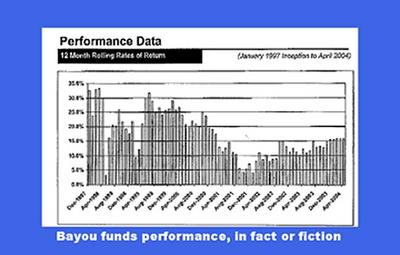 They must have had a really great Sharpe Ratio. Alas, William F. Sharpe himself says his ratio is useless for evaluating the "abolute return" potential of hedge funds. The ratio is too easy to fudge. Sharpe points out that Long-Term Capital Managment had a great Sharpe ratio just before it went bust in 1998. The Bayou funds troubles may have started shortly thereafter.
Bayou's admirable returns, it seems, weren't merely merely fudged, they were imagined. (It helps when your "independent auditor" is your CFO.)
Every affluent investor is a potential sucker. Yet in Bayou's case the biggest sucker of all may have been the manager, Sam Israel III. When his funds’ reported assets were over $400 million, he seems to have been down to $100 million or so. And that sum he supposedly entrusted to a miracle worker to invest in “two private, managed, buy/sell leveraged transactions” that in ten years would turn $100 million into $7.1 billion!
LIke to know what annualized return would be required to achieve that miracle?
Fifty-three percent!
Can regulators protect affluent investors against themselves? It won't be easy. The 100 hedge fund managers of Greenwich, CT, are already threatening to leave the country if efforts are made to place them under adult supervision.
Looks like responsible wealth managers and trustees will have to try to provide the protection. That won't be easy, either.
Offer too much protection and clients will think you're way too 20th-century fiduciary and take their business elsewhere.
Offer too little and the suddenly-poorer clients will sue the pants off you.
Life is hard, isn't it?
P. S. According to today's New York Times, Israel told his CFO that the miracle worker had been “referred to us by Alan Greenspan.” Nice touch!
Sam Israel's investment approach for his Bayou funds is said to have appealed to investors because it was understandable. No fancy swaps, no leveraged bets on toxic tranches of CDOs. Just good, old fashioned short-term trading in stocks that always seemed to work out well.
Was he actually the only person on the planet who could trade stocks for consistent profits month and month and year after year? If so, why wasn't he world famous? Some of the smarter money must have had its doubts all along.
As the chart from Bayou's sales brochure shows, the funds never seemed to have a bad year.
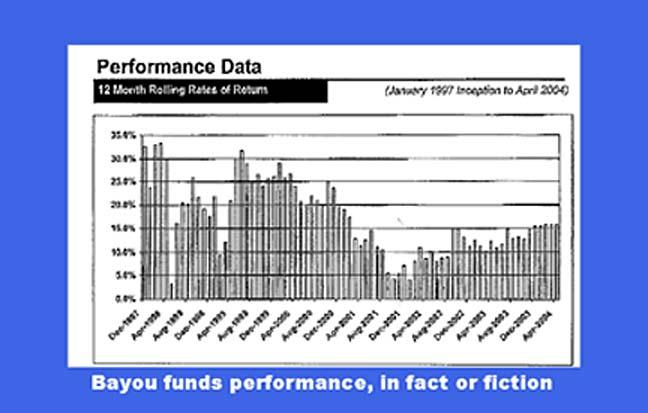 They must have had a really great Sharpe Ratio. Alas, William F. Sharpe himself says his ratio is useless for evaluating the "abolute return" potential of hedge funds. The ratio is too easy to fudge. Sharpe points out that Long-Term Capital Managment had a great Sharpe ratio just before it went bust in 1998. The Bayou funds troubles may have started shortly thereafter.
Bayou's admirable returns, it seems, weren't merely merely fudged, they were imagined. (It helps when your "independent auditor" is your CFO.)
Every affluent investor is a potential sucker. Yet in Bayou's case the biggest sucker of all may have been the manager, Sam Israel III. When his funds’ reported assets were over $400 million, he seems to have been down to $100 million or so. And that sum he supposedly entrusted to a miracle worker to invest in “two private, managed, buy/sell leveraged transactions” that in ten years would turn $100 million into $7.1 billion!
LIke to know what annualized return would be required to achieve that miracle?
Fifty-three percent!
Can regulators protect affluent investors against themselves? It won't be easy. The 100 hedge fund managers of Greenwich, CT, are already threatening to leave the country if efforts are made to place them under adult supervision.
Looks like responsible wealth managers and trustees will have to try to provide the protection. That won't be easy, either.
Offer too much protection and clients will think you're way too 20th-century fiduciary and take their business elsewhere.
Offer too little and the suddenly-poorer clients will sue the pants off you.
Life is hard, isn't it?
P. S. According to today's New York Times, Israel told his CFO that the miracle worker had been “referred to us by Alan Greenspan.” Nice touch!
Thursday, September 15, 2005
From the databank: Millionaires
Last year the U.S. produced new millionaires at the rate of 619 per day. What a country!
Number of Americans with a net worth (not counting primary residence) of at least $1 million last year, as estimated in the Merrill Lynch/Cap Gemini World Wealth Report:
2.5 million
2.5 million
Number of people worldwide with a net worth of at least US$1 million:
8.3 million
Number of millionaires worldwide with net worth of $1 million to $5 million:
7.4 million
Number of millionaires worldwide with net worth of $5 million to $30 Million:
744,000
Number of millionaires worldwide with net worth of $30 million or more:
77,500
8.3 million
Number of millionaires worldwide with net worth of $1 million to $5 million:
7.4 million
Number of millionaires worldwide with net worth of $5 million to $30 Million:
744,000
Number of millionaires worldwide with net worth of $30 million or more:
77,500
Number of U.S. households, as estimated by the Boston College Center on Wealth and Philanthropy, with a net worth (not counting primary residence) of $1 million or more:
7.4 million
7.4 million
Number of millionaire U.S. households sorted by age of householder:
Under age 35: 211,000
Age 35-44: 1.0 million
Age 45-64: 3.9 million
Age 65 and older: 2.3 million
Under age 35: 211,000
Age 35-44: 1.0 million
Age 45-64: 3.9 million
Age 65 and older: 2.3 million
Notice that most U.S. millionaire households contain no individual millionaires (7.4 million households but only 2.5 million millionaires). Rather, they consist of households where she has $600,000 and he has $500,000, or he has $800,000 and she has $400,000, etc.
If you're looking for business where the big money is, find one of the maybe 20,000-to-30,000 Americans with a net worth of $30 million or more. Grab his or her family-office business and you're all set.
But if you're looking for a host of clients who will need all the trust and investment help you can give them in the challenging years ahead, give a thought to those "no millionaire" millionaire households. There sure are a lot of them!
Charitable IRA rollovers
According to an e-mail that I received yesterday from Trusts & Estates magazine, Congress is poised to try out the "charitable IRA rollover" concept for the rest of the year in connection with tax relief for Hurricane Katrina. Key portion of the e-mail:
I've tried to find the legislation, but according to Tax Notes the language hasn't been drafted yet. I take it that the transfer to charity would count toward the year's minimum distribution requirements, which would be a big part of the appeal. The provision would apparently expire at the end of this year, so it will be important to get the word out quickly.
If you have clients who would like to donate more to Katrina relief and who have funds tied up in IRA accounts, this could be part of your year-end strategy. Under the pending legislation, anyone 70 1/2 years old and older would be allowed to roll over amounts from their IRA accounts (and other pension plans that can first be rolled into an IRA) directly to a qualified charitable organization on a tax-free basis.
Taxpayers aged 59 1/2 years old and older would be able to transfer IRA funds to a charitable remainder trust and give that remainder to charity without tax consequence.
I've tried to find the legislation, but according to Tax Notes the language hasn't been drafted yet. I take it that the transfer to charity would count toward the year's minimum distribution requirements, which would be a big part of the appeal. The provision would apparently expire at the end of this year, so it will be important to get the word out quickly.
Thursday, September 08, 2005
A trustee is held liable for bad estate planning advice
Following up on her banker's advice to create and fund a Crummey trust to lower future estate taxes, an individual had her lawyer draft the trust, and began making contributions to it. Unfortunately, the lawyer neglected to include a Crummey power of withdrawal for the beneficiaries, making this a somewhat rare form of that trust.
After a number of contributions were made, the trustee noticed the drafting deficiency and called it to the attention of the draftsman. The draftsman disagreed that a mistake had been made. Neither of them reported the question to the grantor. Oddly, the trustee continued to encourage contributions to the trust "to lower estate tax obligations." Perhaps the trustee expected a retroactive trust amendment or something. Needless to say, the defective trust saved no estate taxes, so the furious beneficiaries sued the trustee for their mother's lawyer's mistake (deeper pockets, perhaps?).
The Wisconsin Supreme Court held that the trustee had no fiduciary duty to review the trust, nor to call the defects to the attention of the grantor. However, continuing to recommend contributions to a trust when the purpose of saving estate taxes could not be met was negligence. Decision for the beneficiaries. [Hat tip: Gerry Beyer.]
Wednesday, September 07, 2005
Can US Trust come back?
As reported here, Peter Scaturro, Schwab's choice to head up the once-renowned trust institution, hopes that hedge funds, private placements and other alternative investments can lead to a revival.
Vote delayed
As JLM surmised yesterday, the vote on estate tax repeal was cancelled, given the urgency of finding a good political response to Katrina. That doesn't kill the reformation process, but it may weaken it. Now under consideration: a tax holiday for aviation fuel, and tax incentives for building new refineries.
Subscribe to:
Posts (Atom)

 Posts


