Thursday, December 14, 2006
Maybe Your Bank Isn't So Bad
You say your bank's clients are getting restless? Since early 2001, no client phone call has actually been answered by anyone with a pulse? Here's a story from The Spectator to show them things could be . . . worse.


Hedge Funds Move Upmarket
Report from Reuters: "The minimum net worth an investor must possess to be allowed to invest in hedge funds would more than double to $2.5 million in investments, excluding a personal residence, under a measure proposed by the U.S. Securities and Exchange Commission on Wednesday."
Will the higher minimum actually enhance hedge-fund ownership as a status symbol?
Wonder if the higher minimum will apply to Goldman Sachs’ new "virtual" fund of hedge funds? The firm's Absolute Return Tracker Index aims to replicate hedge fund returns for an annual fee of 1.01%. According to the chatter on CNBC, private bankers should be salivating at the chance to package the ART index.
In any case, hedge funds continue to grab the public fancy. Why else would John Wiley & Sons have published "Hedge Funds for Dummies"?
You and your not-dumb clients will find a decent briefing on the subject here, written by Lord William Rees-Mogg, the former editor-in-chief of The Times.
Will the higher minimum actually enhance hedge-fund ownership as a status symbol?
Wonder if the higher minimum will apply to Goldman Sachs’ new "virtual" fund of hedge funds? The firm's Absolute Return Tracker Index aims to replicate hedge fund returns for an annual fee of 1.01%. According to the chatter on CNBC, private bankers should be salivating at the chance to package the ART index.
In any case, hedge funds continue to grab the public fancy. Why else would John Wiley & Sons have published "Hedge Funds for Dummies"?
You and your not-dumb clients will find a decent briefing on the subject here, written by Lord William Rees-Mogg, the former editor-in-chief of The Times.
Tuesday, December 12, 2006
Is This Any Way to Market Revocable Trusts?
When living trusts became an estate planning must, bank customers needed to name a successor trustee. Bank trust departments, by and large, were not eager to fill the bill. They were looking for immediate-fee business, not long-term relationships. Self-trusteed trusts (standby trusts, banks called them) offered, at best, only a custody fee.
Here's a different kind of trust company. In this clear, informative web page, New Convenant Trust Company treats self-trusteeship as the default option:
Should more bank trust departments be marketing standby trusts as a primary product?
Before you answer "No," remember that sometimes the pros are wrong and the customers are right. Steve Jobs once thought a video iPod was a really stupid idea.
Here's a different kind of trust company. In this clear, informative web page, New Convenant Trust Company treats self-trusteeship as the default option:
What is a Revocable Trust?Admittedly, New Covenant Trust Company is not your usual, for-profit, trust institution. A wing of the Presbyterian Foundation, the company specializes in charitable remainder trusts and such. (In the case of an everyday revocable trusts, New Covenant requires the grantor to leave 10% of the trust fund, up to $250,000, to a Presbyterian or Presbyterian-related charity.)
A revocable trust is created to accept ownership of your assets during your lifetime. This is appealing for several reasons:
• You may retain complete management, control, use and distribution of your trust assets. If you prefer, you can designate someone else to serve as trustee for you.
• You select an alternative trustee in the event you become incapacitated. The trustee will manage the trust funds for you. The trust should clearly state how to determine incapacity.
• You can add or remove assets from the trust or change any of the terms at any time as you determine in your sole discretion.
• At your death, the trust becomes irrevocable and provides for the distribution or the continued management of the remaining assets in the trust by the successor trustee. The distribution is private; no involvement of probate.
Should more bank trust departments be marketing standby trusts as a primary product?
Before you answer "No," remember that sometimes the pros are wrong and the customers are right. Steve Jobs once thought a video iPod was a really stupid idea.

Monday, December 11, 2006
Childless? Don't be Caught Dead in Texas!
Merrill Anderson's Texas clients used to tell me how hassle-free probate was in that state, thanks to independent administration of estates.
Texas needs more hassles, according to this article in the Austin American-Statesman.
Theme of the special report : "Texas estate laws make stealing from the dead an easy crime."
Texas needs more hassles, according to this article in the Austin American-Statesman.
Theme of the special report : "Texas estate laws make stealing from the dead an easy crime."
Sunday, December 10, 2006
When sunk costs trump anchoring
For behavioral finance fans, the NYTimes magazine's annual review of ideas includes this unexpected insight:Low Starting Prices Lead to High Auction Sales.
The reason seems to be that low initial prices attract more bidders, and more bidding means that more people have invested more time in the auction. That, in turn, justifies the higher price in the successful bidder's final offer.
The reason seems to be that low initial prices attract more bidders, and more bidding means that more people have invested more time in the auction. That, in turn, justifies the higher price in the successful bidder's final offer.
Saturday, December 09, 2006
Expanded HSAs
The tax extenders just enacted by Congress lifts the cap on HSA contributions and removes the link to the deductible of the health insurance plan of the HSA owner. Details here ($). The new approach means that the HSA can really be a savings account, not just a spending management account. Also, there's a once-in-a-lifetime chance to fund an HSA with a tax free transfer from an IRA. That means that otherwise taxable IRA money can become tax free.
There's something here that I'm not getting. Couldn't this change effectively make all medical expenses fully deductible, provided only that they are channeled through an HSA? I guess not, if an employer's health program is not structured as an HSA. Still, the 10-year cost of eliminating the cap on deductions is a scant $712 million, which must assume that no one will be switching to the HSA format in the future. Why won't everyone take that approach now?
In a contrasting revenue projection, allowing the deduction of sales taxes in those states without an income tax for only two years, 2006 and 2007, has a ten-year cost of $5.5 billion. That seems way too high.
I'll be watching for the new HSA marketing plans.
There's something here that I'm not getting. Couldn't this change effectively make all medical expenses fully deductible, provided only that they are channeled through an HSA? I guess not, if an employer's health program is not structured as an HSA. Still, the 10-year cost of eliminating the cap on deductions is a scant $712 million, which must assume that no one will be switching to the HSA format in the future. Why won't everyone take that approach now?
In a contrasting revenue projection, allowing the deduction of sales taxes in those states without an income tax for only two years, 2006 and 2007, has a ten-year cost of $5.5 billion. That seems way too high.
I'll be watching for the new HSA marketing plans.
Friday, December 08, 2006
Tax extenders pass in the House
By a vote of 367 - 45 the House passed and sent to the Senate H.R. 6111, which includes the tax extenders, some energy provisions and Medicare reforms. Of course, we've been here before.
After the Crash: How Wall Street Preserved a Football Legacy
All the Wall Streeters didn't jump out windows in 1929. The fatter cats hung around waiting for business to pick up.
Many joined the new Downtown Athletic Club. In the Depression years the club became a popular place to work out, socialize and sit around cursing FDR's New Deal.
Club members became become fervent fans of college football, thanks to a touchdown club organiized by the club's athletic director. When the club decided to award a trophy to each year's best player, members proposed naming it for the athletic director, who had been a famed coach in his day.
He didn't think much of the award idea and declined.
After the athletic director's death in 1936, the Downtown Athletic Club named the award for him anyway.
The Heisman trophy will be awarded tomorrow for the 72nd time.
When the Senior Assistant Blogger's daughter entered Oberlin, he was astonished to learn that Heisman had been the college's first coach.
Most notably, says today's New York Times, he may have saved the game from self-destructing.
To prevent football from deteriorating into nothing but savage scrimmaging, Heisman coaxed the Father of the Game, Yale's sainted Walter Camp, into adopting the forward pass.
Give a cheer, then, to the battered Wall Streeters who raised their depressed spirits by following football. And tell the young footballers in your family to read up on Heisman. He's worth remembering.
Many joined the new Downtown Athletic Club. In the Depression years the club became a popular place to work out, socialize and sit around cursing FDR's New Deal.
Club members became become fervent fans of college football, thanks to a touchdown club organiized by the club's athletic director. When the club decided to award a trophy to each year's best player, members proposed naming it for the athletic director, who had been a famed coach in his day.
He didn't think much of the award idea and declined.
After the athletic director's death in 1936, the Downtown Athletic Club named the award for him anyway.
The Heisman trophy will be awarded tomorrow for the 72nd time.
* * *
When the Senior Assistant Blogger's daughter entered Oberlin, he was astonished to learn that Heisman had been the college's first coach.
John William Heisman (1869-1936) was the first professional football coach at Oberlin College. In 1892, he led the Yeomen football team to a perfect 7-0 record. In those days of high-powered football, the '92 Oberlin grid squad defeated both Ohio State and Michigan . . .Heisman coached lots of other places. Along the way he helped invent the game.
Most notably, says today's New York Times, he may have saved the game from self-destructing.
To prevent football from deteriorating into nothing but savage scrimmaging, Heisman coaxed the Father of the Game, Yale's sainted Walter Camp, into adopting the forward pass.
Give a cheer, then, to the battered Wall Streeters who raised their depressed spirits by following football. And tell the young footballers in your family to read up on Heisman. He's worth remembering.
Thursday, December 07, 2006
Hedge Funds Need “Christmas Miracle”
All hedge fund managers want for Christmas is a return equal to the S&P 500, according to this FINalternatives item:

[H}edge funds will need a Christmas miracle to reach double-digits this year, as the [Hedge Fund Research] HFRX Global index sits at 7.56% year-to-date. The broad-market S&P500, on the other hand, is up 12.2% YTD.
On the bright side, only one of the eight strategies tracked by HFR was in the red last month: equity-market neutral, which dipped 0.53% and has returned only 3.82% YTD.

Old Congress Ends with a Whimper (and Tax Extenders?)
At least the Lame Duck Congress is staying in character. After fooling around aimlessly during the estimated 100 days or so that Congress labored in Washington, D. C. this year, the members are now prepared to leave town tomorrow.
The tax extenders? The bill has been festooned with unrelated goodies, including measures relating to oil and gas royalties and timber.
Nevertheless, on CNBC, the Boston Globe's Rick Klein predicts that enough junk will be pruned from the bill to allow the extenders to pass.
The tax extenders? The bill has been festooned with unrelated goodies, including measures relating to oil and gas royalties and timber.
Nevertheless, on CNBC, the Boston Globe's Rick Klein predicts that enough junk will be pruned from the bill to allow the extenders to pass.
Hanging on to the old money
Jim Macdonald commented here on the importance of private banking to the the future Bank of New York Mellon. Today's Wall Street Journal confirms his observations with this short piece ($), which, although interesting, doesn't really have much news in it. Perhaps it is the product of some diligent PR people.
Mellon's wealth management group oversees some $92 billion for wealthy families, while BoNY manages $60 billion. None of the client contact folks at either bank are in jeopardy from the merger, according to the article, because keeping that staff is one key to keeping clients happy. There's already enough pressure from the younger generation for finding new financial advisors without increasing the churn of the bank's contact people.
Mellon's wealth management group oversees some $92 billion for wealthy families, while BoNY manages $60 billion. None of the client contact folks at either bank are in jeopardy from the merger, according to the article, because keeping that staff is one key to keeping clients happy. There's already enough pressure from the younger generation for finding new financial advisors without increasing the churn of the bank's contact people.
"It is a goal of every financial adviser, every private bank, every community foundation and every charity to retain a connection to the next generation to help them achieve their goals," says Paul G. Schervish, director of the Center on Wealth and Philanthropy at Boston College.
In a conference call with investors, Robert P. Kelly, Mellon's president and chief executive, said the banks would work hard to keep clients through the merger: " 'Lose no customers' is our rallying cry."
Tuesday, December 05, 2006
Trust Advertising in 1956
 From a November, 1956 New Yorker, here's a glimpse of what a typical trust ad from a NY trust institution looked like in those days.
The Guaranty ad gives you a greater appreciation of the creativity that went into the Chase nest egg ads from the same era, as seen here and here.
No wonder those old Chase nest-egg ads now sell as collectibles on eBay.
Monday, December 04, 2006
This is the week for the tax extenders
Tax Notes Today ($) reports this morning that Congress is expected to wrap up its work this week. The continuing resolution funding the government expires on December 8; rather than try to finish the appropriations bills before the holiday, the Republicans are expected to punt the job to January, to the next Congress.
A new extenders bill needs to be introduced and passed in the House, before going on to the Senate. Favored provisions will get just two years of life, that is, retroactively for 2006 and ahead for only 2007. Some trade and health-related provisions may be included in the bill as well.
As to the Alternative Minimum Tax for next year, the silence is deafening, in contrast to last year at this time.
A new extenders bill needs to be introduced and passed in the House, before going on to the Senate. Favored provisions will get just two years of life, that is, retroactively for 2006 and ahead for only 2007. Some trade and health-related provisions may be included in the bill as well.
As to the Alternative Minimum Tax for next year, the silence is deafening, in contrast to last year at this time.
The Bank of New York Reinvents Itself
 Today The Bank of New York announced the acquisition of Mellon Financial.
Generations ago, BONY maintained a strong presence in trusts and wealth management. Lately the bank has been best known for its corporate services.
Earlier this year, BONY divested its retail branches in exchange for Chase's corporate trust business.
Now BONY is opening new private banking offices, pretty well blanketing the greater New York metropolitan area, plus outposts in Florida and Boston.
The bank has also launched an award-winning ad campaign for private banking. The campaign plays up BONY's long history, such as this bit of trust lore from the ad running in today's New York Times:
“Generation after generation, The Private Bank of The Bank of New York has been acquiring financial wisdom and serving its clients with unwavering commitment.
“This is the home of the nation's first trust, created for the wife and seven children of our founder, Alexander Hamilton. And this is where we have continued to serve our clients and their families ever since.”
Wednesday, November 29, 2006
Trusts for Pets Come to Ohio
 Trusts for pets come to Ohio next year.
As reported here, dogs and cats in Columbus, Oberlin or Piqua no longer will face poverty when their owners predecease them.
For a Hefty Inheritance, Think Thin!
Thin people tend to accumulate more wealth than the obese, this New York Times article reports.
Obesity results in shorter life spans. And “sociologists have long noted that in developed countries, the higher-status people tend to be thin and the lower- status ones are fat.”
Less easy to explain is this finding: “Thin people tend to receive bigger inheritances.”
Obesity results in shorter life spans. And “sociologists have long noted that in developed countries, the higher-status people tend to be thin and the lower- status ones are fat.”
Less easy to explain is this finding: “Thin people tend to receive bigger inheritances.”
Do-It-Yourself Hedge Funds
How does a hedge fund that outperforms most but only charges 0.36% a year strike you? As you'll read here, the only catch is the $20 million minimum:
The program, FundCreator , designed by Professor Harry Kat of the Cass Business School at the City of London University with PhD student Helder Palaro, lets investors design futures trading strategies similar to hedge funds called synthetic funds that use 78 futures contracts to imitate various risk-return profiles, the reports said.
Hedge funds typically charge a 2% fee per year, in addition to 20% of profits, and funds of hedge funds add a 1% of assets fee and 10% of profits fee, Financial Times said.
The simulator charges 0.36% a year and a $5,250 set-up charge, the reports said.
The minimum investment is about $20 million, Hedge World reported, due to the large size of most of the contracts. About 10 investors are testing the system.
Professor Kat says that his system outperformed 82% of funds of hedge funds.
Tuesday, November 28, 2006
A U.S. Bank for Bond, James Bond?
 Wasn't that 007 skiing at Aspen? Mr.Bond must have stopped by Denver to consult his confidential banker at American International Depository and Trust.
As reported in the What's Offline column in The New York Times, E. Jerry James has founded what's said to be the first private bank for foreigners in the United States. He created the bank to take advantage of Colorado’s Foreign Capital Depository Act of 2001.
From the point of view of the bank's foreign clients, AID&T will be "off shore":
As a U.S. banking institution, we provide access to investments in various asset classes to international families and businesses. These families and businesses will enjoy the added benefits of confidentiality, asset protection, and tax mitigation as well as trust services and family office services, all in the most politically and economically secure country in the world."Tax mitigation." Sure has a nice ring to it!
Monday, November 27, 2006
Why So Many “Emerging Affluents” Never Emerge
Google the news for "ponzi scheme." A whole bunch of items pop up, reporting on Ponzi schemes from hither and yon, each in some stage of investigation, prosecution or recrimination.
Yesterday's New York Times took a long look at the phenomenon. Hard to write much new about the urge to get rich quick and the costly consequences. Still, it's good to be reminded of the basics:

• Ponzi's heirs can tailor a scheme to trap people from any walk of life or education level.
• Many Ponzi schemes are "affinity frauds," perpetrated in clubs, churches or other groups where one "client" will quickly tell friends about the chance for easy money.
• Victims of Ponzi schemes never heard of diversification. If they have a $125,000 inheritance or $575,000 needing investment, it all goes to the scheme. All of it!
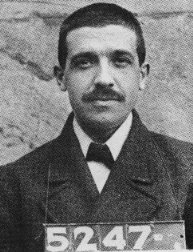
Carlo Ponzi, your name will live on until human nature changes.
Yesterday's New York Times took a long look at the phenomenon. Hard to write much new about the urge to get rich quick and the costly consequences. Still, it's good to be reminded of the basics:
• Ponzi's heirs can tailor a scheme to trap people from any walk of life or education level.
• Many Ponzi schemes are "affinity frauds," perpetrated in clubs, churches or other groups where one "client" will quickly tell friends about the chance for easy money.
• Victims of Ponzi schemes never heard of diversification. If they have a $125,000 inheritance or $575,000 needing investment, it all goes to the scheme. All of it!
Carlo Ponzi, your name will live on until human nature changes.
Wednesday, November 22, 2006
Thoughts for Thanksgiving
Ben Pease of TD Banknorth appears on the byline of this monthly commentary.
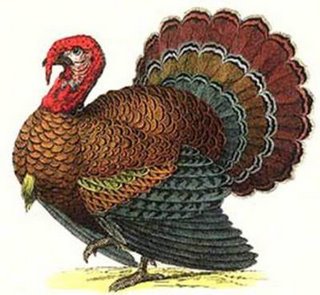
Thanksgiving is quickly approaching. In many homes, it is a time for food, family and football. For turkeys, on the other hand, it's just another attempt to make it through the day. Survival isn't easy for the turkey, regardless of the season. All year, turkeys must avoid more than simply hunters, holidays and carnivores to survive; they have to be smart and keep their cool. One long-held wives' tale about turkeys is that they can actually drown by looking upward too long while it is raining. Or, that they are very prone to sudden heart attacks if startled or overly excited. True or not, life is certainly not easy for the turkey.
Well, some resurrected "turkeys" are beginning to come back to the financial markets. With the Dow Industrial Average breaking through new highs and climbing toward 12,200, many investors are dusting off their overabundance of optimism, dating back to the late 1990s. . . . Could we be heading back toward the "hot sector of the day" on the evening news and investment advice from the local barber? I hope not. Remember, stay smart, keep your wits, and don't drown in the optimism of others by continually looking up.
• • •We have a meaningful - if not somewhat tormenting - tradition at my home on Thanksgiving Day. As the food hits the table and our stomachs are growling in anticipation, we pause for a few moments to allow each person to declare what they have been thankful for over the past year. Generally, it includes things such as appreciation for family, new children, a promotion or a newfound relationship. I can't remember a time when I've heard someone say they were thankful for the recent bond rally, the FOMC decision, or XYZ finally beating analyst estimates. It is interesting, in this age of long hours and long days; the most valuable things in life are still free. Have a wonderful Thanksgiving. . . .

Tuesday, November 21, 2006
With the "ownership society" vanishing, can we create a "fiduciary society"?
From Jim Webb's Op-Ed in The Wall Street Journal:
Fox are roaming the farmyards, and nobody (certainly not shareholders' "agents") guards the chicken coops.
Ideally, the solution might be to go back to direct investments in stocks and bonds for every portfolio over $100,000. Get rid of the passive intermediaries. Not likely.
More likely is increased government regulation, leading us nearer and nearer to state capitalism. (China and Russia will be glad to give us pointers.)
Can't there be a better way? All ideas on how to move from an "agency society" to a "fiduciary society" will be gratefully received.
When I graduated from college in the 1960s, the average CEO made 20 times what the average worker made. Today, that CEO makes 400 times as much.From a speech by Vanguard founder John Bogle, accepting a leadership award in Colorado:
[T]he “ownership society”—in which the shares of our corporations were held almost entirely by direct stockholders—gradually lost its heft and its effectiveness. It is not going to return. In its stead, a new “agency society” has developed, with financial intermediaries controlling the overwhelming majority of shares. (Since 1950, institutional ownership has risen from 8 percent of U.S. stocks to 68 percent; individual ownership has dropped from 92 to 32 percent.)Bogle sees the imperial compensation packages of CEO's (not to mention their back-dated stock options) as symptoms of deep trouble in the investment world.
Fox are roaming the farmyards, and nobody (certainly not shareholders' "agents") guards the chicken coops.
Ideally, the solution might be to go back to direct investments in stocks and bonds for every portfolio over $100,000. Get rid of the passive intermediaries. Not likely.
More likely is increased government regulation, leading us nearer and nearer to state capitalism. (China and Russia will be glad to give us pointers.)
Can't there be a better way? All ideas on how to move from an "agency society" to a "fiduciary society" will be gratefully received.
Monday, November 20, 2006
How much can be earned from collecting state quarters?
Earnings, in this case, means profits by the U.S. Mint from the sale of the state quarters to collectors, that is, the value of currency taken out of circulation less the cost of production. Uncle Sam has "earned" $4 billion to $5 billion so far, the New York Times reports. The program has worked so well that it's being extended to the one dollar coin. By February of 2007 Sacagawea will be joined first by George Washington, then all the rest of the dead Presidents on a schedule that extends to 2016.
I think it's unfortunate that the new Presidential dollars will be no larger that the Sacagawea, which is too close to the quarter in size to be quickly distinguished. On the other hand, I expect better acceptance of Presidential dollars as real money.
I wonder whether any collectors have profited from collecting the state quarters thus far?
I think it's unfortunate that the new Presidential dollars will be no larger that the Sacagawea, which is too close to the quarter in size to be quickly distinguished. On the other hand, I expect better acceptance of Presidential dollars as real money.
I wonder whether any collectors have profited from collecting the state quarters thus far?
The Trust Officer: Most Versatile of Bankers
Google "trust officer" as we did this morning and you'll be directed to What does a Trust Officer do? at the web site of Baylake Bank in Wisconsin.
Pay them a virtual visit. Trust officers in the Green Bay area need all the sympathy they can get after yesterday's game: Patriots 35, Packers zip. Yikes!
Pay them a virtual visit. Trust officers in the Green Bay area need all the sympathy they can get after yesterday's game: Patriots 35, Packers zip. Yikes!
Estate Planning for Persons With Less Than $5 Million
Jonathan Blattmachr, Georgiana Slade and Bridget Crawford provide some useful observations and eleven strategies in this downloadable article.
Sunday, November 19, 2006
Bulls, Bears . . . and Lame Ducks
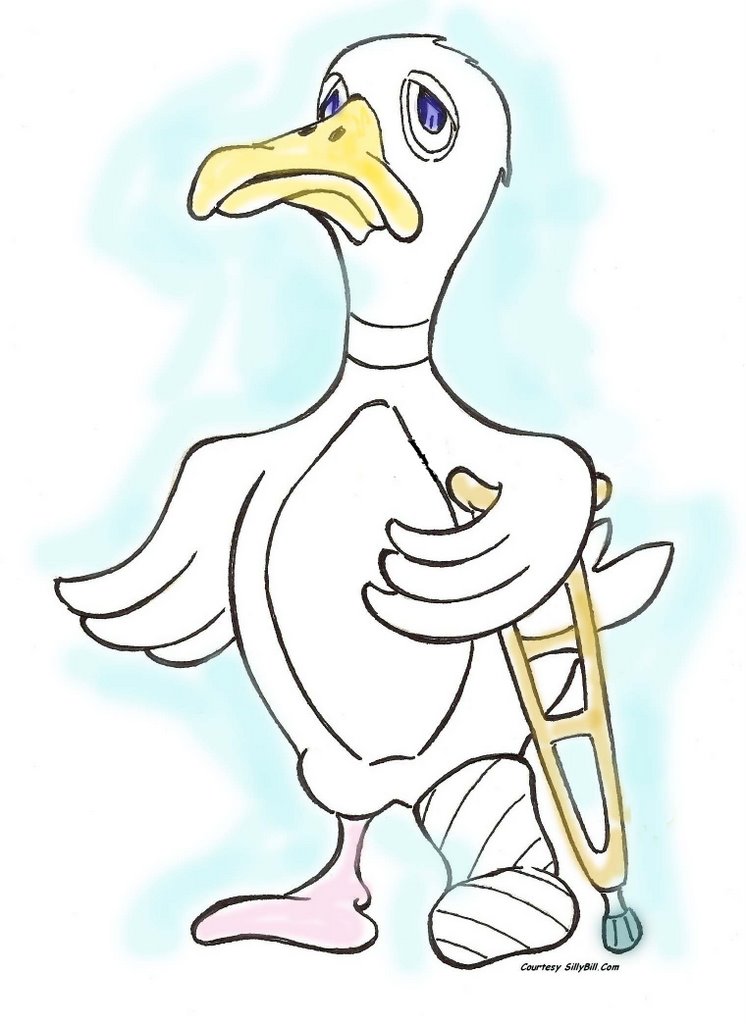 From Week in Review in The New York Times:
[T]he political phrase of the moment is actually derived not from the hunt for waterfowl, but for riches. The Oxford English Dictionary — which defines the term as “a disabled person or thing: spec. (Stock Exchange slang): one who cannot meet his financial engagements; a defaulter” — traces its origins to the London stock market in the 18th century, where broke investors were said to waddle out the doors onto Exchange Alley. Horace Walpole, the Gothic author and the fourth Earl of Orford, was so tickled by the expression that in 1761 he made the first known written reference to it, in a letter to Sir Horace Mann that asked, “Do you know what a Bull, and a Bear and Lame Duck are?”
Friday, November 17, 2006
Hedge Funds: Where are the Customers‘ Yachts?
 That's the question raised by The Economist in this article.
The editors of The Economist seem to have difficulty believing in Tinker Bell or hedge funds. Still, the article offers useful stats and raises a pertinent question: How long will investors pay alpha prices for beta performance?
Quite a while, probably. The article concludes that hedge funds' boosters and detractors both exaggerate:
Hedge funds are not the panacea for every pension-fund deficit, nor are they the cause of every ill in the financial markets. They are like a fast-growing adolescent, sometimes boisterous, sometimes clumsy but still developing. Where skill does exist, clients will probably find that managers get the bulk of the benefits. But as long as clients blindly believe in that skill, they will pay for the hedge funds' yachts.For a somewhat more positive take on hedge funds, see this interview with Steven Drobny, President, Drobny Global Advisors.
Drobny believes the astonishing expenses faced by hedge-fund investors pose no problem:
"Investors are allowed to choose what they want and if they don't like something they can vote with their feet."
About that yacht
If you've followed Ben Stein's advice and struck it rich running your own hedge fund, you can pick up the cool old yacht above for a mere 900,000 euros. German-built in the early 1920s, the vessel later served as the official presidential yacht of Generalissimo Franco of Spain.
Fun with numbers
Just back from the New England trust conference, where the keynote speaker made the following observations (numbers are approximate):
100,000,000—number of U.S. households
400,000—number of licensed U.S. financial advisors
250—households per advisor
$150,000—average investable assets of U.S. households (gross wealth divided by households)
$8,100—median investable assets of U.S. households (50% have more, 50% less).
20,000,000—more realistic prospecting base for financial advisors
50—number of actual prospects per advisor
So that's why selling financial services to the high net worth market has gotten so tough!
100,000,000—number of U.S. households
400,000—number of licensed U.S. financial advisors
250—households per advisor
$150,000—average investable assets of U.S. households (gross wealth divided by households)
$8,100—median investable assets of U.S. households (50% have more, 50% less).
20,000,000—more realistic prospecting base for financial advisors
50—number of actual prospects per advisor
So that's why selling financial services to the high net worth market has gotten so tough!
Wednesday, November 15, 2006
MIT 23, YALE 22.9
MIT scored a return on its endowment that edged even Yale for the twelve months ending last June. So reports the NY Sun here.
Seth Alexander, a former member of David Swensen's team at Yale, now manages MIT's endowment. Another ex-Swensenite serves as Princeton's wealth manager.
As long as Swensen and his acolytes can produce outsize returns, hedge funds seem destined to remain in style.
Seth Alexander, a former member of David Swensen's team at Yale, now manages MIT's endowment. Another ex-Swensenite serves as Princeton's wealth manager.
As long as Swensen and his acolytes can produce outsize returns, hedge funds seem destined to remain in style.
Tuesday, November 14, 2006
Hopes for resolution on estate taxes dim
As the lame duck session gets underway, attention has turned to the expired "tax extenders" legislation (including the R&D tax credit and the itemized deduction of state sales taxes). That legislation is presently included in the "trifecta bill" with a number of changes to the estate tax and an increase in the minimum wage. Action isn't expected before December. Though the trifecta bill may not be dead, it's on life support. According to Tax Analysts ($):
[Retiring Ways and Means Chairman] Thomas suggested that any efforts to move estate tax reform this year have finally been put to bed, telling reporters that the rush to wrap up work this year will likely prevent any further debate on the estate tax.Wasn't it Senator Frist who proclaimed last August that the Senate would never consider the extenders apart from estate tax reform? Yes, it was.
Without completely dismissing the possibility of his chamber once again taking up the trifecta bill this year, Senate Majority Leader William H. Frist, R-Tenn., told reporters earlier in the day it is "most likely" that Congress will act only on the tax extenders during the lame-duck session.
Thoughts for a Taxpayers' Day
Does your local chapter of Save Our Tax Cuts need a little inspiration? Try this from Good joke: Murphy's Lesser Known Laws:
If Congress, via the federal estate tax, insists on limiting the assets we can pass to our children and grandchildren, why doesn't Congress limit the liabilities we can pass to them, via federal deficits?
For the sake of our descendants, shouldn't we should replace the federal "death tax" with a federal debt tax?
A fine is a tax for doing wrong. A tax is a fine for doing well.If any chapter members are tempted to perform criminal acts in order to achieve deeper cuts in their taxes, you might call their attention to this law:
When you go into court, you are putting yourself into the hands of 12 people who weren't smart enough to get out of jury duty.
* * *
This month the Lame-Duck Congress goes on a Wild Goose Chase, as one pundit put it. Estate-tax reform is expected to be among the geese that get away. Meantime, here's a paradox to ponder:If Congress, via the federal estate tax, insists on limiting the assets we can pass to our children and grandchildren, why doesn't Congress limit the liabilities we can pass to them, via federal deficits?
For the sake of our descendants, shouldn't we should replace the federal "death tax" with a federal debt tax?
Wednesday, November 08, 2006
Rumsfeld Out. Estate-Tax Reform In?
By winning control of the House of Representatives (and possibly the Senate), the Democrats sent at least one senior citizen, Don Rumsfeld, into retirement. Have they also brightened the prospects for estate-tax reform? That's the view offered in this USA Today article:
Repeal of the estate tax, a top priority of the Bush administration, doesn't stand a chance with Democrats in control of the House. But the prospects for legislation that would limit the tax to the super-wealthy are much improved, tax analysts say.
Less than 2% of taxpayers pay estate taxes. But for those who are affected, the tax rates are steep: up to 46% on estates that exceed $2 million. Under current law, the amount of assets exempt from estate tax will rise until 2010, when the estate tax will disappear.
Unless Congress acts, though, the estate tax will rise from the grave in 2011, the exemption will drop to $1 million, and the top rate will hit 60%. (This has led some financial planners to dub the 2001 statute the "Throw Momma From the Train Act," because heirs stand to gain the most if their benefactors die in 2010.)
While Democrats have opposed full repeal of the estate tax, many support increasing the exemption amount, says Clint Stretch, managing principal of tax policy at Deloitte Tax in Washington. Rep. Charles Rangel, the New York Democrat who's expected to chair the House Ways and Means Committee, favored estate tax reform as far back as 2001, Stretch notes. "Clearly, he would be supportive of a significant increase in the exemption amount."
Tuesday, November 07, 2006
Winning Trust
I'm back from the Pennsylvania Bankers Trust and Wealth Management conference, held once again in lovely Hershey, PA. Learned a bit more about Milton Hershey and his trusts, perhaps enough to generate a newsletter article for next year.
We premiered a new product, Winning Trust, for raising awareness of the trust department and encouraging referrals of trust prospects within the bank. We first introduced a video training product called Winning Trust nearly 20 years ago, and it was a sensation in its day. The new product is deliverable via computer, as a standalone narrated movie or unnarrated PowerPoint slides.
The reaction from the PA bankers was good, though we had hoped for more. Perhaps people are just harder to impress these days.
A demo of the presentation will likely be posted shortly on the Merrill Anderson web site. I'll add a link for it when it's ready.
We premiered a new product, Winning Trust, for raising awareness of the trust department and encouraging referrals of trust prospects within the bank. We first introduced a video training product called Winning Trust nearly 20 years ago, and it was a sensation in its day. The new product is deliverable via computer, as a standalone narrated movie or unnarrated PowerPoint slides.
The reaction from the PA bankers was good, though we had hoped for more. Perhaps people are just harder to impress these days.
A demo of the presentation will likely be posted shortly on the Merrill Anderson web site. I'll add a link for it when it's ready.
Sunday, November 05, 2006
What Happens After a Bank Rips Off Your Grandmother?
A bank annuity salesperson snatches most of Grandmother's money, creating a "disaster" for grandma. Things couldn't get worse, right?
Wrong. Another bank annuity salesperson tries to rip off Mother!
This story, told by Jeff D. Opdyke in his Sunday Journal column, is so sad, and so maddening, that we'll show it to you in full:
The salesperson with the fiduciary instincts of a mosquito, the stern loan officer and the nice lady in the trust department are equally "bankers" in the public's eyes.
Contest: In 300 words or less, discuss whether selling expensive, inappropriate deferred annuities to credulous senior citizens is in the best interests of a bank and promotes the bank's long-term success.
Prize for the best entry will depend on the quality of thought and expression.
A little repentance wouldn't hurt, either.
Wrong. Another bank annuity salesperson tries to rip off Mother!
This story, told by Jeff D. Opdyke in his Sunday Journal column, is so sad, and so maddening, that we'll show it to you in full:
More than a year ago, I wrote about my grandmother buying an annuity from a local banker, noting that I viewed the transaction as a financial disaster. This banker persuaded my grandmother to lock up two-thirds of her liquid assets in an annuity.Grandma's disaster is, of course, banking's disaster. People don't distinguish between bankers and in-bank brokers/insurance agents who sell on commission.
Based on the contract details, the banker was clearly clueless. My grandmother had one request -- that the proceeds not go in a lump sum to her daughter -- and the banker told her that would be no problem. He was wrong: The contract specifically notes that the beneficiary, my mom, would receive a lump-sum payment upon my grandmother's death.
I told my grandmother that I wanted to help her try to nullify the contract, but she demurred. She has been dealing with this bank branch since the 1970s and didn't want to raise a stink. So I held my tongue.
However, something good arose from this sorry mess. As I wrote in that column, it's incumbent upon us to watch out for our parents and aging relatives when it comes to their big financial transactions. You must talk to them, tell them not to feel pressured by anyone and encourage them to call you before acting on any investment solicitation, particularly for an annuity.
And I'm happy to say my mom did just that.
She heard me talking to my grandmother, and she listened when I gave her the same message. A few months ago she received a large insurance settlement for a back injury, and when she deposited the check, the bank immediately sat her down with an in-house investment peddler who tried to persuade her to put the entire sum (essentially 100% of her liquid assets) into a variable annuity. It would have basically locked up her money for about a decade.
Mom called me from the banker's desk to tell me about what sounded like a great deal to her. I told her the risks and that in her situation it was a terrible idea. She hung up, but then called back when the banker's spiel continued. She put the banker on the phone, and I told him to back down because this annuity was entirely inappropriate for my mom's situation.
He lost the sale.
Just to be clear: I think that for certain people certain annuities can be great tools for retirement-income planning. I expect to use annuities in my retirement to create a pension-like stream of permanent income my wife and I can never outlive.
But that doesn't mean they're right for everyone, and the worst situation is when you find a parent has been sold an annuity that mangles her finances and leaves her feeling insecure.
The salesperson with the fiduciary instincts of a mosquito, the stern loan officer and the nice lady in the trust department are equally "bankers" in the public's eyes.
Contest: In 300 words or less, discuss whether selling expensive, inappropriate deferred annuities to credulous senior citizens is in the best interests of a bank and promotes the bank's long-term success.
Prize for the best entry will depend on the quality of thought and expression.
A little repentance wouldn't hurt, either.
Friday, November 03, 2006
Direct Mail, Then and Now
1905: Almost-instant messaging
Came across an odd news item from Norwalk, CT the other day. The Norwalk museum had received the gift of a locally-made product from the early years of the 20th century, a Postal Typewriter.
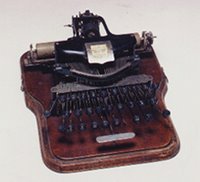
A what? A Postal Typewriter. For its day, it was leading edge technology:
“In the early 1900s, when the phone was not ubiquitous and telegraphs were inconveniently located outside the home, the mail, or the post, was convenient because messages were delivered three times a day. . . . With a Postal Typewriter, people could write a quick letter -- a post card -- and have it delivered by the day's end. . . .”
The Postal Typewriter didn't last. Telephones, an even more quick and convenient form of communication, made same-day messaging old hat.
It's an old story. New technology drives out the old. Or does it? Often new technology develops problems of its own.
In its heyday, the mid-20th century, telephone service was so universl and reliable you could call the White House and speak with a member of the staff. You could call company presidents and arrange appointments, usually via their secretaries but sometimes with the chief honcho himself.
Today, the wired, household telephone is old tech. Outgoing calls get tangled in a jungle of phone trees. Incoming calls are generally an annoyance.
2006: There's no comparison
How did most communication media turn into such a pain? E-mail comes in a hopeless flood. TV commercials beg to be zapped. And those phone calls.
As a result, The New York Times reports, good old direct mail is making a comeback.
“As the world becomes more digital, there is a need for tangible experiences,” says Rob Bagot, executive creative director at McCann Worldgroup San Francisco. “And there’s nothing like a piece of paper.”
Came across an odd news item from Norwalk, CT the other day. The Norwalk museum had received the gift of a locally-made product from the early years of the 20th century, a Postal Typewriter.

A what? A Postal Typewriter. For its day, it was leading edge technology:
“In the early 1900s, when the phone was not ubiquitous and telegraphs were inconveniently located outside the home, the mail, or the post, was convenient because messages were delivered three times a day. . . . With a Postal Typewriter, people could write a quick letter -- a post card -- and have it delivered by the day's end. . . .”
The Postal Typewriter didn't last. Telephones, an even more quick and convenient form of communication, made same-day messaging old hat.
It's an old story. New technology drives out the old. Or does it? Often new technology develops problems of its own.
In its heyday, the mid-20th century, telephone service was so universl and reliable you could call the White House and speak with a member of the staff. You could call company presidents and arrange appointments, usually via their secretaries but sometimes with the chief honcho himself.
Today, the wired, household telephone is old tech. Outgoing calls get tangled in a jungle of phone trees. Incoming calls are generally an annoyance.
2006: There's no comparison
How did most communication media turn into such a pain? E-mail comes in a hopeless flood. TV commercials beg to be zapped. And those phone calls.
As a result, The New York Times reports, good old direct mail is making a comeback.
"I would rather get a catalogue over a call during dinner 10 times over,” [Ginger] Stickel, a mother of two young children in Greenwich, Conn., said. “I always open those letters, and sometimes they’re useful.”Turns out that even junk mail is easier to sort through and jettison than e-mail spam. And higher-class direct mail (dare we mention the classy financial newsletters prepared by The Merrill Anderson Co.?) can seem almost luxurious.
Remember when the Internet and online marketing were going to spell the end of the direct mail business? Well, it hasn’t exactly worked out that way.
“As the world becomes more digital, there is a need for tangible experiences,” says Rob Bagot, executive creative director at McCann Worldgroup San Francisco. “And there’s nothing like a piece of paper.”
Thursday, November 02, 2006
Annuities Explained
Perhaps you're a wealth manager who doesn't use the A-word much. But a client wants a briefing. What to do? You might just print out Mark Trumbull's helpful layperson's guide from The Christian Science Monitor.
Subscribe to:
Posts (Atom)

 Posts
Posts


