Keith Richards described Prince Rupert zu Loewenstein-Wertheim-Freudenberg, Count of Loewenstein-
Scharffeneck, this way: “He is a great financial mind for the market. He plays that like I play guitar."
The unlikely money manager to rock-and-roll royalty died at age 80 last Tuesday in London. Read a Brit tabloid tribute. The New York Times obit is here.
Friday, May 23, 2014
Thursday, May 22, 2014
What's the Estate Tax on a “$4.8 Million” Madoff Account?
Through a personal pension plan, in 1992 Bernard Kessell started investing millions with Bernie Madoff. Kessell died in 2006. Madoff's firm told Kessel's executor that the date of death value of the account was more than $4.8 million. That value was reported on Kessel's federal estate tax return.
After Madoff's massive Ponzi scheme was exposed in 2008, Kessel's estate filed an amended return valuing the Madoff account at zero and claiming a refund. The IRS balked. Now the question of value has gone to Tax Court.
In a way, Kessel and his heirs were lucky. Before the roof fell in, they were able to withdraw more than he had invested. But not really so lucky. The Madoff trustee has sought to claw back such faux profits, using them to reimburse Bernie's less lucky investors.
What was the true value of Kessel's Madoff account? Apparently the Tax Count will have to decide.
Sunday, May 18, 2014
Retirement Investing is Personal
From Dueling Strategies for Your Retirement Funds:
For anyone approaching retirement, an important investing question is: Should your strategy be "to" or "through"? ***
The "to" refers to preserving savings for an expected retirement date; the goal is to get "to" that date without last-minute harm to your nest egg. Generally this means cutting back sharply on riskier investments—namely stocks ***
A "through" strategy means tilting a portfolio to keep increasing savings well into, or "through," retirement. That means higher allocations to stocks and other riskier investments despite a bigger risk of losses.
The strategies aren't dueling. As we discussed five years ago, different retirees have different goals. See The Trouble With Target Date Funds.
Saturday, May 17, 2014
Will the tax-free Roth retirement account really stay tax free?
Maybe not, warns Megan McArdle. She decided to do one anyway.
Thursday, May 15, 2014
Thomas Jefferson Considers Gifts to His Grandchildren
Poplar Forest, a plantation Jefferson inherited at his wife's death, was a significant source of income. In 1805 he wrote to his Poplar Forest estate manager:
“The time is now approaching when I shall wish to be parceling off some of my lands to my grandchildren. This renders it necessary that I should understand the separate value of each portion of them distinctly. As no person is so well acquainted with them as yourself, I must ask a favor of you to consider the questions on the paper enclosed, and to write at the end of each the answer in figures, and to send me the same paper to Monticello, by the first post.”
The previously unknown letter is now for sale.
In that same year of 1805, Jefferson began work on this octagonal house.
![]() |
| Poplar Forest Photo via Wikimedia Commons |
Photos of Huguette Clark
Published by Huffington Post, taken from a new biography of her.
Tuesday, May 13, 2014
The Great Hedge Fund Mystery
Why do hedgies make so much? The New Yorker's John Cassidy can't figure it out. He asks for help.
Monday, May 12, 2014
Merrill Lynch Ponders “Sustainable” Wealth
Sustainable farming, sustainable energy sources, sustainable forests…Merrill Lynch goes with the flow and surveys Sustainable Wealth.
The survey – conducted last December among investors with $5-million and up – deals mostly with the "values" side of family wealth but did include a question on trusts.
Two-thirds of respondents believed assets should be held in trust for the lifetime of their heirs.
Three quarters of respondents under age 56, who presumably have younger children, said lifetime trusts were a good idea.
But…more than half the respondents also said that heirs should be handed full control of their inheritances at a certain age, usually under 35. That's surveys for you.
The survey – conducted last December among investors with $5-million and up – deals mostly with the "values" side of family wealth but did include a question on trusts.
Two-thirds of respondents believed assets should be held in trust for the lifetime of their heirs.
Three quarters of respondents under age 56, who presumably have younger children, said lifetime trusts were a good idea.
But…more than half the respondents also said that heirs should be handed full control of their inheritances at a certain age, usually under 35. That's surveys for you.
•
In targeting the $5 million and up market for legacy planning, how well does Merrill Lynch Private Bank get along with its BofA sibling, US Trust? Just asking.
Sunday, May 11, 2014
1969: More Ads from the Mad Men Era
In the spring of 1969 Merrill Lynch joined the rush to promote hot new go-go stocks:
It used to be that practically all you needed to sniff out a growth stock was a good nose for technology. Xerox smelled good to some people. Polaroid smelled good to others. And sure enough, both rose higher than a soufflĂ© at Pavillon.Young and small was the way to go, Merrill Lynch figured, because "we wanted companies that could show dramatic gains in earnings. That’s a lot easier for Davids than for Goliaths."
Alas, go-go shares were about to collapse. Investors soon decided the only trustworthy stocks were the Goliaths, the Nifty Fifty.
US Trust must have sensed market uncertainty, for it reran one of its classic ads. Could any headline be more timeless?
Instead of spotlighting an affluent adult as usual, this Chemical ad features a kid. In current dollars the lucky lad's trust is worth way over $1 million. Would an ad calling attention to that much youthful good fortune prove problematic today?
Friday, May 09, 2014
Mark Zuckerberg: a Billion Here, a Billion There…
Last year, CNBC's Robert Frank reports, Mark Zuckerberg paid an estimated $1 billion in taxes.
Facebook's CEO also made last year's biggest charitable donation, giving the Silicon Valley Community Foundation shares worth about $1 billion.
If $1 billion is starting to sound like a routine sum, remember the John Allen Paulos comparison:
A million seconds is less than twelve days.
A billion seconds is almost thirty-two years.
| Photo: Wikimedia Commons |
If $1 billion is starting to sound like a routine sum, remember the John Allen Paulos comparison:
A million seconds is less than twelve days.
A billion seconds is almost thirty-two years.
Thursday, May 08, 2014
Huguette Clark's Monet Sells for $27 Million
Huguette Clark, the eccentric recluse who owned a number of splendid homes yet chose to live in a hospital, left notable works of art. Now that disputes over her estate are resolved, Christie's has sold her Monet painting of water lilies for $27 million ($24 million plus $3 million buyer's premium).
Christie's was hoping for more. The $24-million sales price may be bad news for the Washington, D.C. Corcoran Gallery, according to the Los Angeles Times.
Though The New York Times describes the Christie's auction of Impressionist and modern art as "tepid," Reuters hails the sale as Christie's best since 2010. In the art world as on Wall Street, apparently, the state of the market may be a matter of opinion.
![]() |
| Clark's Monet |
Though The New York Times describes the Christie's auction of Impressionist and modern art as "tepid," Reuters hails the sale as Christie's best since 2010. In the art world as on Wall Street, apparently, the state of the market may be a matter of opinion.
Monday, May 05, 2014
Investing 101: William Bernstein's Study Guide for Millennials
Would you believe me if I told you that there’s an investment strategy that a seven-year-old could understand, will take you fifteen minutes of work per year, outperform 90 percent of finance professionals in the long run, and make you a millionaire over time?
So begins "If You Can," William Bernstein's little investment guide for Millennials. Featured in The New York Times, the e-booklet is free at Bernstein's web site (the PDF is here) and sometimes on Amazon. All Millennials have to do, Bernstein advises, is invest 15 percent of their income in three index funds: foreign and domestic equities, and bonds.
Of course, it's not really that simple. His e-booklet offers a crash course in how to get past five hurdles that stand in the way of the young would-be investor. He describes each hurdle and suggests a reading program of one or more books.
The first hurdle, learning to save rather than spend. The recommended reading, "The Millionaire Next Door," a work that Bernstein terms "the most important book you'll ever read."
Surmounting the next hurdles requires gaining investment literacy and, equally important, a sense of investment history.
Last hurdle, "the monsters who populate the financial industry."
A great college course, preferably required, could be built around Bernstein's booklet. But how many colleges would risk offending their Wall Street donors?
Of course, it's not really that simple. His e-booklet offers a crash course in how to get past five hurdles that stand in the way of the young would-be investor. He describes each hurdle and suggests a reading program of one or more books.
The first hurdle, learning to save rather than spend. The recommended reading, "The Millionaire Next Door," a work that Bernstein terms "the most important book you'll ever read."
Surmounting the next hurdles requires gaining investment literacy and, equally important, a sense of investment history.
[I]f learning about the theory and practice of finance is akin to studying aeronautics, then studying investment history is akin to reading aircraft accident reports….The fourth hurdle is human psychology. We're not designed to think long term or stay the course.
Last hurdle, "the monsters who populate the financial industry."
To be avoided at all costs are: any stock broker or “full-service” brokerage firm; any newsletter; any advisor who purchases individual securities; any hedge fund. Most mutual fund companies spew more toxic waste into the investment environment than a third-world refinery. Most financial advisors can’t invest their way out of a paper bag.Tough words, those. But I'd give much the same advice to our family's Millennials. Anyway, wealth managers can afford to roll with the punch – beginner investors are not lucrative business.
A great college course, preferably required, could be built around Bernstein's booklet. But how many colleges would risk offending their Wall Street donors?
Saturday, May 03, 2014
1969: Amex "salutes" Ugly Americans
Not all the beneficiaries of the postwar boom of the 1950s and 1960s were as cosmopolitan as TV's Mad Men. In honor of Derby Day, here's an American Express ad from the spring of 1969. Obviously, this American couple arriving at Ascot never saw "My Fair Lady."
Tuesday, April 29, 2014
Department of Uncanny Coincidences
Op-ed in yesterday's New York Times:
No Accounting Skills? No Moral Reckoning
Business news item in today's New York Times:
Bank Finds a Mistake: $4 Billion Less Capital
No Accounting Skills? No Moral Reckoning
Business news item in today's New York Times:
Bank Finds a Mistake: $4 Billion Less Capital
Monday, April 28, 2014
The Age of Asset Management
Finally got around to reading Bloomberg Businessweek's Asset Managers are the New Banks. Should have been more prompt.
Read Haldane's speech. Conventional asset management, where funds are managed by stock and bond pickers, is being squeezed between high-cost alternatives, such as hedge funds and private equity, and low-cost index funds and ETFs. Old-fashioned prudent investing seems to have succumbed to the temptation of market timing. Just like the much maligned small investor, many pension funds tend to buy high, sell low.
The good news: Asset management should continue to boom globally. "In China and India, personal financial assets have grown at a rate of 25% per year for the past 20 years."
One of the more disquieting parts of covering banking regulation is how often, in an interview, either a regulator or a banker will say something like this: Regulators have to treat banks with some respect. If they clamp down too hard, the money will go somewhere else, to a place we only dimly understand. Beyond the banks, the logic goes, there be monsters.
In a speech last week to a group of asset managers in London, Andrew
Haldane, in charge of financial stability for the Bank of England, began to map out the land of the monsters. The number of people saving money in the world has grown larger, older, and richer, he said. Life expectancy is rising—as is population and per-capita GDP. And all these rich old people need to put their savings somewhere. It is not going into savings accounts but instead into a category known as assets under management, or AUM: pension funds, exchange-traded funds, hedge funds, private equity.
AUM in the U.S. was about half of GDP in the 1940s; it has now grown to almost two and a half times GDP.
Read Haldane's speech. Conventional asset management, where funds are managed by stock and bond pickers, is being squeezed between high-cost alternatives, such as hedge funds and private equity, and low-cost index funds and ETFs. Old-fashioned prudent investing seems to have succumbed to the temptation of market timing. Just like the much maligned small investor, many pension funds tend to buy high, sell low.
The good news: Asset management should continue to boom globally. "In China and India, personal financial assets have grown at a rate of 25% per year for the past 20 years."
Saturday, April 26, 2014
The Status of Tax Reform
Carl Hulse in The New York Times:
As Congress prepares to return from a two-week spring break on Monday, the capital is frozen in the shadow of the midterm elections, with large tasks such as revising the tax code dismissed with hardly a hearing.
Thursday, April 24, 2014
Executors and Their Troubles
![]() | ||
| Oleg Cassini |
Thereafter Cassini's widow seems to have lost interest in settling the estate. A Manhattan probate judge has suspended her as executor, pending a decision as to whether she should be replaced.
Fireman's executor overwhelmed. Nearly three years after a volunteer fireman in New Jersey died, "none of the beneficiaries have received their disbursements from his estate. The lack of action — and alleged dearth of communication with the executor — prompted borough officials to file a lawsuit compelling executor John Benensky of Madison to fulfill his fiduciary duty and give a formal accounting of the estate."

The estate includes a business and is valued at over $1 million. Agreeing to serve, says the overwhelmed executor, was "a spur of the moment” decision. He had no idea the job would be so complicated.
Replaced executor fights for the job. A few months before she died, an elderly widow executed a codicil to her 2010 will. Her amendment made no changes to the disposition of her $22 million estate; the codicil merely replaced the lawyer she had named as her executor with three new co-executors.
After the widow's death the lawyer fought to regain his appointment as executor (and as successor trustee of the widow's living trust). Failing in probate court, he appealed. Now the appeals court has rebuffed him:
A person who was named as an executor in a will cannot contest a codicil by which the testator named someone else to that position.
•
Estate settlement is a task that sometimes involves big money and often stirs strong emotions. Maybe naming a dull, disinterested bank as executor isn't such a bad idea.Wednesday, April 23, 2014
Happy 450th, Will!
William Shakespeare was born 450 years ago today, and we're still not too sure what he looked like. Wikipedia illustrates these three candidates.
More certain, according to the Financial Times, is that the Bard was a better entrepreneur and investor than most playwrights.
Related post: Brush Up Your Shakespeare – and See His Last Will
More certain, according to the Financial Times, is that the Bard was a better entrepreneur and investor than most playwrights.
Related post: Brush Up Your Shakespeare – and See His Last Will
Tuesday, April 22, 2014
Remembering Alex Porter and “Hedged” Funds
Alex Porter, who worked at the first hedge fund, A. W. Jones & Co., and later ran his own successful firm, died April 18.
As one of “the last practitioners from the A.W. Jones era,” Porter carried the long-ago notion of a “hedged” fund as one that is “long and short and thereby inured to the vicissitudes of the overall market,” said James Grant, a friend and colleague who publishes Grant’s Interest Rate Observer.For Porter, less volatility didn't mean lesser performance. From 1976 until 1993, his first fund reportedly generated a net compound annual return of about 20 percent .
Today, by contrast, the term “hedge” suggests “leveraged and long” investing, he said, which often amplifies rather than cushions market swings.
Monday, April 14, 2014
Bulls, Bears and Bucks
![]() |
| Bull and Bear at Frankfurt Stock Exchange |
The financial world is a veritable zoo, Forsyth observes: dogs and pigs (who get slaughtered) and penguins and black swans and, of course, bulls and bears.
Our founder, Merrill Anderson himself, pointed out that nest eggs are fake. Forsyth concurs:A 1490 edition of Aesop’s Fables contains an extra story never seen before. It’s about two guys who make a deal to sell a bearskin to apes, before having actually obtained a bear. They reckon that bear hunting must be easy, but when it’s time to hunt they both flee in fear, one climbing a tree and the other playing dead.The moral of the fable: Don’t sell the skin till you have caught the bear. Any financier, though, will recognize the principle of the naked short. This maxim was so well known in the 18th century that those who sold speculatively were known as bearskin jobbers, and then simply as bears
The nest egg that we’re taught to store away? It is a perfectly real thing among chicken farmers, who insert a fake egg into a nest. The hen won’t leave until the egg hatches, and in the meantime she lays a bunch of real eggs of her own. Thus the nest egg is the capital, the real egg’s the interest.Like to make a few bucks? "The only reason that anyone has ever made a buck," Forsyth writes, "is that Native Americans had no interest in coins or checks, and preferred to be paid in buckskins."
Sunday, April 13, 2014
The Art of Saving Sales or Use Tax
At Business Insider, 9 Pieces of Good Advice From Notorious Business People reminded me of Tyco's former CEO, Dennis Koslowski, and his tax evasion conviction.To avoid New York State sales tax, Koslowski had paintings that he or his wife purchased for his New York apartment (the one with the $6,000 shower curtain) shipped to his New Hampshire home. The shipments turned out to be empty boxes.
Even if Koslowski (who recently finished his jail term for his misbehavior at Tyco) had been a New York resident who purchased art in another state, he would have been subject to NY use tax. Today's art collectors are luckier.
As The New York Times reports, collectors have discovered a "send it out of state" strategy that works. See Buyers Find Tax Break on Art: Let It Hang Awhile in Oregon.
To avoid use tax, purchased artworks are shipped to museums in Oregon or other tax friendly states (New Hampshire qualifies) on loan. After a period on exhibit, the purchases drift home tax free. The Times diagrams it for you here.
Marketing Wall Street to Mad Men
As Mad Men begins its last season (actually, its penultimate half season) brush up on the era with three ads from April, 1969.
By 1969 growth stocks had become a craze. So-called Gunslingers frantically traded speculative go-go stocks, creating avalanches of paper that overwhelmed brokers' back offices. Merrill Lynch ran this apologetic ad. "Paperwork, we've got it …. And, quite frankly, service problems, too."
The surge in growth stocks reflected real economic progress. Many a Salaried Man, including those in advertising and network TV, went from entry-level affluent to investment-management prospect. Merrill Anderson produced this ad for U.S. Trust, featuring a clever John Northcross illustration.
Not everyone approved of members of the Greatest Generation who became salaried men. Where was their get up and go, their entreprenurial spirit? Happily, many did launch businesses and some succeeded beyond their expectations. They were the target market for this Chemical Bank ad:
By 1969 growth stocks had become a craze. So-called Gunslingers frantically traded speculative go-go stocks, creating avalanches of paper that overwhelmed brokers' back offices. Merrill Lynch ran this apologetic ad. "Paperwork, we've got it …. And, quite frankly, service problems, too."
The surge in growth stocks reflected real economic progress. Many a Salaried Man, including those in advertising and network TV, went from entry-level affluent to investment-management prospect. Merrill Anderson produced this ad for U.S. Trust, featuring a clever John Northcross illustration.
Not everyone approved of members of the Greatest Generation who became salaried men. Where was their get up and go, their entreprenurial spirit? Happily, many did launch businesses and some succeeded beyond their expectations. They were the target market for this Chemical Bank ad:
Saturday, April 12, 2014
Today the blog begins its tenth year
The first post was nine years ago today. We've had nearly 2,500 posts, of which I'd guess at least 80% must be credited to JLM. Certainly, all the best posts, the ones that have attracted the most hits for the blog, are his, according to Google Analytics. His post at the end of March on Paul Krugman and estate taxes had 120 page views within a week. Sure, the Instapundit does that in an average minute, but he's writing for the whole universe. My posts take years to break into three figures for page views.
Thanks again, JLM, for sharing your thoughts and your wisdom!
Thursday, April 10, 2014
Life and Taxes in Mad Men Days
Mad Men starts its last season Sunday. Heralding the event is a poster by a real Mad Man, Milton Glaser, still active at 84.
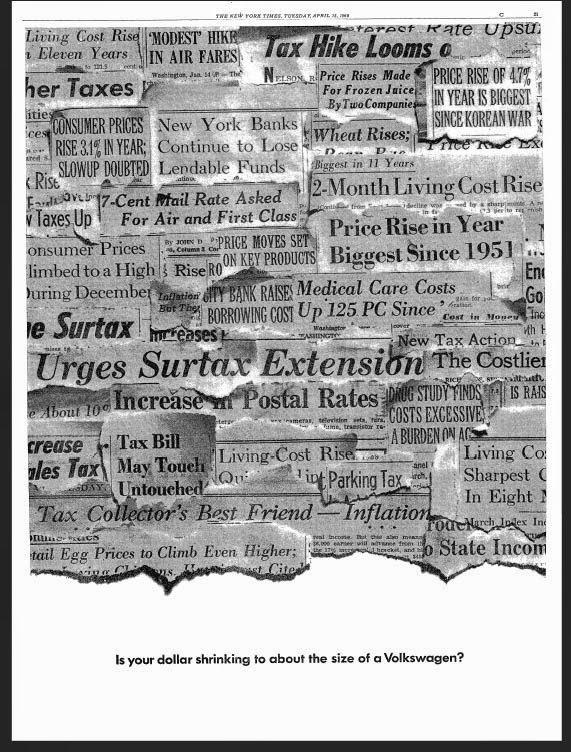
Times Machine, the new, improved portal to New York Times archives going all the way back to the 1800's, offers subscribers an easy way to relive Mad Men days. I'm struck by how the ads tell you as much about the era as the articles.
Here, for instance, is an offbeat Volkswagen ad from tax time, 1969.
The Consumer Price Index had increased by less than 2% a year from 1958 through 1965, so the 4% rise in 1968 was cause for alarm. These days, believers in growth through inflation might welcome it.
Times Machine, the new, improved portal to New York Times archives going all the way back to the 1800's, offers subscribers an easy way to relive Mad Men days. I'm struck by how the ads tell you as much about the era as the articles.
Here, for instance, is an offbeat Volkswagen ad from tax time, 1969.
The Consumer Price Index had increased by less than 2% a year from 1958 through 1965, so the 4% rise in 1968 was cause for alarm. These days, believers in growth through inflation might welcome it.
Tuesday, April 01, 2014
How Low Should the CFPB Stoop?
From American Banker, How the CFPB Seeks to Shape the Message.
Some of the actions the CFPB makes, like late night embargoes, are also strategies frequently employed by banks…. But that, say critics of its public relations tactics, is precisely the point. The CFPB should be held to a higher standard….
Saturday, March 29, 2014
"Traust!" Or As We Say Today, "Trust"
![]() |
| Photo: Alex Lentati |
One of the most reassuring words the English could hear from a Viking invader was "traust." It indicated the giant on one's doorstep did not have rape and pillage on his to-do list. He was offering protection and support.
"Traust" passed into English as "trust." By the early 1400s it gained a legal meaning: "confidence placed in one who holds or enjoys the use of property entrusted to him by its legal owner."
Trust Acronyms. Enough Already?
In his Wealth Matters column Paul Sullivan delves into the mysterious world of trust acronyms and trips only once, referring to CRATs as CLATs.
What do you say, tax planners? Time for less argot, more clarity?
3/31 Update: Sent Sullivan an email pointing out he hadn't quite made it unscathed through the thickets of trust acronyms. This morning he thanked me for my note, which may have been the friendliest he got.
"As you may recall from your years of writing about trusts, get one thing wrong and a swarm of t&e attorneys attacks you like a hive of angry bees."
What do you say, tax planners? Time for less argot, more clarity?
3/31 Update: Sent Sullivan an email pointing out he hadn't quite made it unscathed through the thickets of trust acronyms. This morning he thanked me for my note, which may have been the friendliest he got.
"As you may recall from your years of writing about trusts, get one thing wrong and a swarm of t&e attorneys attacks you like a hive of angry bees."
Thursday, March 27, 2014
Can You Spot a Trust Company?
As they liked to say back in the age of print, you can't judge a book by its cover.
Optima Bank and Trust, despite its name, offers no trustee or investment services.
Glenmede, despite its ad logo, is of course a trust company.
Takeaway: Use "trust" in your name if you wish your personal banking services to sound upscale. Eschew "trust" if you want to be seen as a forward-looking wealth manager.
Hey, we don't make the marketing rules. We just report them.
Optima Bank and Trust, despite its name, offers no trustee or investment services.Glenmede, despite its ad logo, is of course a trust company.
Takeaway: Use "trust" in your name if you wish your personal banking services to sound upscale. Eschew "trust" if you want to be seen as a forward-looking wealth manager.
Hey, we don't make the marketing rules. We just report them.
Sunday, March 23, 2014
Money Makes the World Go 'Round
As investing grows more global, so does the flow of money. International migrants sent $529 billion in remittances back to their home countries in 2012, according to the World Bank.
Pew Research has turned the World Bank data into an interactive world map. The clip below shows where remittances flow from the U.S.
Friday, March 21, 2014
How Can Bankers to the Rich Earn Their Fees?
Top banks and trust companies charge real money for wealth management these days, according to the WSJ.
Though wire houses and banks still dominate the high net worth market, the WSJ graphic shows independent advisers are nibbling voraciously at their business.
Corrected 3/26
Annual fee for managing $5 million: $46,500To earn such generous compensation, says the Journal, a wealth manager needs to do more than allocate assets. No surprise there. More than three decades ago, when Daniel Davison ran US Trust, the bank depicted the breadth of its services by commissioning Winston Churchill's granddaughter to create a sculpture of a trust officer walking a client's dog.
For managing$20$30 million: $201,000
Though wire houses and banks still dominate the high net worth market, the WSJ graphic shows independent advisers are nibbling voraciously at their business.
Corrected 3/26
Thursday, March 20, 2014
Has Investing Reached a Fork in the Road?
Within living memory, investing has evolved in three stages:
task force: "Last year they traveled more than 350,000 miles, studied more than 10,400 annual reports and held more than 5,400 interviews with company executives."
Then efficient market theory came along. All that analytical work, it seemed, was pointless. On average, stock pickers produced only average results. And that was before commissions.
SS
Stock selection was the key after World War II. Fifty years ago Shearson boasted of its stock-picking
task force: "Last year they traveled more than 350,000 miles, studied more than 10,400 annual reports and held more than 5,400 interviews with company executives."Then efficient market theory came along. All that analytical work, it seemed, was pointless. On average, stock pickers produced only average results. And that was before commissions.
AA
Asset Allocation reflected the finding that investment returns depended mainly on how funds were deployed among different asset classes. Selection of specific securities was secondary. Thanks to index funds, followed by similar ETFs, asset allocation became simple, efficient … and deadly dull.
Efforts to spice up AA by creating dozens of asset sub-classes ("I'm tweaking my Chinese midcaps and dumping Irish micros.") didn't help much.
II
Irregular Investments – less alliteratively, alternative investments – avoid the shortcomings of both SS and AA. Markets are less efficient in the II world, and private equity deals appeal to investors who want to feel they've entered the big leagues.
"Hedge funds, private equity, and private debt are being extolled as some of the best ideas for wealthy investors' portfolios in 2014," according to this Barron's cover story. (I gained access; results for other nonsubscribers may vary.) As shown here, Goldman Sachs is putting 14% of clients' money into private equity. GenSpring puts a full quarter of client assets into hedge funds.
As an investment method for the 1%, irregular or alternative assets are winners. Clients feel special. Wealth managers harvest hefty fees. But for lesser investors, a competing approach is gaining ground.
"Hedge funds, private equity, and private debt are being extolled as some of the best ideas for wealthy investors' portfolios in 2014," according to this Barron's cover story. (I gained access; results for other nonsubscribers may vary.) As shown here, Goldman Sachs is putting 14% of clients' money into private equity. GenSpring puts a full quarter of client assets into hedge funds.
As an investment method for the 1%, irregular or alternative assets are winners. Clients feel special. Wealth managers harvest hefty fees. But for lesser investors, a competing approach is gaining ground.
CC
Cost Control. Even if most funds and portfolios typically produce more or less average returns, investors can gain a sure-fire edge by lowering their costs. Jack Bogle, of Vanguard fame, has proselytized for cost control for years. His latest salvo: The Arithmetic of “All-In” Investment Expenses.
Even one-percenters can be tightwads when confronted by today's investment fees. Stuart Lucas, for example, believes investors should focus on what they net after expenses and taxes.
Stuart E. Lucas, chairman of Wealth Strategist Partners, which manages about $1 billion for a small number of wealthy families, analyzed state and federal taxes along with management fees to argue that if 50 percent of your return went to someone else, then you should reconsider the investment.
Will pricey Irregular Investments prevail as hedge funds seek to expand their customer base beyond the 1%? Or will the 1% decide hedge funds are so yesterday and boost their returns by cutting expenses? We'll be watching.Index funds and most mutual funds are under the 50 percent line. Hedge funds are always above it for a taxpaying individual. Private equity investments are on the line.
Monday, March 17, 2014
Can You Make a Valid Will When You're All Thumbs?
You probably can, especially if you're texting in a state that's adopted The Uniform Probate Code.
Texting Your Will.
Texting Your Will.
Saturday, March 15, 2014
Your Wealth Is Your Health
The old saying, "your health is your wealth," needs rearranging. And Star Trekkers should learn to say,"Prosper and live long."
Where Incomes Are Higher, Life Spans Are Longer.
How will longevity reshape wealth management and estate planning?
Where Incomes Are Higher, Life Spans Are Longer.
How will longevity reshape wealth management and estate planning?
Thursday, March 13, 2014
Boomer Inheritance Boom Fizzles, But Wait Until 2031!
Some wealthy parents of Boomers are still around, and those that aren't seem to have favored philanthropy – or dynasty trusts – rather than outright transfers of wealth to the next generation. See The New York Times:
What do you think? Will Boomers conserve and pass along the family wealth? Or will they joyfully spend the kids' inheritances?
The top 1 percent of households owns about 35 percent of American wealth, more than the entire bottom 90 percent does. But at least at the moment, growing inequality has not resulted in a big boom in inheritances. Since the 1980s, the value of inherited wealth has only drifted upward slightly. In fact, wealth transfers as a proportion of net worth have fallen, to 19 percent in 2007 from 29 percent in 1989.Maybe the Boomers' heirs, the Gen X and Gen Y crowd, will be luckier. Starting in 2013, the consulting firm Accenture forecasts, "10 percent of the country’s total wealth will change hands every five years through inheritances, estates, gifts and the like."
What do you think? Will Boomers conserve and pass along the family wealth? Or will they joyfully spend the kids' inheritances?
Friday, March 07, 2014
Ads From the Growth Stock Era
"Stocks yield more than bonds because stocks are riskier." That folk wisdom prevailed for the first half of the twentieth century, wavering only in 1929. You know what happened then.
By 1964, however, the new era of Growth Stocks had kept stock yields lower than bond yields for half a decade. Chase Manhattan's nest egg ads responded. No more beating around the bush with loss leaders like custody. This March 1964 ad makes a simple pitch for investment advisory service.
Personal note: The old pumper is from my old home town.
Also from March 1964, this ad from a Greenwich, Connecticut trust company. Putnam was a classy wealth manager in its day. Bank of New York Mellon acquired Putnam in the late 1990s.
In 1964, the Putnam ad tells us, the most expensive residential property in Greenwich was priced at $450,000. Today the most expensive is the waterfront estate we showed you here. Then offered at $190 million, the 50-acre waterfront property is now available for $130 million.
A bonus March 1664 ad: This Irving Trust message didn't enable Irving to succeed as a major commercial bank, but it sure looked good.
By 1964, however, the new era of Growth Stocks had kept stock yields lower than bond yields for half a decade. Chase Manhattan's nest egg ads responded. No more beating around the bush with loss leaders like custody. This March 1964 ad makes a simple pitch for investment advisory service.
Personal note: The old pumper is from my old home town.
Also from March 1964, this ad from a Greenwich, Connecticut trust company. Putnam was a classy wealth manager in its day. Bank of New York Mellon acquired Putnam in the late 1990s.
In 1964, the Putnam ad tells us, the most expensive residential property in Greenwich was priced at $450,000. Today the most expensive is the waterfront estate we showed you here. Then offered at $190 million, the 50-acre waterfront property is now available for $130 million.
A bonus March 1664 ad: This Irving Trust message didn't enable Irving to succeed as a major commercial bank, but it sure looked good.
Subscribe to:
Posts (Atom)